BESS as a Buffer for EV Charging Hubs in Ireland: Cutting Grid Connection Costs
Want 6 x 150 kW EV chargers on a site with only 400 kVA available? A BESS buffer lets you serve simultaneous fast charging without a costly ESB Networks reinforcement.
By Smart Solar Editorial · Updated 15 May 2026 · 8 min read
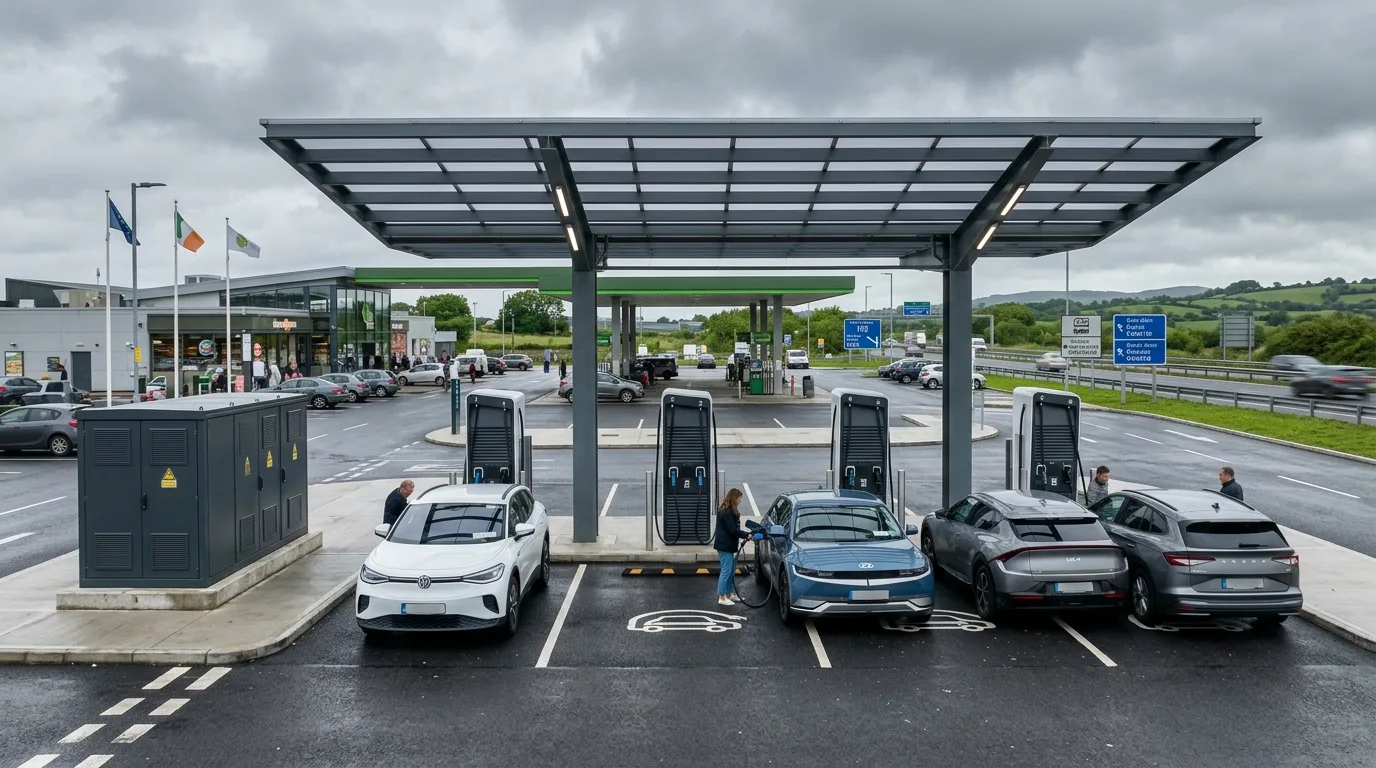
Ireland is on track for over 1 million EVs by 2030 under the Climate Action Plan, and the supporting charging infrastructure is being built out by ESB ecars, EasyGo, Ionity, Tesla, Atlantic Charging and a growing list of private hub operators. The problem they all run into: the grid connection cost.
A 6-bay 150 kW DC fast charging hub needs theoretically 900 kW of import capacity. On many Irish sites, especially rural and suburban locations along the N-network, ESB Networks would quote €500k-€2M for an MV reinforcement to deliver that connection - if it can be delivered at all within a reasonable timeframe.
A BESS buffer solves this elegantly. By absorbing energy during quiet periods and discharging during peak charging events, a much smaller grid connection can support a much larger nameplate charging capacity.
The math of grid-constrained EV hubs
Consider an Irish motorway services site:
- 6 x 150 kW DC fast chargers (nameplate 900 kW combined)
- Average utilisation: 35% over 14 daytime hours
- Peak utilisation: 4 chargers simultaneously at full power for 30-45 minutes
- Site is 8 km from nearest 38 kV substation - MV reinforcement quote: €1.4M, 18-month timeline
Option A: Pay for the MV reinforcement, get 1 MVA connection. Pay €1.4M one-off plus ongoing higher capacity charges.
Option B: Take a 400 kVA LV connection (under NC6, often available within 3-6 months for €40k-€80k) and add a 600 kW / 1.5 MWh BESS buffer. Total cost ~€900k, 6-month delivery.
Option B wins on:
- Lower upfront capex
- Faster time to revenue
- BESS also earns peak shaving + DS3 + arbitrage on top
- Avoids the planning and easement headaches of MV reinforcement
This is now the default architecture for new Irish EV hubs in rural and suburban locations in 2026.
How BESS buffering works in practice
The EMS controls power flow between grid, BESS and chargers:
- Idle periods (overnight, off-peak): Grid charges BESS at low tariff rates
- Quiet daytime: Grid supplies any chargers in use; BESS holds reserve
- Peak event: When charger draw exceeds the grid connection ceiling, BESS discharges to make up the difference
- Post-event recovery: Once charger load drops, BESS recharges from grid within the connection ceiling
The grid connection is sized for the average load plus a margin, while the BESS handles the peak swing.
Sizing rules for EV hub BESS
A practical framework:
- Calculate nameplate charger power: Number of chargers × max kW
- Estimate worst-case simultaneous draw: Typically 60-80% of nameplate (not all chargers max simultaneously)
- Choose grid connection: Average daytime energy / 14 hours, plus 30-50% headroom
- BESS PCS rating: Worst-case simultaneous draw minus grid connection ceiling
- BESS kWh: PCS rating × worst-case event duration (typically 45-60 minutes) × 1.4 buffer
Example: 6 x 150 kW chargers (900 kW nameplate), worst-case simultaneous 720 kW (80%).
- Average daytime energy: 5,000 kWh/day ÷ 14h = 360 kW
- Grid connection: 360 × 1.4 = ~500 kVA
- BESS PCS: 720 - 500 = 220 kW
- BESS energy: 220 kW × 0.75h × 1.4 = ~230 kWh
Round up to 250 kW / 500 kWh for safety margin and dual-use revenue capability.
ESB Networks NC6 vs NC7 considerations
- NC6 (LV, up to ~200 kVA): 3-6 month process, €15k-€80k typical connection fee. Suits small hubs (2-4 chargers with BESS).
- NC7 (MV, 200 kVA - 5 MVA): 12-24 month process, €100k-€2M+ depending on reinforcement. Required for large hubs without BESS.
A BESS buffer often keeps you in the NC6 window where you would otherwise need NC7. The time and cost savings are substantial.
Revenue stacking at EV hubs
The BESS at an EV hub does not only support fast charging - it can also:
- Earn DS3 revenue during overnight and quiet daytime periods
- Reduce capacity charges by smoothing daily load profile
- Arbitrage off-peak to peak tariff spreads
- Optionally pair with PV canopy generation for additional self-consumption
On a typical Irish hub, the BESS adds €25k-€60k per year of secondary revenue on top of its primary buffering role.
Hardware choices for EV hub BESS
For 250 kW - 1 MW EV hub buffers in 2026, common selections include:
- Sungrow PowerStack 250CS - 250 kW / 257 kWh, modular
- Tesla Megapack 2 (subset) - usually overkill below 1 MW
- BYD Battery-Box Pro / MV - flexible sizing
- GE Vernova Reservoir - up to 4 MWh blocks
- Sonnen Multi - smaller commercial up to 200 kW
Pair with bidirectional metering, dynamic load management firmware (Kempower, ABB Terra HP, Tritium PKM150, Alpitronic Hypercharger all support this), and an EMS that can handle the multi-objective optimisation.
Real Irish examples
Several Irish EV hub operators now use BESS buffers as standard:
- Atlantic Charging rolled out BESS-buffered hubs along the Wild Atlantic Way where MV connections were prohibitive
- Applegreen uses BESS buffering at several N-network locations
- ESB ecars has piloted BESS at urban high-power hubs where local grid is constrained
- Tesla Supercharger Ireland uses BESS at select rural locations
Planning and grid compliance
Behind-the-meter EV+BESS systems need:
- ESB Networks Connection Agreement (NC6 or NC7 depending on size)
- G99 compliance for the BESS PCS and chargers
- CRU compliance for fast charging tariffs and accessibility
- Planning permission may be required for canopy/civils above certain thresholds
- Fire safety assessment under IS EN 62619 for the BESS
The integrated design is increasingly standardised - leading Irish EPCs like Activ8 Solar Energies, Enerpower and Powerlink have delivered multiple EV+BESS hubs in 2024-2026.
Common pitfalls in EV-hub BESS deployments
Three errors recur on Irish EV-hub BESS projects:
- BESS sized for nameplate, not 95th-percentile usage. Real-world charger utilisation data shows simultaneous draw at 4 x 150 kW chargers rarely exceeds 480 kW (80% of theoretical 600 kW). Sizing PCS to the full 720 kW (80% of all six) adds 30–40% capex for a peak that occurs <5% of operating hours. Use telemetry from comparable hubs (EasyGo and Atlantic Charging publish anonymised data) to right-size.
- Charger firmware that ignores dynamic load management. Some legacy Tritium and ABB chargers default to fixed 150 kW even when EMS signals a lower cap. The result is BESS rapid discharge to depleted SOC mid-session, leaving the next user with a 50 kW session. Confirm OCPP 2.0.1 + Smart Charging Profile support before ordering chargers.
- Cooling sized for Irish summer, not edge cases. A 500 kWh BESS in a metal enclosure under direct sun in a Wexford services plaza can hit 40 °C cabinet internal temperature on a 25 °C ambient day. Specify HVAC rated for 45 °C ambient and consider white-painted or canopy-shaded cabinets. Over-temperature derating cuts available PCS power by 20–30% precisely when fast-charging demand peaks (Friday afternoon, summer bank holidays).
Bottom line
For Irish EV charging hubs constrained by grid capacity, a BESS buffer is the most cost-effective way to deliver high-power simultaneous charging without expensive MV reinforcement. The same hardware earns secondary revenue from peak shaving and DS3, often delivering payback under 5 years even before the EV charging margin is counted.
Get 3 free commercial battery quotes — free and no obligation.
Frequently asked questions
Can a battery let me run more EV chargers on a small grid connection?
Yes - this is the core use case for EV hub BESS buffering. A 500 kVA grid connection plus 250 kW / 500 kWh BESS can support up to 6 x 150 kW DC fast chargers running simultaneously for short peaks, where the grid alone would need 900+ kVA.
How much does a BESS for EV charging cost in Ireland?
A typical 250 kW / 500 kWh BESS for a 4-6 bay DC fast charging hub costs €350k-€500k installed in 2026, including PCS, cells, EMS, dynamic load management firmware and commissioning.
Will ESB Networks approve a BESS at an EV charging hub?
Yes - behind-the-meter BESS at EV hubs follow standard NC6 (LV) or NC7 (MV) connection processes. A pure load-and-buffer system without export is typically approved within 3-6 months for LV connections.
Can EV hub BESS earn DS3 revenue?
Yes. Spare BESS capacity outside peak charging hours can be contracted to a DS3 aggregator (Statkraft, Veri, GridBeyond) for €20k-€40k per MW per year, on top of charger revenue.
What size BESS do I need for a 4-charger 150 kW hub?
Typical sizing is 200-300 kW PCS and 300-500 kWh of cells, assuming a 500 kVA grid connection. The exact sizing depends on expected utilisation profile and charger simultaneity factor.
Sources & further reading
- Climate Action Plan EV Targets — Government of Ireland
- ESB Networks Connection Charges — ESB Networks