Commercial vs Domestic Solar in Ireland: 12 Key Differences
Domestic solar in Ireland is a consumer product. Commercial solar is an asset class. Here are the twelve ways they really differ and why it changes how you procure.
By Smart Solar Editorial · Updated 4 November 2026 · 10 min read
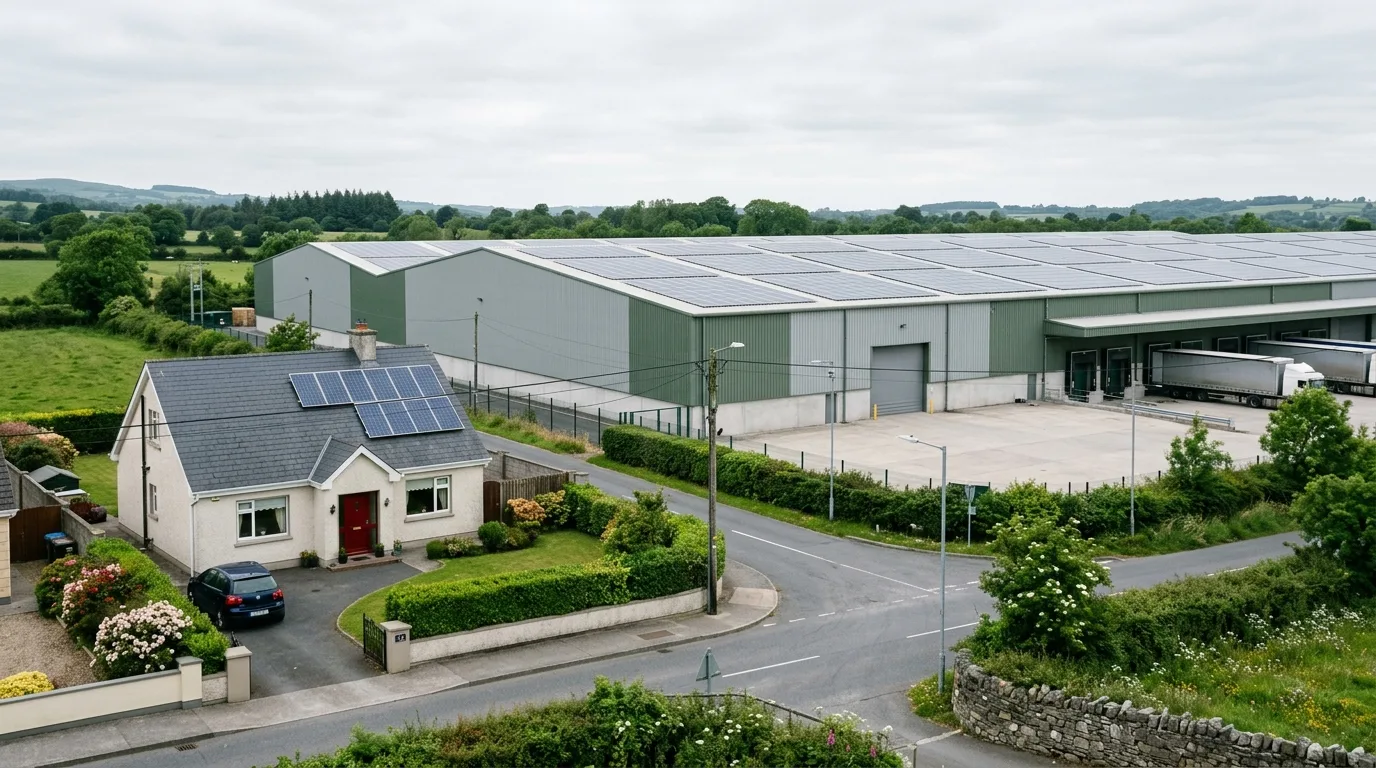
Many Irish business owners assume commercial solar is just a bigger version of the PV system on their house. It is not. The grant scheme, the grid connection, the tariffs, the inverters and even the warranty conventions are different. Here is a side-by-side breakdown of the twelve differences that actually matter when you procure commercial solar PV in Ireland in 2026.
1. Grant scheme
Domestic systems claim the SEAI Solar PV Grant, currently up to €1,800 for typical 4-6 kWp installs. Commercial systems claim the Non-Domestic Microgeneration Grant (NDMG), which pays up to €325,200 (an effective 45% for applications made 6 October 2026 – 6 July 2027) on business, farm and public-sector premises — no BER required. The application portal, eligibility rules and timelines are completely different.
2. VAT treatment
Domestic installs on a private dwelling are zero-rated (0% VAT) when the panels and their installation come in one supply-and-install contract, and so are installs on recognised schools. Commercial buildings are not. Revenue's Tax and Duty Manual on solar panels (last reviewed May 2025) says a supply-and-install contract on a commercial building may take the reduced rate (13.5%) if the goods are no more than two-thirds of the contract value, and the standard rate (23%) otherwise. Commercial installs frequently add battery storage, MV switchgear and transformer works, which can count towards that two-thirds test. A VAT-registered business can normally reclaim the VAT it is charged, but your accountant should sign off the VAT split before contract.
3. Tax relief on capex
Domestic homeowners get no income-tax relief on their solar capex. Commercial installs qualify for the Accelerated Capital Allowance (ACA), allowing 100% write-off in year one against trading profits. For a profitable Irish company that is worth 12.5% of capex back in cash.
4. ESB Networks application
Domestic systems use the NC6 application (or are notified afterwards if below 6 kW). Commercial systems use NC7 above 11 kW three-phase and shift to the larger SCOG/DSO commercial track above 200 kVA. NC7 requires single-line diagrams, G99 protection settings and often a network study. Lead times are 8-14 weeks for sub-200 kVA and 6-12 months for larger sites.
5. Export tariff
This is the cruncher. Domestic exporters under MSS currently receive around 18-21 c/kWh from most suppliers in 2026. Non-domestic exporters receive substantially less, typically 13-15 c/kWh, because they are deemed to be commercial counterparties without the residential top-up. This is one reason commercial systems are designed for self-consumption first, export second.
6. Inverter platforms
Domestic systems are dominated by SolarEdge SE3000H-SE10K, GoodWe DNS, Sungrow SH-RT and Huawei SUN2000-3KTL to 10KTL hybrid platforms. Commercial systems jump to SolarEdge SE17K-SE100K, Huawei SUN2000-100KTL and 215KTL, SMA Sunny Tripower CORE2 and Sunny Highpower, and Sungrow SG110CX. These are three-phase only, transformerless, often with built-in MV interfaces.
7. Module choice
Domestic projects increasingly use all-black aesthetic modules. Commercial projects optimise pure €/Wp and yield, defaulting to high-power bifacial N-type TOPCon at 440-580 Wp from Jinko Tiger Neo, Trina Vertex, JA Solar, Longi Hi-MO and REC.
8. Structural engineering
A domestic system is usually attached to rafters with off-the-shelf rail. A commercial install needs a chartered structural engineer's sign-off, point-load calculations against the building's I.S. EN 1991-1-3/4 snow and wind loading, and often a roof condition survey. Ballasted flat-roof systems require wind-tunnel-tested calculations.
9. Health and safety
Domestic installs typically run for 1-3 days with a 2-3 person crew. Commercial installs are CDM-style projects: PSCS appointment, PSDP designs, mandatory Safe Pass, Safe-T training, rescue-at-height plans, harness logs, lifting plans and traffic management. Expect 10-30% of project cost to be soft costs.
10. Warranties and O&M
Domestic systems are usually fit-and-forget with a 2-year workmanship warranty. Commercial assets need a formal O&M contract, typically 5-25 years, with response SLAs, annual cleaning, IV-curve tracing every 3-5 years, and inverter spare-parts stocking. Monitoring is non-negotiable.
11. Financing options
Domestic systems are mostly cash-funded or on a home-improvement loan. Commercial solar has a richer toolbox: balance-sheet capex, asset finance from banks like AIB, Bank of Ireland and Finance Ireland, sale-and-leaseback, lease-purchase, or a third-party-owned Power Purchase Agreement (PPA) where a developer pays for the kit and you pay only for the kWh.
12. Stakeholder approval
Domestic projects need one homeowner to say yes. Commercial projects need finance, operations, facilities, EHS, insurance and often landlord consent. The project does not start when the EPC is chosen; it starts when the decision matrix is built.
What this means for procurement
The biggest mistake Irish businesses make is asking a domestic installer to quote a 50 kWp commercial system. The work itself can usually be delivered, but the documentation, ESB Networks engagement, structural sign-off and tax treatment will not match enterprise expectations. Use SEAI-registered contractors who routinely operate at commercial scale - Activ8 Solar Energies, Enerpower, Powerlink, Solar Electric Ireland, Mercury Engineering, John Sisk and ESB Smart Energy Services among them - and ask specifically for their last three references at your size range.
Snapshot table
| Item | Domestic | Commercial |
|---|---|---|
| Grant scheme | Solar PV Grant up to €1,800 | NDMG up to €325,200 (enhanced to 6 Jul 2027) |
| Tax relief | None | ACA 100% year-1 |
| Export tariff | 18-21 c/kWh | 13-15 c/kWh |
| Grid application | NC6 | NC7 / MEC |
| Inverter | 3-10 kW hybrid | 17-215 kW commercial three-phase |
| Structural sign-off | Standard rail | Chartered engineer required |
| Typical capex | €6k-€15k | €60k-€1.1M |
Common pitfalls Irish buyers hit
A handful of mistakes recur across Irish commercial solar projects in 2026. Avoid them and you compress your timeline by months and your capex by 8–15%.
- Sizing to roof area, not load profile. A 250 kWp roof can fit nicely on a 4,000 m² warehouse, but if the building draws 90 kW baseload between 09:00–17:00, you are exporting 60–70% of generation at 13–15 c/kWh while importing evenings at 28–34 c/kWh. Always run a 15-minute interval analysis from your half-hourly ESB Networks data before sizing.
- Underestimating NC7 timelines. A 150 kVA NC7 application currently runs 10–14 weeks for the offer letter alone, plus 6–12 weeks for connection works. Many EPCs quote "8 weeks" — that is the optimistic Dublin metropolitan scenario, not the rural MV reality.
- Assuming yield equals national average. Irish yield varies materially by county: 1,020 kWh/kWp achievable in south Cork and Kerry, 900–950 in the midlands, and as low as 850 in north Donegal. Use county-specific PVGIS data, not "950 kWh/kWp Ireland average".
- Skipping the BER refresh. A new BER post-installation often moves a B3 commercial building to B1 or A3, which strengthens lease valuations and is occasionally required by ESG-conscious tenants and CSRD-reporting landlords.
Once you internalise these twelve differences, you stop comparing apples to oranges and start procuring solar as the multi-decade infrastructure asset it actually is.
Get 3 free commercial solar quotes — free and no obligation.
Frequently asked questions
Can a domestic solar installer do my commercial project?
Technically often yes for small systems under 50 kWp, but the documentation, NC7 application, structural sign-off and tax treatment require commercial-grade processes. Most domestic installers are not registered for the Non-Domestic Microgen Grant.
Is the commercial export tariff really lower than domestic?
Yes. In 2026 commercial non-domestic exporters typically receive 13-15 c/kWh under the MSS Clean Export Guarantee, compared to 18-21 c/kWh for residential exporters, because of how the scheme is structured.
Do commercial solar systems need planning permission?
Rooftop systems on most commercial buildings are exempt under the 2023 amended planning regulations. Ground-mount systems above 50 kW typically require planning. Protected structures always require consent.
What about commercial battery storage in 2026?
Commercial batteries are increasingly common, typically 50-500 kWh paired with solar to lift self-consumption from 70% to 90%+. They do not currently attract the NDMG grant but can be included in EXEED-funded projects.