Commercial Solar O&M Agreement Ireland 2026: What to Include
A weak O&M agreement turns a 25-year asset into a 10-year problem. Here is what an Irish commercial solar O&M contract should include in 2026, and what good service looks like.
By Smart Solar Editorial · Updated 15 May 2026 · 9 min read
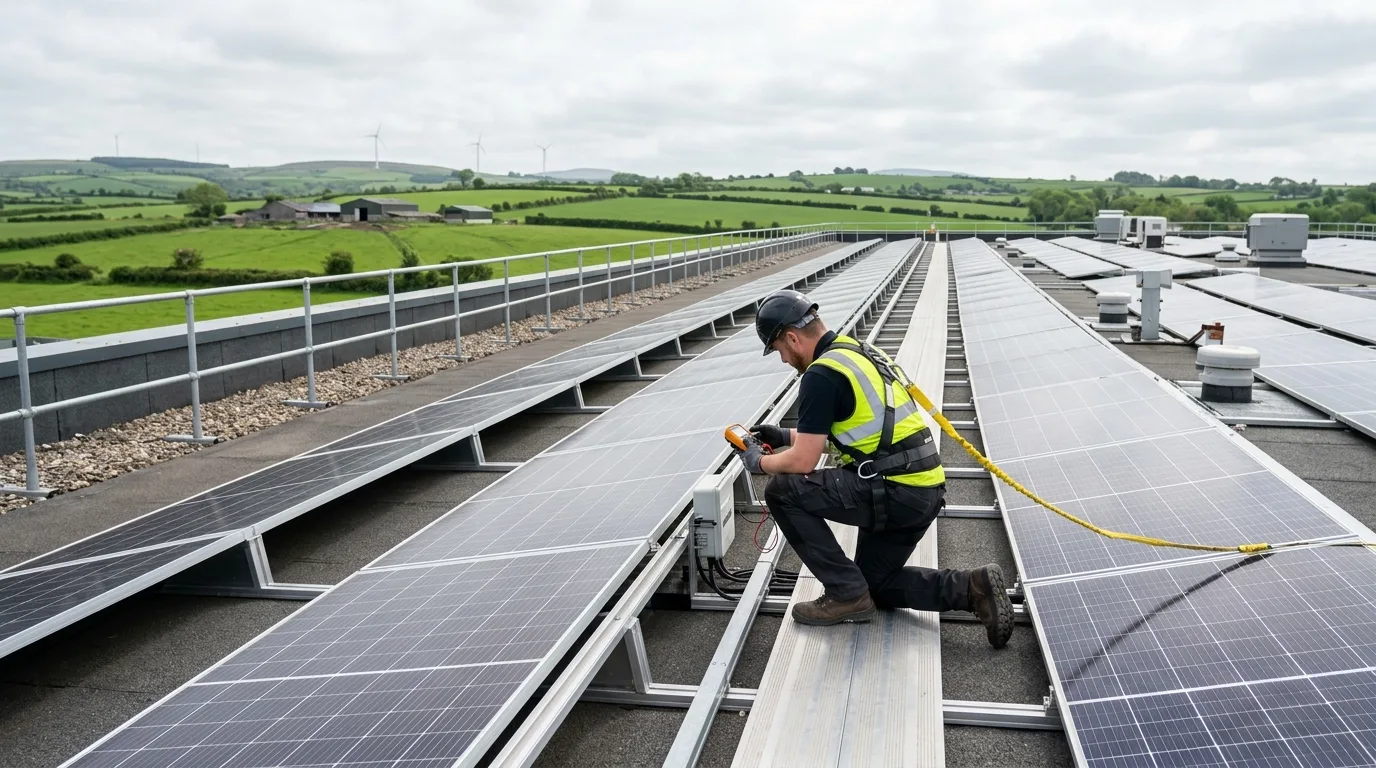
Commercial solar PV is a 25-30 year asset. The Operations and Maintenance (O&M) agreement is what ensures the asset actually delivers across that life rather than slowly degrading into underperformance. A well-written O&M agreement adds 5-10% to lifetime returns through better availability, faster fault resolution and proactive intervention. A weak agreement (or no agreement at all) typically loses the same amount, and often more. This guide covers what an Irish commercial solar O&M agreement should include in 2026, the typical pricing, and what good service actually looks like.
What O&M covers
A commercial solar O&M contract typically covers:
Operations
- Remote monitoring of system performance
- Alarm management and triage (24/7 or 8x5 depending on tier)
- Performance reporting (monthly and annual)
- Energy yield analysis and benchmarking
- Compliance reporting (grant drawdown evidence, CSRD inputs)
- Liaison with ESB Networks on grid events
- Supplier coordination for export tariff issues
Preventive maintenance
- Annual visual inspection
- Annual electrical testing (string IV curves, insulation resistance)
- Inverter inspection and cleaning of cooling fins
- Mounting structure inspection and torque check
- DC isolator and AC switchgear inspection
- Earthing and bonding verification
- Vegetation management (for ground-mount and around inverters)
- Module cleaning (typically every 2-3 years in Ireland)
Reactive maintenance
- Fault diagnosis and repair
- Inverter replacement under warranty management
- Module replacement under warranty management
- Reset and reconfiguration after grid events
- Battery and storage system maintenance (if included)
Reporting and compliance
- Monthly performance dashboard
- Annual performance ratio calculation
- Annual maintenance certificate
- CSRD/ESG data export
- Insurance certification updates
Typical service tiers
Most Irish commercial O&M providers offer 2-3 service tiers:
Basic / Reactive
- Annual visual inspection
- Reactive call-out as needed (charged separately)
- Remote monitoring (basic)
- Annual performance report
- Typical price: €4-€8/kWp per year for 100-500 kWp systems
Standard / Preventive
- Annual visual + electrical inspection
- Quarterly remote performance review
- Reactive call-out included (with defined response times)
- Monthly performance reporting
- Inverter warranty management
- Typical price: €8-€15/kWp per year
Premium / Full Service
- Twice-yearly site inspection
- Continuous remote monitoring with 24/7 alarm escalation
- Defined response SLAs (e.g. site attendance within 24 hours)
- Performance guarantee (e.g. 98%+ availability)
- Full warranty management including module claims
- Liquidated damages for underperformance
- Typical price: €15-€25/kWp per year
For most Irish commercial sites in 2026, the Standard tier delivers the best value. Premium suits PPA-backed projects, institutional owners and sites where downtime is materially expensive.
What to insist on in the contract
Defined service levels
- Maximum response time to high-severity alarms (typically 4-24 hours)
- Maximum time to site attendance (typically 2-5 working days for non-critical)
- Maximum time to repair (typically 5-15 working days excluding parts lead time)
- Escalation matrix and named contacts
Performance guarantee
A meaningful availability guarantee (e.g. 98%+) with liquidated damages for underperformance. The damages formula should compensate for actual lost energy at your blended electricity price, not just a token amount.
Reporting standards
- Monthly performance report within 10 working days of month-end
- Annual performance report and certificate
- Performance ratio calculation methodology specified
- Standard format compatible with your CSRD process
Pricing transparency
- Annual O&M fee per kWp
- Itemised additional services (extra cleaning, after-hours call-out, etc.)
- Annual price escalation (typically CPI-linked or capped)
- Pass-through of inverter warranty extension costs
Term and termination
- Initial term typically 5-10 years (matches inverter warranty extension)
- Renewal rights with reasonable notice
- Termination for cause (failure to meet SLAs, insolvency)
- Termination for convenience (often with 3-6 month notice and penalty)
- Handover obligations (documentation, monitoring access, spare parts)
Spare parts and warehousing
- Defined held stock of critical spares (DC isolators, inverter fans, surge modules)
- Lead times for non-stocked items
- Cost recovery mechanism for spares
Cybersecurity
- VLAN segregation of monitoring network
- Vulnerability and patch management
- Incident response procedure
- NIS2 compliance for in-scope sites
What good O&M actually looks like
For a 200 kWp Irish commercial solar system on a Standard O&M contract in 2026, the typical year looks like:
- Continuous monitoring with 24/7 alarm escalation
- Monthly performance dashboard showing yield vs PVGIS-predicted, year-on-year, and against fleet benchmark
- Quarterly remote review identifying any underperforming strings or inverters
- Annual site visit including visual inspection, electrical testing, mounting torque check, inverter service, module spot-clean
- 2-4 reactive call-outs for grid events, communication losses, or minor faults
- Annual report with performance ratio, availability, and recommended actions
- Warranty claims management for any equipment failures
- Insurance and compliance documentation maintained
Year-on-year availability targets of 98%+ are realistic and routinely achieved by good Irish O&M providers.
Cleaning - what is true in Ireland
Module cleaning in Ireland is less frequent than in drier climates. Irish rainfall typically delivers sufficient natural cleaning except where:
- Bird-roosting is a problem (gulls near coastal sites)
- Agricultural dust accumulates (especially around grain stores, silage yards)
- Industrial process exhausts deposit residues
- Pollen build-up affects flat-tilted modules
Typical Irish commercial cleaning interval: every 2-3 years. Cost: €3-€8/kWp per cleaning event. Some O&M providers include cleaning in the contract; most charge separately.
Track cleaning effectiveness with before/after performance monitoring. If cleaning consistently lifts output by less than 2-3%, the interval can be extended.
In-house vs outsourced O&M
For large industrial sites with existing maintenance teams, partial in-house O&M can work:
- In-house: visual inspections, simple resets, electrical isolations
- Outsourced: electrical testing, inverter service, fault diagnosis
This hybrid approach reduces cost while maintaining technical capability. Requires clear interface definition and training of in-house staff. Most sites under 1 MWp find full outsourcing easier.
Who provides commercial O&M in Ireland
Major Irish commercial solar O&M providers in 2026 include the same EPCs offering installation - Activ8 Solar Energies, Enerpower, Powerlink, Mercury Engineering, ESB Smart Energy Services - plus specialist independent O&M providers and a growing number of regional service contractors.
The EPC-installed-then-EPC-O&M model is most common and operationally simplest. Independent O&M makes sense for portfolios across multiple original EPCs, or where the original EPC has exited the market.
Tendering an O&M contract
If your original EPC O&M offer is uncompetitive, or if your contract is up for renewal:
- Request the system as-built drawings, monitoring access, and 3 years of performance data
- Issue a structured RFP to 3-5 O&M providers
- Evaluate on price, SLAs, performance guarantees, references and team capability
- Insist on Irish service presence (not just remote monitoring)
- Specify a 12-month transition period at the end of the previous contract
Switching O&M providers is straightforward if documentation is in order. The key is ensuring the new provider can take full operational responsibility without dependency on the previous provider.
Bottom line
A good commercial solar O&M agreement in Ireland in 2026 costs €8-€20/kWp per year and protects the lifetime value of the asset through proactive monitoring, fast response, structured maintenance and clear performance guarantees. Insist on defined SLAs, meaningful availability targets, transparent reporting and Irish service presence. For PPA-backed and institutional projects, take the Premium tier; for self-funded SME projects, the Standard tier usually delivers the best value. The marginal annual cost is small; the cost of operating an unmaintained 25-year asset is substantial.
Get 3 free commercial solar quotes — free and no obligation.
Frequently asked questions
How much does commercial solar O&M cost in Ireland in 2026?
Typical pricing is €4-€8/kWp/year for basic reactive service, €8-€15/kWp/year for standard preventive service, and €15-€25/kWp/year for premium full service with performance guarantees. Standard tier delivers the best value for most commercial sites.
What should be included in a solar O&M agreement?
Continuous remote monitoring, defined response and repair SLAs, annual preventive maintenance with electrical testing, performance reporting, warranty management for inverters and modules, and a meaningful availability guarantee with liquidated damages for underperformance.
How often should commercial solar panels be cleaned in Ireland?
Typically every 2-3 years. Irish rainfall provides effective natural cleaning except near coastal bird-roosting areas, agricultural dust sources, or industrial exhausts. Track cleaning effectiveness with before/after monitoring.
Can I do solar O&M with my in-house maintenance team?
Partial hybrid models work for large sites. In-house handles visual inspections, simple resets and isolations; specialist contractor handles electrical testing, inverter service and fault diagnosis. Most sites under 1 MWp find full outsourcing simpler.
Should I stay with my original EPC for O&M or switch?
Original EPC O&M is operationally simplest and usually offers competitive first-term pricing. Switching at renewal makes sense if pricing has become uncompetitive, the EPC has exited the market, or you have a portfolio of multiple original EPCs that benefits from consolidation.
Sources & further reading
- IEC 62446-1 PV Systems Verification — International Electrotechnical Commission
- SEAI Quality Assurance Framework — SEAI
- Best Practices for Solar O&M — US National Renewable Energy Laboratory