How to Choose a Commercial BESS EPC Contractor in Ireland 2026
EPC choice determines whether your BESS arrives on time, on budget and delivering its business case. Here is the framework Irish commercial buyers should use in 2026.
By Smart Solar Editorial · Updated 15 May 2026 · 9 min read
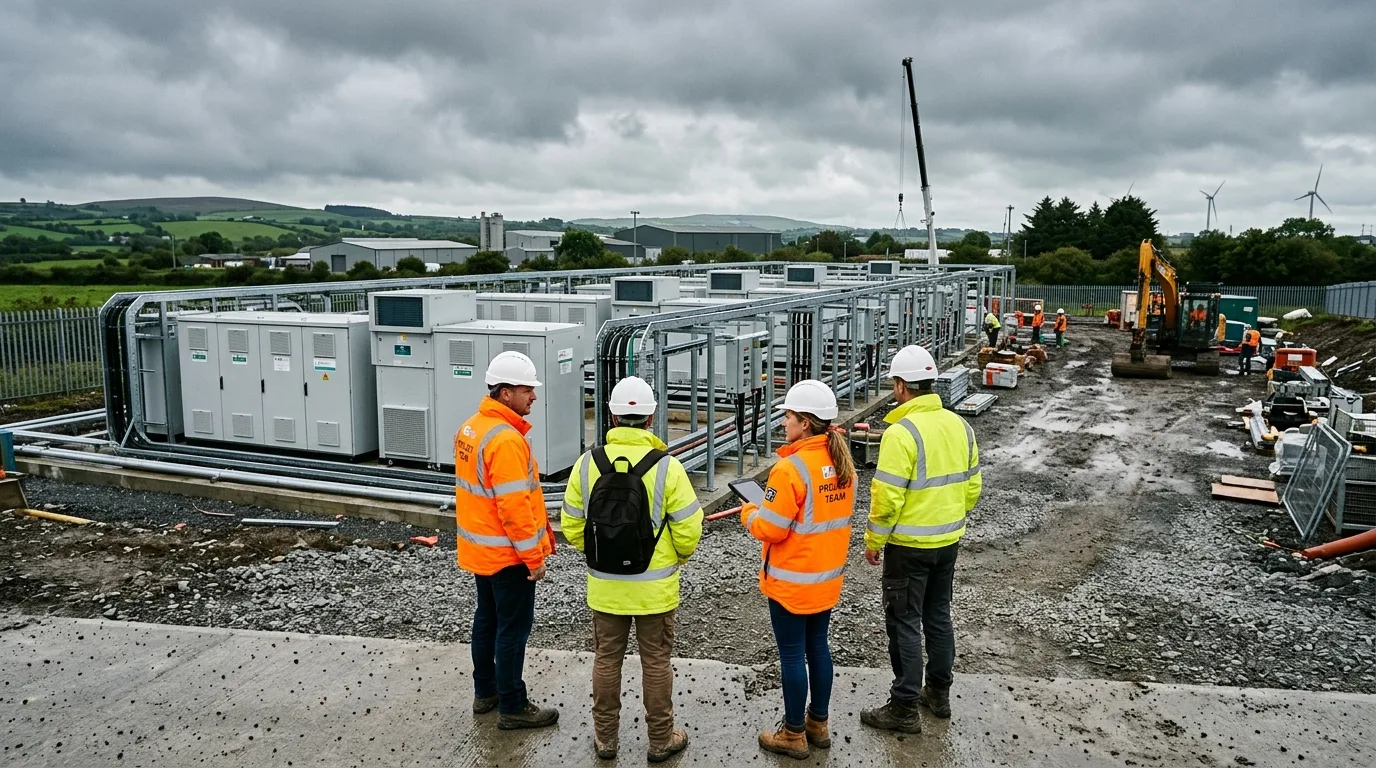
Choosing the right EPC (engineering, procurement and construction) contractor is one of the most consequential decisions in a commercial battery storage project. The right EPC delivers on time, on budget, with strong warranty terms and a system that actually meets its business case. The wrong EPC creates delays, cost overruns, technical issues that surface years later, and revenue underperformance. This article provides a 12-point framework for Irish commercial buyers in 2026.
The Irish commercial BESS EPC landscape 2026
Several types of contractors compete for Irish commercial BESS work:
1. Specialist solar+storage EPCs
- Activ8 Solar Energies (largest Irish commercial solar/BESS installer)
- Enerpower (Waterford and southeast specialist)
- Powerlink Energy (Wexford-headquartered, growing nationally)
- Solar Electric Ireland
- Killowen Solar (Ulster focus)
- Smart Solar Ireland (multi-product commercial installer)
2. Large electrical contractors with BESS capability
- Mercury Engineering (large industrial and data centre)
- Designer Group
- DPS Group
- McLaughlin & Harvey
- Suir Engineering
3. Utility-EPC consortia for utility-scale
- ESB International
- Statkraft direct delivery
- Power Capital + EPC partner consortia
- Lumcloon Energy (for Lumcloon site)
4. Battery-specific specialists
- BESS-focused subsidiaries of major equipment vendors
- International EPCs entering the Irish market through partnerships
For most commercial projects in 2026, the specialist solar+storage EPC route is dominant. For complex industrial and data centre applications, large electrical contractors with BESS teams are often preferred.
The 12-point selection framework
1. Irish commercial BESS track record
How many commercial BESS projects (not residential) have they delivered in Ireland in the last 24 months? Look for:
- Minimum 5 commercial-scale projects (above 100 kWh) completed
- At least 2 projects above 500 kWh
- Variety of site types (factory, retail, data centre, etc.)
- Reference site visits available
2. Equipment vendor relationships
Confirm direct relationships with tier-one BESS vendors:
- Tesla certified installer
- Sungrow PowerStack certified
- BYD MV/MV+ partner
- GE Vernova, Fluence or Wartsila if utility-scale
Direct vendor relationships mean better warranty, faster service response, and access to engineering support.
3. ESB Networks experience
How many NC6 and NC7 applications have they led to successful completion? Specifically:
- NC7 MV connections (much more complex than NC6)
- Connection in your region (local engineer familiarity helps)
- Witness commissioning experience
4. Technical depth
Probe the technical team:
- Chartered electrical engineers (Engineers Ireland chartership)
- Sized engineering team beyond sales
- In-house EMS programming capability
- DS3 / aggregator integration experience
- IS EN 62619 fire engineering capability
5. Financial capability
A BESS project ties up significant capex. Verify:
- Audited accounts for the last 3 years
- Insurance coverage (PI, EL, public liability, contract works)
- Bonding capability (often required for large projects)
- Bank references
- No recent unresolved disputes
A failed EPC mid-project is one of the most expensive problems you can encounter.
6. Reference site visits
Insist on visiting 2-3 completed reference sites. Look for:
- Installation quality (cable management, labelling, signage)
- Operational performance vs original projections
- Customer satisfaction with EPC responsiveness
- O&M relationship status
Reference visits typically reveal more than any document review.
7. Project management depth
Mid-large BESS projects need real PM:
- Dedicated project manager assigned to your project
- Documented project management methodology
- Regular reporting cadence (weekly minimum)
- Change control and variation management process
- Quality assurance plan
8. Subcontractor management
EPCs subcontract civils, MV switchgear, sometimes commissioning. Ask:
- Which subcontractors will they use?
- What is their vetting and management process?
- Performance history with named subcontractors
- Backup options if a subcontractor fails
9. Health, safety and environment
Commercial BESS installation involves working with significant electrical energy. Confirm:
- ISO 45001 or equivalent SMS
- Safe Pass training for all on-site staff
- LV/MV switching qualifications
- Lithium battery handling training
- HSE / HSA performance records
10. Warranty and after-sales
What warranties does the EPC offer beyond manufacturer terms?
- EPC workmanship warranty: 2-5 years typical
- Performance warranty (system delivering business case): rare but valuable
- Warranty on installation work specifically
- Response time SLAs for warranty calls
- O&M contract options post-warranty
11. EXEED and grant expertise
If your project involves EXEED grant or Climate Action Fund:
- Experience working with accredited Project Energy Managers
- Familiarity with EXEED milestone reporting
- Ability to align project delivery with grant compliance
12. Commercial terms and risk allocation
Compare apples-to-apples:
- Lump sum vs cost-plus pricing
- Liquidated damages for delay
- Performance guarantees and penalties
- Contract type (FIDIC, NEC, bespoke)
- Insurance and indemnity provisions
- Payment milestones aligned with progress
Tender structure for commercial BESS
A typical Irish commercial BESS procurement runs:
- Pre-feasibility with 1-2 EPCs to scope project (no commercial commitment)
- Formal tender issued to 3-5 EPCs with detailed RFP
- Tender clarifications Q&A period (2-3 weeks)
- Tender responses evaluated technically and commercially
- Shortlist of 2-3 EPCs for site visits and interviews
- Best and final offers from shortlisted EPCs
- EPC selection with reasoned scoring
- Contract negotiation and signing
- Project commencement
Total tender duration: typically 8-16 weeks for mid-size projects, longer for complex industrial.
What good tender documents include
A complete RFP for an Irish commercial BESS includes:
- Project background and business case context
- Site description with constraints and access details
- Half-hourly load profile for last 12 months
- Existing infrastructure (PV, ESB Networks MIC, existing UPS)
- Functional requirements (peak shave target, DS3 intent, backup needs)
- Technical specifications (preferred chemistry, vendor preferences)
- Commercial structure (lump sum, fixed price, performance guarantees)
- Schedule requirements
- Insurance and bonding requirements
- Submission format and evaluation criteria
- Annexes (single-line diagrams, site plans, photographs)
A well-prepared RFP usually saves 4-8 weeks in the tender process and attracts better-quality responses.
Red flags to avoid
- EPCs unwilling to share reference sites
- Pricing significantly below market (often signals corner-cutting)
- Vague warranty terms or warranty assignment without depth
- No dedicated project manager named
- Reluctance to commit to specific equipment vendors at tender
- High staff turnover during the proposal phase
- Pressure to sign before due diligence completes
- Limited or no recent commercial BESS experience
Common procurement mistakes
- Selecting on lowest price alone - cheapest quote often costs the most across project life
- Skipping reference site visits - documentation lies, sites do not
- Vague EPC contract - ambiguity becomes the EPC's friend during disputes
- No owner's engineer - tilts technical decisions in EPC's favour
- Late EXEED/planning engagement - grants and approvals constrain EPC timeline
When to engage an owner's engineer
For projects above €500k capex, engage an independent owner's engineer (OE) to:
- Prepare or review the tender package
- Evaluate technical responses
- Audit equipment specifications
- Witness commissioning testing
- Verify acceptance criteria
Typical OE fee: €15k-€40k for a typical 1 MWh project. Almost always pays back via better contract terms, fewer technical disputes, and stronger performance verification.
Bottom line
EPC selection is the project decision most likely to determine whether your Irish commercial BESS lands on time, on budget, and delivering its 4-7 year payback. Use the 12-point framework, run a structured competitive tender, visit reference sites, and engage an owner's engineer for any project above €500k capex. The 4-12 weeks invested in EPC selection are some of the highest-leverage hours of the entire project lifecycle.
Get 3 free commercial battery quotes — free and no obligation.
Frequently asked questions
Which are the leading commercial BESS EPCs in Ireland?
Leading 2026 Irish commercial BESS EPCs include Activ8 Solar Energies, Enerpower, Powerlink Energy, Solar Electric Ireland, Killowen Solar, Smart Solar Ireland, and Mercury Engineering for large industrial. Specialist consortia handle utility-scale projects.
How do I evaluate a BESS EPC contractor?
Use a 12-point framework covering: Irish commercial BESS track record, equipment vendor relationships, ESB Networks NC6/NC7 experience, technical depth, financial capability, reference sites, project management, HSE record, warranty, EXEED expertise, and commercial terms.
Should I engage an owner's engineer for my BESS project?
Yes for any project above €500k capex. An owner's engineer (typical fee €15k-€40k) prepares the tender, evaluates responses, audits specifications, witnesses commissioning, and verifies acceptance. Almost always pays back through better contract terms and project performance.
What warranty should I expect from a BESS EPC?
Standard 2026 Irish EPC warranty: 2-5 years on workmanship, 10 years on LFP cells (manufacturer), 10 years on PCS (manufacturer). Performance warranties (system delivering business case) are rare but worth negotiating for larger projects.
How long does the EPC tender process take?
Typically 8-16 weeks for mid-size commercial projects from RFP issue to contract signing, longer for complex industrial. Pre-feasibility, RFP preparation, tender response, shortlisting, BAFO, and contract negotiation all take time but produce better outcomes.
Sources & further reading
- Engineers Ireland Chartered Engineer Register — Engineers Ireland
- Safe Electric Ireland — Safe Electric