BESS O&M Agreement: What to Negotiate for an Irish Commercial Battery
An O&M agreement determines how your BESS performs across 15 years. Here is the scope, SLAs, pricing and clauses to negotiate for Irish commercial systems in 2026.
By Smart Solar Editorial · Updated 15 May 2026 · 8 min read
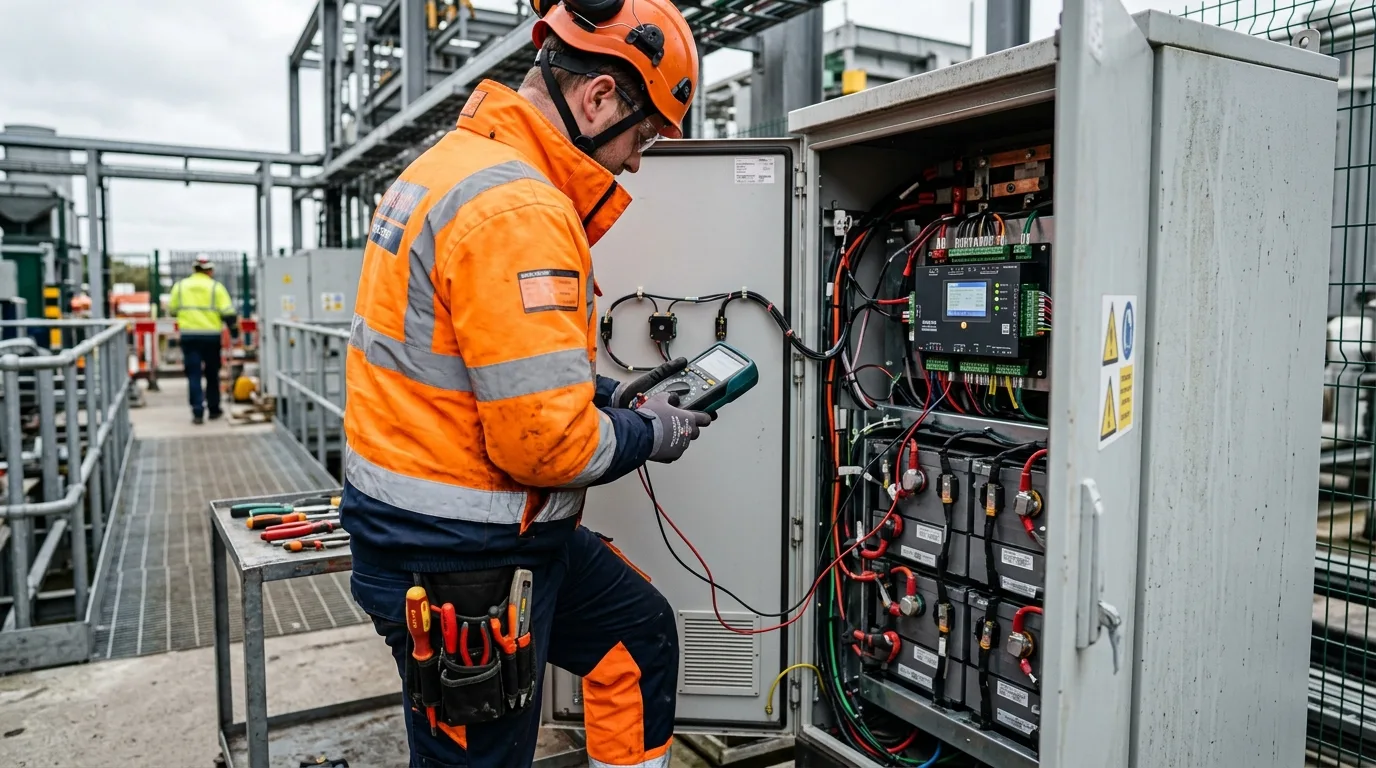
A commercial battery storage system is a 15+ year asset that needs ongoing operations and maintenance to deliver its business case. The O&M agreement - typically signed at commissioning or shortly after - defines who does what, how quickly, and at what cost. A well-structured O&M contract preserves the BESS's commercial performance; a poor one leads to drift, declining revenue and warranty disputes. This article walks through the key O&M agreement provisions for Irish commercial BESS in 2026.
What an O&M agreement covers
A typical commercial BESS O&M contract addresses:
- Routine preventive maintenance (quarterly and annual inspections)
- Reactive maintenance and fault response (24/7 callout)
- Software and firmware management (updates, security patches)
- Performance monitoring and reporting (monthly and annual)
- Spare parts management (stocking and replacement)
- Warranty administration (claims against manufacturer)
- Compliance and audit support (IS EN 62619, ESB Networks, EirGrid)
- Emergency response coordination (fire service, ESB Networks)
- End-of-warranty inspection and recommissioning
- Optional augmentation services (cell refresh, equipment upgrades)
The scope and depth varies by contract tier - basic, standard, premium or full-service.
Typical O&M scope tiers
Tier 1 - Basic (reactive)
- Phone support during business hours
- 48-hour response to faults
- Annual inspection only
- Spare parts billed separately
- Typical fee: €3,000-€6,000 per year per MWh
Tier 2 - Standard (proactive)
- 24/7 phone support
- 24-hour on-site response
- Quarterly inspections
- Annual deep maintenance
- Performance reporting monthly
- Limited spare parts included
- Typical fee: €8,000-€15,000 per year per MWh
Tier 3 - Premium (comprehensive)
- 24/7 fully attended NOC
- 8-hour on-site response
- Quarterly + targeted inspections
- All preventive maintenance included
- Comprehensive spare parts
- Software and firmware updates included
- Annual third-party verification
- Typical fee: €15,000-€25,000 per year per MWh
Tier 4 - Full LTSA (Long-Term Service Agreement)
- Premium plus availability guarantee
- Performance warranty
- Mid-life cell refresh included
- Multi-year fixed pricing with escalation
- Typical fee: 2-3% of capex per year
For most Irish mid-size commercial BESS in 2026, Tier 2 or Tier 3 is the standard - balancing cost against operational support.
Service Level Agreements (SLAs)
The contract should specify clear SLAs:
| Service | Standard SLA (Tier 2) | Premium SLA (Tier 3) |
|---|---|---|
| Phone response | 4 hours | 1 hour |
| On-site response (urgent fault) | 24 hours | 8 hours |
| Faultmotive availability target | 96% | 98% |
| Quarterly inspection | Within calendar quarter | Within calendar quarter |
| Performance report | Within 15 days of month-end | Within 5 days of month-end |
| Warranty claim filing | Within 30 days | Within 10 days |
| Spare part fitment | 14 days | 5 days |
SLAs should include penalties for shortfall - typically liquidated damages or service credits for missed targets.
Pricing structures
Common O&M pricing models:
1. Fixed annual fee. Predictable budget; vendor carries cost risk. Most common for Tier 2 and 3 contracts.
2. Capex-percentage. Fee = 1-2.5% of original capex per year. Used for premium and LTSA contracts.
3. Per-kWh-throughput. Fee scales with actual cycling. Less common but appropriate for high-throughput sites.
4. Hybrid. Fixed base fee plus per-event reactive fees. Useful for reducing base cost while allocating variable risk.
For Irish commercial BESS in 2026, fixed annual fee is the dominant structure - easy to budget, easy to compare across vendors.
Contract length and renewal
Typical O&M contract lengths:
- 1-year contracts: Maximum flexibility, often higher per-year cost
- 3-5 year contracts: Standard balance of price and commitment
- 5-10 year contracts: Best pricing, lower flexibility
- LTSA (15-year): Full asset life, fixed pricing with defined escalators
Most commercial buyers in Ireland opt for 5-year initial contracts with renewal options. LTSA suits projects with project finance debt requiring availability guarantees.
Inflation and escalation
Multi-year O&M contracts must address pricing escalation:
- Fixed annual escalator (e.g. 3% per year)
- CPI-linked (Irish Consumer Price Index, capped at 5%)
- Index-linked (e.g. SCSI tender price index)
- Rebase mechanism (e.g. annual review tied to specific indices)
Without escalation provisions, the O&M provider eventually loses money on long contracts. Without caps, the buyer faces unpredictable cost growth.
Spare parts strategy
Spare parts policy is one of the most consequential O&M decisions:
1. Vendor-stocked. Service provider maintains spares; faster fitment but priced into fees.
2. Buyer-stocked. Buyer holds spares on site; lower service fees but higher capex and risk of obsolescence.
3. Manufacturer-stocked. Original equipment manufacturer maintains spares; longest lead times but lowest standing capital.
4. Shared pool. Multi-site portfolios share spares across locations; efficient but logistically complex.
For mid-size commercial BESS, vendor-stocked critical spares (PCS modules, BMS controllers) plus buyer-stocked consumables (filters, fuses) is the standard 2026 model.
Warranty administration
The O&M provider typically handles manufacturer warranty claims. Key terms:
- Claim filing timeline - usually 7-30 days from fault
- Documentation requirements - cell health data, operational logs, fault traces
- Manufacturer interface - direct vendor relationship needed
- Cost recovery - warranty repairs at manufacturer cost, not buyer cost
- Failure escalation - what happens if manufacturer rejects a valid claim
Without competent warranty administration, valid claims often go unfiled or are rejected on technicalities - eroding warranty value.
Performance reporting requirements
Good O&M contracts mandate transparent performance reporting:
- Monthly performance report: availability, throughput, faults, cell health
- Quarterly trend analysis: degradation curve, RTE trends, capacity tracking
- Annual deep performance review: vs original business case, recommendations
- Real-time dashboard: owner portal access
- EirGrid settlement data: for DS3-participating systems
Reporting transparency is the foundation of trust between buyer and O&M provider - and the early warning system for performance issues.
Termination and transition
Plan for the possibility of changing O&M providers:
- Termination for convenience - 6-12 month notice typical
- Termination for breach - shorter notice on material breach
- Transition cooperation - 90-day handover to new provider
- Data and documentation transfer - all operational data belongs to buyer
- No proprietary lock-in - tools and software accessible by other providers
These terms preserve buyer optionality across the 15-year asset life.
Compliance and audit
The O&M provider should support ongoing compliance with:
- IS EN 62619 / NFPA 855 for fire safety
- ESB Networks operational and reporting requirements
- EirGrid for DS3 and capacity market
- CRU regulatory reporting
- HSA / HSE workplace safety
- Insurance underwriter requirements
- Internal audit and ESG reporting
Compliance support is increasingly important as the regulatory environment becomes more demanding.
Common O&M pitfalls
- Scope ambiguity - "all reasonable maintenance" is a recipe for dispute
- Vague SLAs - response times not defined or penalties missing
- Excluded events - too many force majeure exclusions
- Spare parts gaps - critical spares not stocked
- No performance reporting - operational issues hidden until major failure
- Inflexible termination - locked into underperforming providers
- Excessive variation pricing - any change order extracted for premium fees
A well-drafted O&M contract addresses each of these explicitly.
Bottom line
The O&M agreement is the document that determines whether your commercial BESS sustains its commercial performance across 15 years. Tier 2 or Tier 3 scope is standard for Irish 2026 commercial systems, with clear SLAs, performance reporting, transparent spare parts policy and explicit termination terms. Budget €8k-€25k per MWh per year for ongoing O&M, and negotiate the contract with the same rigour as the original BESS supply contract. Cheap O&M almost always costs more in revenue underperformance and unscheduled downtime than the few thousand euros saved on the fee.
Get 3 free commercial battery quotes — free and no obligation.
Frequently asked questions
How much should I budget for BESS O&M in Ireland?
Typical 2026 O&M costs for an Irish commercial BESS: Tier 2 standard service €8k-€15k per MWh per year, Tier 3 premium €15k-€25k per MWh per year, full LTSA approximately 2-3% of original capex per year.
What does a BESS O&M agreement cover?
Routine preventive maintenance (quarterly and annual inspections), reactive fault response (24/7), software/firmware updates, performance monitoring and reporting, spare parts management, warranty administration, compliance support, and emergency response coordination.
Should I sign a multi-year BESS O&M contract?
5-year initial contracts with renewal options are standard for Irish commercial BESS. Multi-year contracts deliver lower per-year cost but reduce flexibility. LTSA (15-year) suits projects with project finance requiring availability guarantees.
What SLAs should I require from an O&M provider?
Standard SLAs: 4-hour phone response, 24-hour on-site response for urgent faults, 96-98% availability target, quarterly inspections, monthly performance reports within 15 days of month-end. Premium tiers offer faster response (1-hour phone, 8-hour on-site).
Can I switch BESS O&M providers?
Yes if the contract permits. Standard termination provisions include 6-12 month notice for termination for convenience, with 90-day transition cooperation period. All operational data and documentation should belong to the buyer for seamless handover to a new provider.
Sources & further reading
- Engineers Ireland Engineering Service Resources — Engineers Ireland
- Health and Safety Authority Ireland — HSA