Commercial BESS Decommissioning in Ireland: End-of-Life Planning
Every BESS reaches end of life. Plan for cell recycling, equipment removal and site reinstatement at project start - it is cheaper and easier than retrofitting decommissioning into a legacy contract.
By Smart Solar Editorial · Updated 15 May 2026 · 8 min read
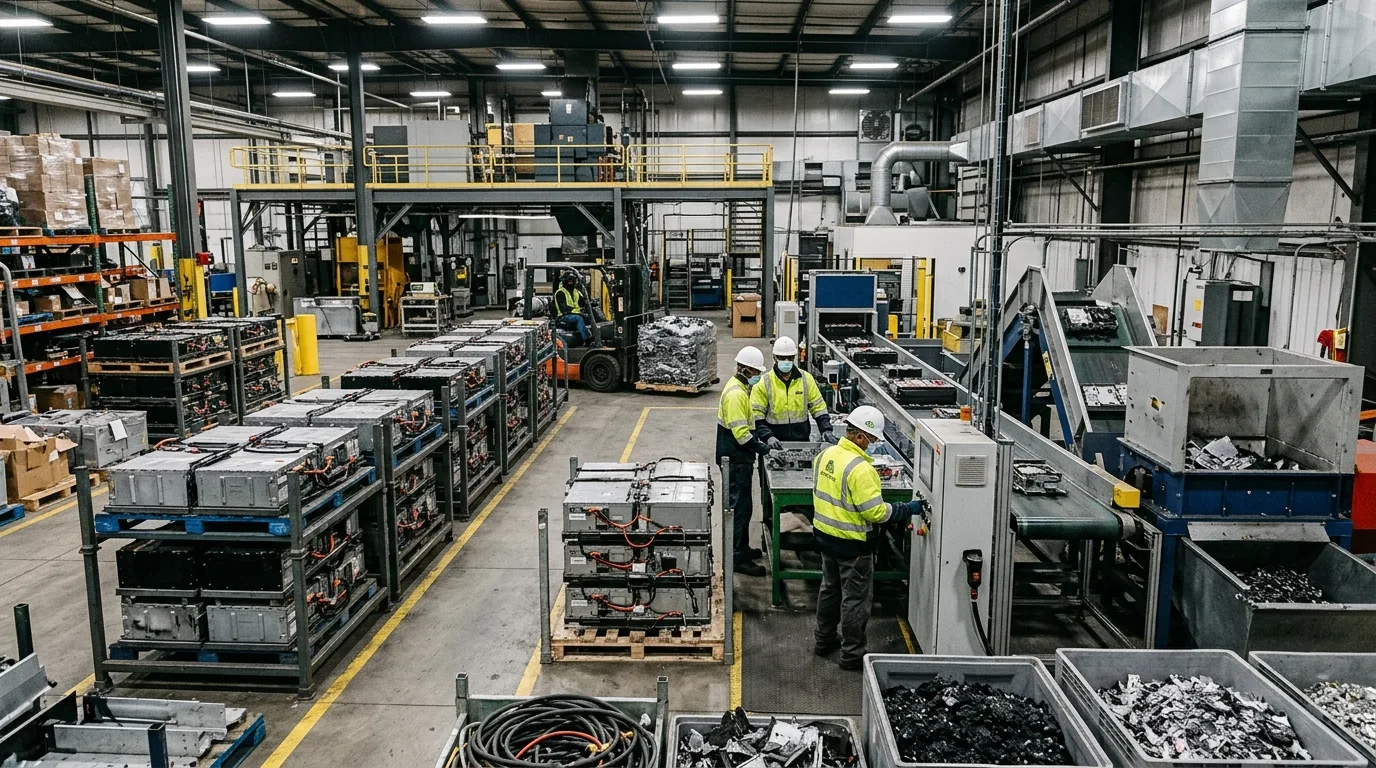
Every commercial battery storage system has a finite operational life - typically 15-20 years for modern LFP systems with mid-life cell refresh. Eventually the cells degrade beyond economic operation, components reach end of life, or the underlying site changes use. Planning for decommissioning at project start is dramatically cheaper than retrofitting it into a legacy contract years later. This article walks through the BESS decommissioning landscape for Irish commercial systems in 2026.
When decommissioning happens
A commercial BESS typically reaches end of life when:
- Cells degrade below economic threshold (typically 60-70% original capacity, often year 12-18)
- PCS reaches end of supported life (typically year 12-15)
- Major component failure with uneconomic repair
- Site decommissioning for unrelated reasons (closure, redevelopment)
- Technology obsolescence with significantly better alternatives
- Regulatory or insurance changes requiring upgrade
Mid-life cell refresh (around year 10-12) extends operational life and defers full decommissioning, but eventually full decommissioning becomes the right answer.
The decommissioning process
A typical decommissioning sequence:
- Decommissioning plan prepared 12-18 months before planned shutdown
- Regulatory notifications (CRU, ESB Networks, EirGrid for grid-services assets)
- Insurance updates for changed risk profile
- Final operational period with reduced cycling to maximise residual cell value
- Safe shutdown with cell state-of-charge minimisation
- Disconnection from grid and isolation
- Cell removal to certified recyclers
- PCS, BMS, EMS removal for refurbishment or recycling
- Civil works removal (concrete pad, fencing, foundations)
- Site reinstatement to agreed condition
- Final certification and handover
Total typical timeline: 6-12 months from planning to site reinstatement.
EU Battery Regulation 2023/1542
The EU Battery Regulation (in force since 2024, with phased implementation through 2025-2027) establishes:
- Producer Responsibility - battery manufacturers must take back end-of-life batteries
- Mandatory recycling targets (90% lithium recovery by 2027)
- Material recovery requirements by chemistry
- Carbon footprint declarations for new batteries
- Battery passport for traceability (in force 2027)
- Reuse and repurposing requirements before recycling
Implementation in Ireland is via EPA / DECC regulations referencing the EU framework. The producer responsibility provisions mean manufacturers like BYD, Tesla, Sungrow, CATL bear some end-of-life cost responsibility - reducing cost burden on buyers compared to pre-2024.
Cell recycling in Ireland
Lithium battery recycling capacity in Ireland is limited in 2026, with most cells shipped to European processing facilities:
- EU recycling hubs: Germany (Duesenfeld, Accurec, BASF), Belgium (Umicore), Spain (Ecobat), France (Veolia)
- Irish collection and pre-processing: Returnbatt, KMK Metals Recycling, ResourceKraft
- Specialist transport: licensed ADR Class 9 hazardous materials carriers required
Cell recycling extracts valuable materials:
- Lithium carbonate
- Iron and phosphate (LFP)
- Nickel, manganese, cobalt (NMC)
- Aluminium and copper (current collectors)
- Plastics for general recycling
Recyclers either pay for or charge for cells depending on chemistry, condition and market prices for recovered materials.
Decommissioning costs
Typical 2026 decommissioning cost for a 1 MWh commercial LFP BESS in Ireland:
| Item | Indicative cost |
|---|---|
| Decommissioning plan and consultants | €5,000-€15,000 |
| Cell removal labour and equipment | €15,000-€30,000 |
| Cell transport to EU recycler | €8,000-€20,000 |
| Cell recycling fees (net of material credits) | €10,000-€40,000 |
| PCS removal and disposal/refurbishment | €5,000-€15,000 |
| BMS/EMS removal | €2,000-€5,000 |
| Civil works removal (pad, fencing, cables) | €5,000-€20,000 |
| Site reinstatement | €3,000-€15,000 |
| Final electrical safety certification | €2,000-€5,000 |
| Project management | €5,000-€10,000 |
| Total typical decommissioning cost | €60,000-€175,000 |
For a 1 MWh system this is roughly 8-25% of original gross capex - a meaningful number that should be planned for at project start.
Decommissioning bonds
For larger commercial and utility-scale BESS, ESB Networks, CRU and local authorities increasingly require decommissioning bonds posted at project start:
- Typical bond value: 1-3% of capex, indexed
- Bond mechanism: bank guarantee, insurance bond, or escrow
- Bond release: on certified completion of decommissioning
- Bond enforcement: if owner fails to decommission, bond funds the work
For a €1M BESS, a 2% bond ties up €20,000 for the asset life. Cheaper than facing a €100k+ decommissioning liability with no plan.
Reuse and second-life applications
Before recycling, EU regulation encourages reuse or repurposing. Several routes exist for end-of-life commercial BESS cells:
- Second-life stationary storage - cells at 60-70% capacity can serve less demanding applications (residential, off-grid, telecoms)
- EV charging buffer - lower-cycle requirements suit aged cells
- Battery aggregation for behind-the-meter portfolio operators
- Educational/research applications
Second-life economics depend on cell quality, market demand and logistics costs. For commercial LFP cells in good condition at end of primary life, second-life value is typically €30-€80/kWh - useful but rarely material to the original BESS business case.
Best practice timeline planning
A typical 15-year commercial BESS lifecycle:
- Year 0: Project commissioning, decommissioning bond posted
- Years 1-8: Normal operation
- Year 8: First major cell health assessment
- Years 9-11: Continued operation, plan mid-life refresh
- Year 11-12: Mid-life cell refresh (50% cell replacement)
- Years 12-17: Extended operation
- Year 16-17: Decommissioning plan preparation
- Year 18: Decommissioning execution
- Year 18-19: Site reinstatement
Some assets retire earlier (12-15 years) without mid-life refresh; others extend to 20-25 years with multiple refreshes. The asset owner makes the economic call.
Regulatory and reporting obligations
End-of-life of a commercial BESS triggers various notifications:
- EPA notification for hazardous waste movement
- CRU notification if registered for system services
- EirGrid deregistration of DS3/DSU contracts
- ESB Networks Connection Agreement closure
- Local authority site reinstatement notification
- Insurance policy adjustment or cancellation
- Decommissioning records retention for 7-15 years
A competent decommissioning consultant handles these in sequence.
Choosing a decommissioning contractor
Practical criteria for selecting a decommissioning contractor in Ireland:
- Track record with commercial lithium battery decommissioning
- EU recycling partner relationships
- ADR Class 9 transport capability
- HSE record for hazardous materials handling
- Insurance with appropriate liability cover
- References from previous Irish BESS decommissioning
- Pricing transparency (per-kWh or itemised)
The contractor pool is smaller than for original installation - early engagement helps avoid pricing premium for last-minute work.
Cost mitigation strategies
Ways to reduce decommissioning costs:
- Plan at project start - cheaper than retrofitting
- Include in O&M contract - long-term provider knowledge reduces friction
- Choose Tier-1 vendors - producer responsibility under EU regulation reduces cost
- Maintain cell health records - higher residual value if cells are well-documented
- Consider second-life - some cell value capture vs straight recycling
- Bundle decommissioning across portfolio - economies of scale for multi-site operators
- Optimise final operational period - lower cycling preserves residual value
Bottom line
Commercial BESS decommissioning in Ireland costs €60k-€175k for a typical 1 MWh system, representing 8-25% of original capex. Plan for it at project start with a decommissioning bond, include it in O&M contracts, and engage early when end of life approaches. EU Battery Regulation continues to shift cost responsibility toward manufacturers, reducing buyer burden over time. Done well, decommissioning is a routine 6-12 month project closing the lifecycle of a successful asset.
Get 3 free commercial battery quotes — free and no obligation.
Frequently asked questions
How much does it cost to decommission a commercial battery in Ireland?
Typical 2026 decommissioning cost for a 1 MWh LFP commercial BESS is €60k-€175k including cell removal, EU recycling fees, equipment disposal, civils removal and site reinstatement. This represents 8-25% of original capex.
Do I need a decommissioning bond for a commercial BESS?
For larger commercial and utility-scale projects, increasingly yes - typically 1-3% of capex posted as bank guarantee, insurance bond, or escrow. Released on certified completion of decommissioning. ESB Networks, CRU and local authorities may require it as a condition of approval.
Where are commercial batteries recycled in Ireland?
Most cells are collected by Irish specialists (Returnbatt, KMK Metals Recycling, ResourceKraft) and shipped to EU recycling hubs in Germany, Belgium, Spain and France for processing. EU Battery Regulation mandates 90% lithium recovery by 2027.
Can I sell my old battery cells for reuse?
Possibly - cells at 60-70% capacity can serve second-life applications (residential storage, EV charging buffer, telecoms). Typical second-life cell value: €30-€80/kWh. Economics depend on cell quality, market demand and logistics.
How long does BESS decommissioning take?
Typically 6-12 months from planning to site reinstatement: 3-6 months for planning and notifications, 1-2 months for execution, and 1-2 months for final certification and handover. Engage a specialist contractor 12-18 months before planned shutdown.
Sources & further reading
- EU Battery Regulation 2023/1542 — European Union
- EPA Ireland Hazardous Waste — Environmental Protection Agency Ireland
- Department of Environment Climate Communications — Government of Ireland