Backup Power with BESS for Irish Businesses: Replacing Diesel UPS in 2026
Lithium BESS now competes with diesel UPS and DRUPS for Irish commercial backup. Lower TCO, zero emissions, and dual-use revenue from peak shaving and DS3 make the case in 2026.
By Smart Solar Editorial · Updated 15 May 2026 · 9 min read
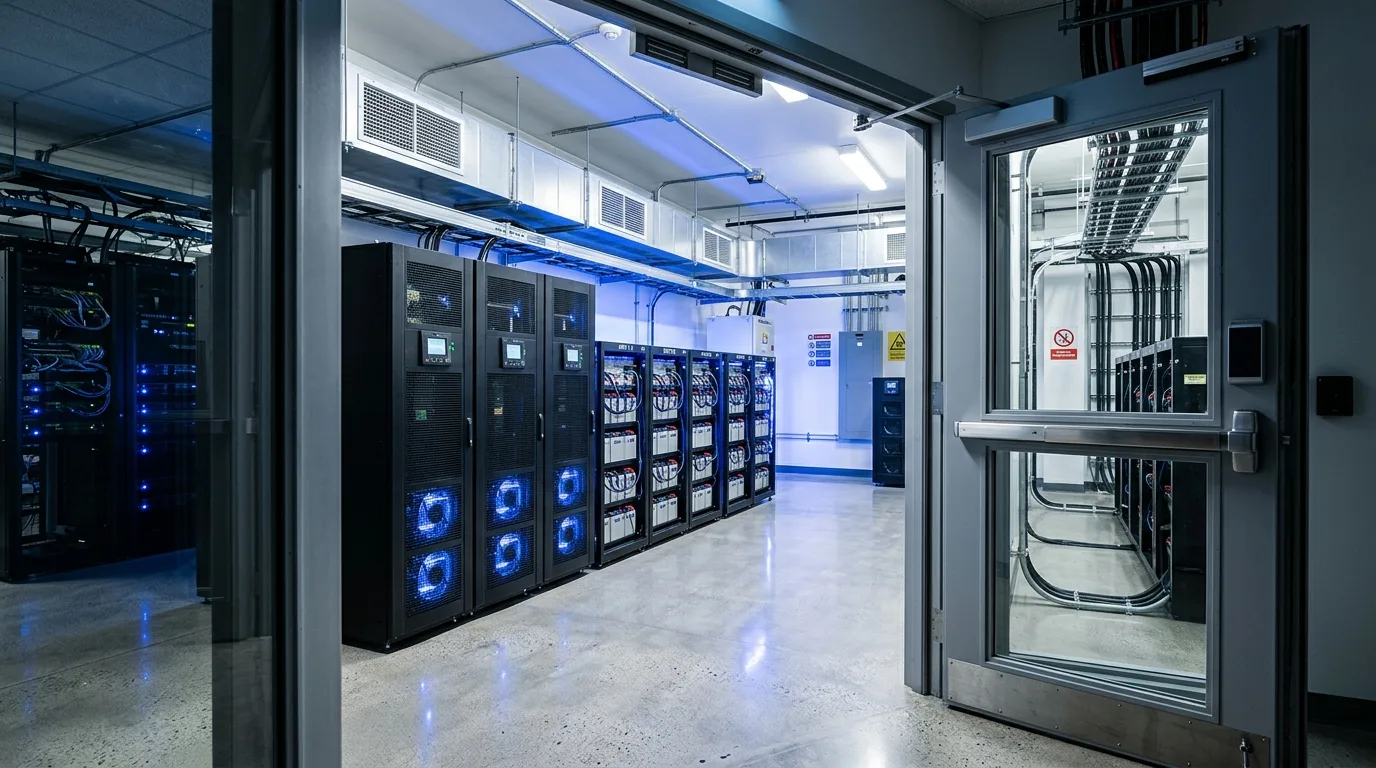
Backup power is one of the oldest reasons Irish businesses have invested in stored energy - from valve-regulated lead-acid (VRLA) UPS in switchrooms to diesel rotary UPS (DRUPS) in data centres to standby diesel generators outside warehouses. By 2026, lithium BESS has become a credible alternative to most of these, with the added advantage that the same hardware can earn revenue every day from peak shaving and DS3 rather than sitting idle waiting for an outage.
What "backup" actually means in an Irish commercial context
Three distinct backup needs exist, and the right BESS architecture differs for each:
1. IT critical load support (UPS replacement). Seconds-to-minutes ride-through for servers, comms and instrumentation. Replaces traditional VRLA UPS.
2. Process continuity. Minutes-to-hours for production lines, refrigeration, controlled shutdown of batch processes. Replaces diesel generator + simple ATS.
3. Whole-site islanded operation. Hours of full-site supply during prolonged outages. Replaces large diesel generator + bulk fuel store.
A lithium BESS handles 1 and 2 well in 2026. For requirement 3, BESS supplements but rarely replaces diesel - the energy density and refuelability of diesel still win for 24h+ outages.
Why lithium BESS displaced VRLA UPS
Traditional VRLA UPS batteries:
- Last 4-7 years and need replacement
- Cannot be cycled daily (only used for outage events)
- Trickle charge consumes ~3% of capacity 24/7
- Limited remote monitoring
- Hazardous waste at end of life
Lithium BESS for the same role:
- Last 12-15+ years
- Can cycle daily for peak shaving while staying ready for backup
- Standby consumption under 1%
- Granular cell-level telemetry
- Recyclable LFP chemistry, no lead waste
The capex differential narrowed substantially through 2024-2026, with installed lithium UPS-grade systems now within 15-25% of equivalent VRLA UPS - and TCO over 10 years is significantly lower for lithium due to no battery replacement.
Grid-following vs grid-forming PCS
This is the technical detail that determines whether your BESS can actually provide backup.
Grid-following inverters require an external voltage and frequency reference (the grid). When ESB Networks supply fails, the PCS detects loss of mains and trips off under G99 protection. The battery sits idle until grid returns. Most behind-the-meter BESS in Ireland for peak shaving / arbitrage / DS3 are grid-following.
Grid-forming inverters create their own voltage and frequency reference. When grid supply fails, a fast-acting transfer switch isolates the site from the grid, the grid-forming PCS takes over, and the BESS supplies the site as an island. Required for any backup function.
Grid-forming capability adds roughly 10-20% to PCS cost and requires:
- Grid-forming PCS firmware (most Tesla Megapack, Sungrow PowerStack, Sonnen Multi units support it)
- Automatic transfer switch (ATS) or static transfer switch (STS)
- Backup load designation (which circuits get backed up)
- Synchronisation logic for return to grid
Sizing for backup duration
Three numbers drive backup BESS sizing:
- Backup power (kW): Critical load total. For a 500-server data hall this might be 800 kW. For a refrigerated warehouse, 250 kW.
- Backup duration (hours): How long you need to ride through, or how long generator startup takes. Typical: 15-30 minutes for "ride to generator", 4-8 hours for "ride through outage".
- Cycle reserve: What proportion of capacity must always be held in reserve. Typical: 25-40% for backup-priority systems.
A 250 kW critical load with 2-hour backup at 30% reserve requires:
- PCS rating: 300 kW (1.2x load for margin)
- Cell capacity nameplate: 250 kW × 2h ÷ 0.70 reserve factor = ~715 kWh
- Plus end-of-warranty degradation buffer: ~800 kWh
That 800 kWh is then available for daily peak shaving and DS3 within the 70% non-reserved band (560 kWh).
ESB Networks outage statistics for Ireland
Why backup matters: ESB Networks reports Customer Average Interruption Duration (CAIDI) typically between 75-95 minutes per year for urban LV customers, with rural areas often experiencing 150-300 minutes. Major weather events (Storm Eowyn 2025, Storm Darragh 2024) have caused 12-72 hour outages in parts of the south and west.
For pharma, dairy, food processing, telecoms and data centres, even a 2-minute outage triggers batch losses, restart costs and missed SLAs in the €10k-€500k range. Backup BESS pays back through avoided incidents alone in many sectors.
Data centre backup: BESS vs DRUPS
Diesel rotary UPS (DRUPS) systems from Hitec, Piller and Euro-Diesel have dominated Irish data centre backup for two decades. By 2026, three things changed:
- LFP BESS achieves the same sub-cycle ride-through with much higher efficiency (no rotating mass losses)
- BESS adds dual-use peak shaving and DS3 revenue (DRUPS cannot)
- BESS has lower carbon intensity (Microsoft, Google, AWS Irish data centres all now mandate this)
- LFP fire safety is now compliant with IS EN 62619 and the latest Uptime Institute Tier IV guidance
Several Irish data centres in 2024-2026 (Aurora, Equinix DB6, EdgeConneX) have either deployed BESS as primary backup or are running pilot replacements of DRUPS units.
Microsoft's 2025 Dublin precedent
In Dublin, Microsoft replaced approximately 40 MW of diesel backup at a Citywest data centre with a hybrid BESS + selective diesel layout in 2024-2025. The BESS handles instantaneous transfer and 30-minute hold; diesel only starts for outages above that threshold. The BESS earns DS3 revenue daily. This template is now being repeated by other operators in Dublin and the south.
Backup BESS for industrial process continuity
For Irish food, pharma, dairy and engineering sites, a 30-90 minute backup window is often enough to:
- Complete in-progress batches safely
- Power down sterile zones in controlled sequence
- Maintain refrigeration during short outages
- Avoid health-and-safety incidents during sudden shutdown
- Keep instrumentation and PLC controllers online
A 500-1,000 kWh BESS with grid-forming PCS typically delivers this for a mid-size factory. Combined with daily peak shaving and DS3 stacking, the same asset earns €60k-€150k per year while providing the backup function.
Cost comparison: BESS vs diesel backup (1 MW for 4 hours)
Lithium BESS (2026 prices):
- 1 MW grid-forming PCS + 4 MWh LFP cells + ATS: ~€2.4M-€2.8M installed
- Annual O&M: €15k-€25k
- 15-year life with mid-life cell refresh: ~€500k
- 15-year TCO: ~€3.3M
- Annual revenue from peak shaving + DS3: €100k-€200k
- Net 15-year TCO after revenue: €0M to €300k positive
Diesel generator:
- 1.2 MW prime-rated diesel + ATS + fuel system + sound enclosure: ~€650k-€850k installed
- Annual O&M (load testing, fuel turnover): €18k-€30k
- 15-year fuel and maintenance: ~€400k
- 15-year TCO: ~€1.0M-€1.3M
- No revenue
- Net 15-year TCO: €1.0M-€1.3M (cost)
Diesel still has lower upfront capex but higher net TCO, no carbon credentials, no daily revenue, and increasing regulatory friction. Lithium BESS wins on TCO and ESG, with diesel often retained as final-tier backup for 24h+ outages.
Bottom line
For Irish commercial backup needs from minutes to 8 hours, lithium BESS in 2026 is a serious competitor to legacy VRLA UPS, DRUPS and standby diesel - especially when the same hardware can earn peak shaving, arbitrage and DS3 revenue between outage events. For sites needing 24h+ ride-through, BESS plus a much smaller diesel often beats a large standalone diesel on TCO.
Get 3 free commercial battery quotes — free and no obligation.
Frequently asked questions
Can a commercial BESS provide backup during ESB outages?
Yes, but only if specified with a grid-forming PCS and an automatic transfer switch. Most behind-the-meter BESS in Ireland for peak shaving are grid-following and trip off in an outage. Grid-forming capability adds roughly 10-20% to PCS cost.
Can a BESS replace my diesel UPS?
For most sub-8-hour backup needs, yes. Lithium BESS now matches DRUPS and traditional VRLA UPS performance with longer life, dual-use revenue from peak shaving and DS3, and lower carbon footprint. Diesel often remains for 24h+ outage scenarios.
How long can a BESS run my business during an outage?
Depends on critical load size and battery capacity. A 1 MWh system can supply 250 kW of critical load for 3-4 hours, or 100 kW for 8-10 hours. Size the battery for your longest expected outage at your critical load demand.
What is grid-forming vs grid-following BESS?
Grid-forming PCS can create its own voltage and frequency reference, enabling islanded backup operation. Grid-following PCS requires the grid as a reference and trips off in outages. Backup applications require grid-forming, which is widely supported by Tesla Megapack, Sungrow, Sonnen Multi and others.
Does adding backup capability affect daily BESS revenue?
Modestly - typically 25-40% of capacity is reserved for backup and unavailable for peak shaving or DS3. The remaining capacity still delivers strong revenue, and avoided outage costs often justify the reserved portion many times over.
Sources & further reading
- ESB Networks Reliability Reports — ESB Networks
- EirGrid System Performance Reports — EirGrid