ESB Networks NC6 Notification for Home Battery Storage in Ireland
All grid-connected home batteries in Ireland require ESB Networks notification (NC6 / G98 equivalent) before commissioning. This guide explains the process, what ESB Networks checks, and what can delay approval.
By Smart Solar Editorial · Updated 15 May 2026 · 7 min read
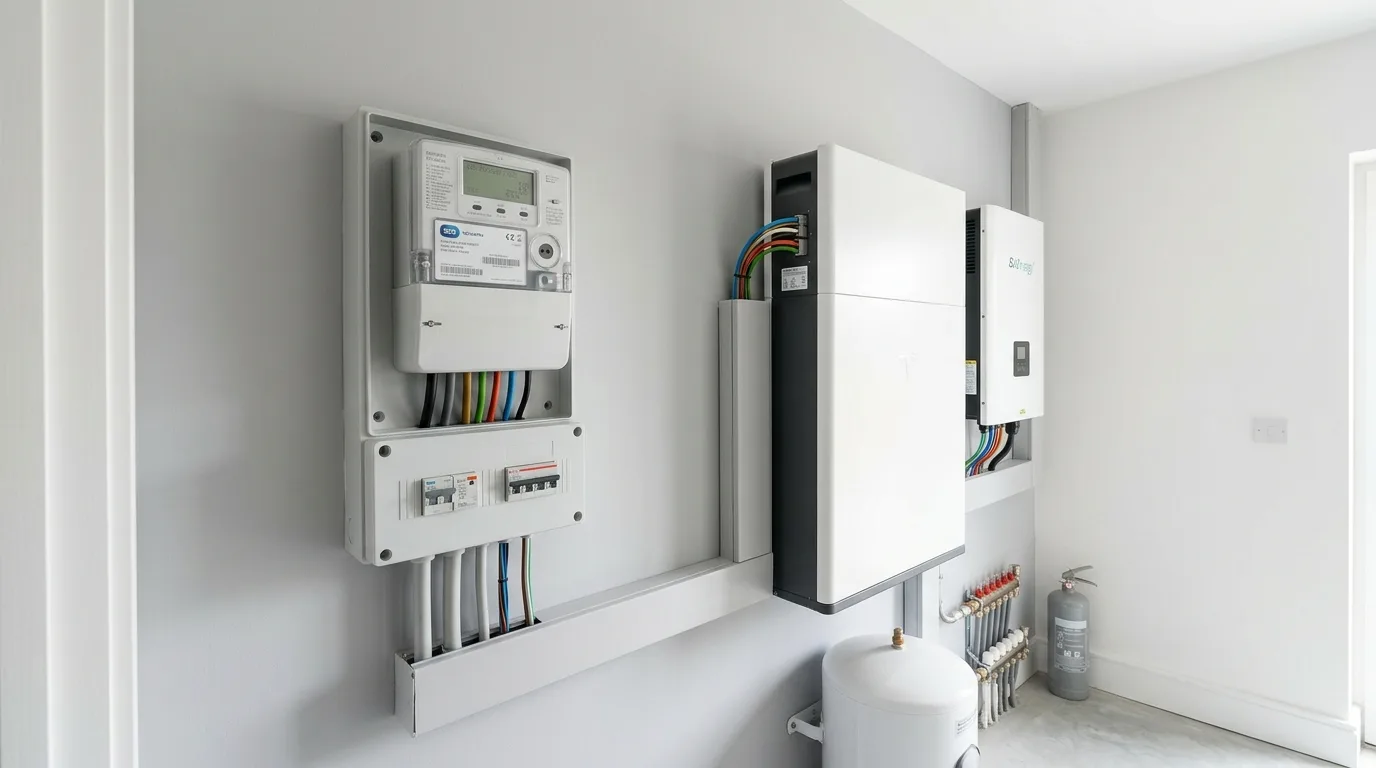
What Is the NC6 Notification and Why Does It Matter?
Before any grid-connected battery storage system (or solar PV system) can be commissioned in Ireland, the installer must notify ESB Networks under the NC6 process (also referred to in some documentation as the G98 or G99 equivalent process, aligned with British standards adopted by ESB Networks for Irish conditions).
This notification is not optional — it is a legal requirement under the Electricity Regulation Act and the terms of your grid connection. Commissioning a battery without NC6 compliance can:
- Invalidate your home insurance (grid connection in breach of regulations)
- Create liability if a fault on your system affects the grid or other customers
- Result in ESB Networks requiring disconnection of your system
- Void your eligibility for the MSS export tariff
A competent installer handles this on your behalf — but you should understand what it involves and what can cause delays.
What NC6 / Micro-generation Notification Involves
For Systems Up to 11 kW Inverter Output (Most Residential)
For home battery systems where the inverter output does not exceed 11 kW AC (the vast majority of residential installations), the process is:
-
Installer submits an NC6 notification to ESB Networks, including:
- Site address and meter point reference number (MPRN)
- Inverter specification (brand, model, output kW, G98 compliance certificate)
- Battery specification (brand, model, capacity kWh)
- Single-line electrical diagram
- Confirmation of anti-islanding protection (the inverter must disconnect from the grid during a power cut)
-
ESB Networks reviews the notification: For standard residential systems under 11 kW, this is typically processed within 1–4 weeks.
-
Conditional approval or assessment: In most cases, ESB Networks acknowledges the notification without further review — the system may be commissioned after a defined waiting period (typically 28 days from submission). If ESB Networks has concerns (network capacity, protection coordination), they may request a more detailed assessment.
-
Smart meter registration: ESB Networks registers your system on their network management systems. Your smart meter is linked to your NC6 record, enabling MSS export tracking.
-
System commissioning: After the notification period, the installer commissions the system. ESB Networks does not typically attend residential installations — the ETCI certification from the installer's electrician serves as the commissioning record.
For Systems Above 11 kW Inverter Output (G99 / Full Application)
For systems with inverter output above 11 kW AC (most commercial installations; some residential with high-power Tesla Powerwall 3 setups), a full G99 grid connection application is required rather than the simpler NC6 notification.
This is a more involved process:
- Formal application to ESB Networks distribution planning
- Load flow study (ESB Networks assesses impact on local network)
- Possible reinforcement works (if local network cannot accommodate the system without upgrades)
- Connection agreement (legal agreement defining export limits and conditions)
- Timeline: 3–6 months (or longer if reinforcement is required)
Note on Tesla Powerwall 3: Powerwall 3 has a maximum AC output of 11.5 kW — marginally above the 11 kW NC6 threshold. In practice, Irish Tesla installers often configure the inverter output to remain at or below 11 kW for residential connections to use the simpler NC6 process. Confirm with your installer how this is handled.
Export Limitation and Rural Network Constraints
In some rural areas of Ireland, the local distribution network — particularly older 10 kV lines and distribution transformers — has limited capacity to absorb power exports from micro-generation systems. ESB Networks may impose an export limit on your system as a condition of the NC6 notification.
Common export limits imposed:
- Zero export (system may not export to grid at all — battery charges from solar only, no MSS earnings)
- 3.68 kW export limit (one-phase, 16 A)
- Full inverter capacity (no restriction — most urban and suburban connections)
If an export limit is imposed:
- You can still benefit from solar self-consumption and battery storage
- MSS export earnings are reduced or eliminated (depending on whether zero export is required)
- The battery and inverter must be configured to comply with the export limit — your installer programs this into the inverter EMS
What determines if an export limit is imposed? ESB Networks assess your local network using their network management systems. Factors include: number of existing micro-generation systems on the same feeder, transformer capacity, and fault level at your connection point. This assessment is automatic in most cases — your installer submits the notification and ESB Networks either approves without restriction or flags a constraint.
If an export limit is likely (common in rural west Connacht, parts of Munster, and isolated rural areas), ask your installer before purchasing whether this affects your economics significantly.
The Smart Meter Requirement
The NC6 notification process implicitly requires a smart meter at your property. Smart meters are required for:
- Half-hourly metering: Accurate tracking of import and export in separate intervals
- MSS export settlement: The MSS tariff is settled based on your smart meter's export data; ESB Networks confirms export kWh to your electricity supplier who pays the tariff
- TOU tariff access: Smart tariffs (Electric Ireland Smart Plan, Energia EV Smart Drive) require smart meters to bill correctly
As of 2026, ESB Networks has installed smart meters in the majority of Irish homes as part of the national smart meter rollout. If you don't yet have a smart meter, contact ESB Networks — installation is free and takes a few hours.
What Your Installer Is Responsible For
A competent registered installer handles:
- Preparation and submission of NC6 notification form
- Provision of inverter G98 compliance certificate (or equivalent)
- Electrical diagram preparation
- Waiting period management (typically 28 days)
- Configuration of inverter export limits if required
- Commissioning after the notification period
What you should do:
- Confirm your installer has submitted the notification before committing to an installation date
- Ask for a copy of the NC6 notification reference number
- Check that your smart meter is in place (contact ESB Networks if not)
- Register for MSS export with your electricity supplier after commissioning
Typical Timeline from Notification to Live System
| Milestone | Timeframe |
|---|---|
| Installer submits NC6 notification | Day 0 |
| ESB Networks acknowledges receipt | 3–10 days |
| Notification waiting period expires | Day 28 (standard) |
| Installer completes commissioning | Day 28–35 |
| MSS export registration with supplier | 2–4 weeks after commissioning |
| First MSS payment credited | 1–3 months after commissioning |
For homes in areas without network constraints, the total timeline from notification to live MSS-earning system is typically 6–10 weeks.
Common NC6 Issues and How to Avoid Them
Problem: ESB Networks requests additional information (common if the inverter model isn't in their approved list). Solution: Choose inverters with proven NC6 approval in Ireland (Solis S6, GivEnergy, Tesla Powerwall 3 are all pre-approved). Your installer should confirm approval status before purchasing.
Problem: Export limit imposed after notification assessment. Solution: Ask your installer to check with ESB Networks' micro-generation team before purchasing whether your address has known network constraints. This pre-check avoids surprises.
Problem: Smart meter not installed — MSS export can't be set up. Solution: Contact ESB Networks to request smart meter installation. Allow 4–8 weeks for this before your battery installation date.
Problem: Installer didn't submit NC6 before commissioning. Solution: Require written confirmation of NC6 submission before signing off on installation completion. An ETCI certificate alone doesn't confirm NC6 compliance.
Get 3 free battery storage quotes — free and no obligation.
Frequently asked questions
What is the NC6 notification for battery storage in Ireland?
The NC6 notification is ESB Networks' process for registering a new grid-connected battery or solar PV system. Your installer submits it on your behalf before commissioning. It allows ESB Networks to register your system, assess network impact, and set up MSS export metering.
How long does ESB Networks NC6 approval take?
For standard residential systems under 11 kW, the waiting period is typically 28 days from submission. ESB Networks usually acknowledges within 3–10 days. Complex applications or constrained network areas can take longer.
Can ESB Networks limit my battery's export to the grid?
Yes. In areas where the local network has limited capacity, ESB Networks may impose an export limit (e.g., zero export, or capped at 3.68 kW). This affects your MSS export earnings but not your ability to use the battery for self-consumption and night-rate arbitrage.
Do I need a smart meter to connect a battery in Ireland?
Yes — a smart meter is required to access the MSS export tariff and to use time-of-use electricity tariffs for night-rate arbitrage. ESB Networks provides smart meters free of charge as part of the national rollout. Contact ESB Networks if you haven't yet been upgraded.
Does Tesla Powerwall 3 require a G99 application rather than NC6?
Powerwall 3's maximum output is 11.5 kW — marginally above the 11 kW NC6 threshold. In practice, most Irish Tesla installers configure the system to cap output at 11 kW, allowing NC6 notification rather than a full G99 application. Confirm your installer's approach before purchasing.