How to Choose a Battery Installer in Ireland: The Complete Checklist
A home battery is a €5,500–€15,000 investment that sits in your home for 10+ years. Choosing the right installer protects that investment — and the wrong one can cost you significantly more.
By Smart Solar Editorial · Updated 4 November 2026 · 8 min read
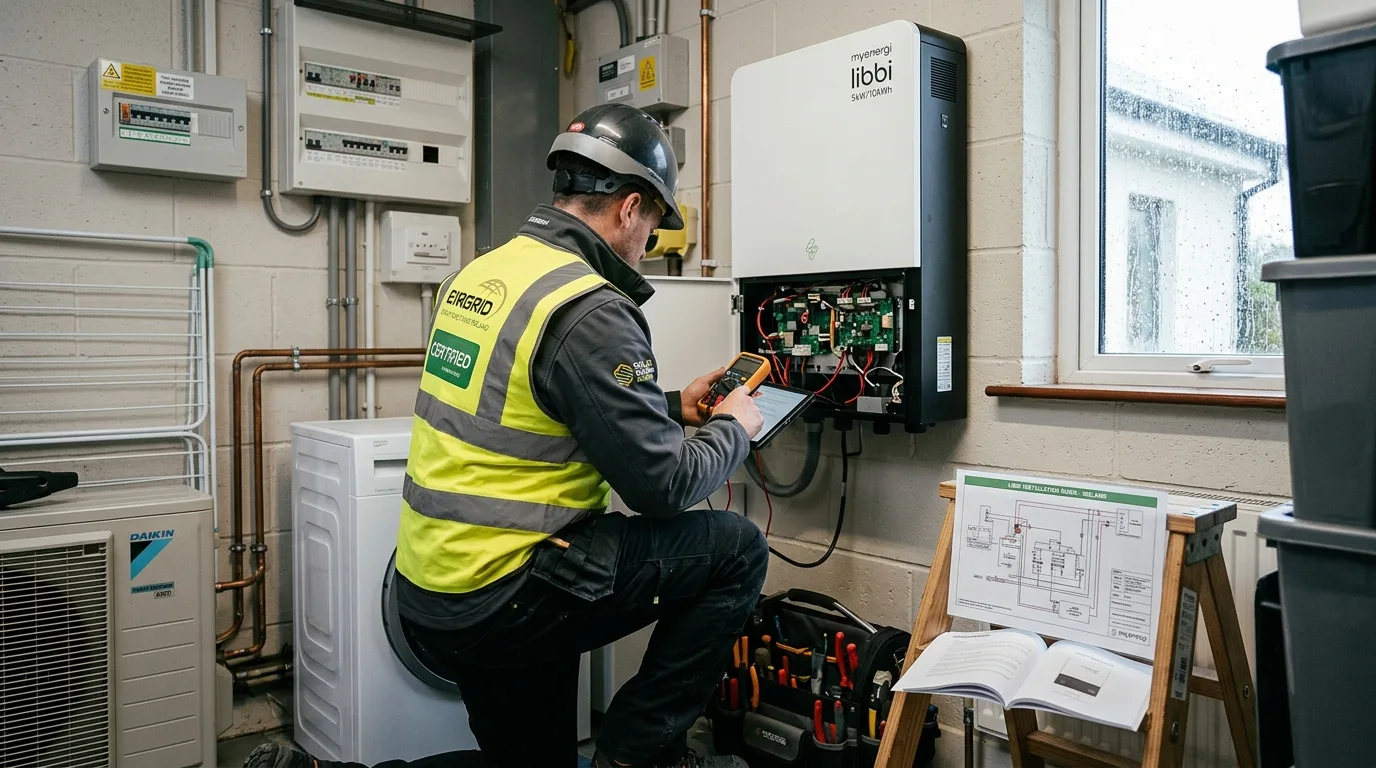
Why Your Installer Choice Matters as Much as Your Battery Choice
Most of this website focuses on which battery to buy — but the installer you choose is at least equally important. An excellent battery installed poorly can underperform for years. A good installer will:
- Size the system correctly for your usage patterns
- Submit the NC6 notification to ESB Networks correctly and on time
- Configure the EMS for optimal savings from day one
- Issue an ETCI completion certificate
- Register your warranty with the manufacturer
- Be available for support and warranty claims for years after installation
A poor installer does none of these reliably — and you may only find out in year 3 when you discover the battery was never registered with ESB Networks and your EMS was misconfigured from the start.
Step 1: Verify SEAI Registration
SEAI-registered installers are the minimum standard for Irish battery and solar installations. SEAI registration requires:
- Relevant electrical qualifications (RECI registration or equivalent)
- Manufacturer-specific product training
- Ongoing CPD (continuing professional development)
- Adherence to SEAI's Installer Code of Practice
SEAI maintains a searchable register of qualified installers on seai.ie. Before engaging any installer, search the register to confirm they appear. An installer not on the SEAI register cannot legally claim SEAI grant funding on your behalf (though since there's no standalone battery grant, this is less critical for battery-only purchases than for solar).
RECI (Register of Electrical Contractors of Ireland) registration is also important for the electrical elements of your installation. RECI contractors have undergone assessment and must maintain liability insurance.
Step 2: Check Manufacturer Certification
For the specific battery brand you're considering, many manufacturers operate their own installer certification programmes:
- Tesla: Tesla-certified installer network (must complete Tesla training and be approved)
- GivEnergy: GivEnergy Approved Installer network
- BYD: BYD Premium Partner network
- Sonnen: Sonnen-certified installer
- Huawei: Huawei Fusion Solar Installer network
Manufacturer-certified installers typically have:
- Direct warranty claim pathways (faster resolution if something goes wrong)
- Access to pre-release firmware and technical support
- Up-to-date training on the specific product being installed
Ask any installer for their manufacturer certification for the brand they're recommending. A company that installs BYD batteries but is not a BYD Premium Partner has no direct relationship with BYD — this matters when you need warranty support.
Step 3: Get at Least 3 Quotes
Never accept the first quote. Getting multiple quotes allows you to:
- Compare pricing (a reasonable installer won't be the cheapest or most expensive)
- Compare specifications (not all installers specify the same battery or inverter)
- Assess responsiveness and professionalism
- Identify unusual pricing patterns (very cheap = corners being cut; very expensive may not be justified)
When requesting quotes, specify the same requirements to each installer to allow like-for-like comparison:
- "I want a 10 kWh LFP battery, fully installed, including NC6 notification, ETCI certificate, and first-year monitoring support"
- Ask for the quote to itemise: battery unit cost, inverter cost, installation labour, NC6, ETCI, commissioning
Step 4: Evaluate the Quote Itself
A well-prepared quote should include:
What Should Be in Every Quote
- Battery brand and model: Exact specification (kWh usable, chemistry, warranty cycles)
- Inverter brand and model: Specific hybrid or AC inverter specified
- Installation description: Wall mounting, cable run length, consumer unit work
- NC6 submission: Confirmation that ESB Networks notification is included
- ETCI Completion Certificate: Confirmation this will be provided
- Manufacturer warranty registration: Confirmation installer will register with manufacturer
- Monitoring setup: App configuration included
- Payment terms: Stage payments vs full payment upfront; deposit amount
Red Flags in a Quote
- "Battery storage system" without naming the brand or model: Vague specifications allow substitution of cheaper components
- No mention of ETCI certificate: Suggests the installer may not complete proper electrical certification
- No mention of NC6: Battery may be commissioned without ESB Networks notification
- Full payment required upfront: Standard practice is 10–30% deposit, balance on completion
- Very short warranty mentioned: Legitimate batteries carry 10-year manufacturer warranties; if the quote mentions 5 years or less, ask why
- Unusually cheap total: Investigate the components — a full 10 kWh system installed for under €5,000 warrants very careful scrutiny
Step 5: Check References and Online Reviews
Ask each installer for:
- Two recent customer references (in your county, similar system size): Call them. Ask: Was the installation completed on time? Were there any problems? Has the system worked as expected? Did the installer respond when you had questions?
- Google Business reviews: An established Irish installer should have 20+ Google reviews. Check the response pattern — do they respond to negative reviews professionally?
- Case studies or photos: Professional installers often share completed installation photos (with customer permission). This demonstrates experience and installation quality.
Step 6: Review the Contract Carefully
Before signing, the installer's contract should specify:
- Exact system specification (battery model, inverter model, cables)
- Total installed price including VAT (0% VAT when the battery is installed at the same time as solar panels; 23% on a standalone battery installation, per SEAI)
- Completion timeline: Reasonable estimates with defined milestones
- What happens if specified components are unavailable (substitution policy)
- Dispute resolution mechanism
- Payment schedule (deposit, intermediate, final)
- Warranty terms: At minimum, reference to the manufacturer's warranty; ideally a commitment that the installer facilitates warranty claims
VAT note: SEAI's Solar PV Scheme Application Guide (V6.0, 12 October 2026) says a battery installed at the same time as solar panels has 0% VAT, while a standalone battery installation has 23% VAT on top. Revenue's Tax and Duty Manual (last reviewed May 2025) zero-rates solar panels on a private dwelling from 1 May 2023, together with ancillary equipment such as batteries supplied and installed in the same contract. Ask the installer to show which rate applies to each part of the quote.
Step 7: Post-Installation Checklist
After installation, before accepting the work as complete:
- ETCI Completion Certificate received: In writing, with the certificate reference number
- NC6 notification confirmed: Ask for the ESB Networks submission confirmation
- Monitoring app configured and working: Log in to the app and verify data is flowing
- Warranty registered: Ask for the warranty registration confirmation number
- EMS configured: Battery is charging at the correct times (verify with a smart tariff window)
- Isolation switch installed and labelled: Visible, accessible, and clearly marked "BATTERY ISOLATION"
- System demonstration: Walk through the app with the installer; understand how to change settings
Questions to Ask Every Installer
Print this list and use it in every installer meeting:
- Are you SEAI-registered and RECI-registered?
- Are you certified by the manufacturer of the battery you're recommending?
- How long have you been installing home batteries in Ireland?
- How many battery systems have you installed in the past 12 months?
- Will you submit the NC6 notification to ESB Networks, and when?
- Will you provide an ETCI Completion Certificate?
- Will you register the battery warranty with the manufacturer on my behalf?
- What happens if I have a problem with the battery in year 5?
- Who answers the phone if the battery shows a fault on a Monday morning?
- Can you provide two recent customer references?
The answers reveal a great deal. A confident, experienced installer answers these without hesitation. An inexperienced or evasive installer struggles.
The Cheapest Quote Is Rarely the Best Value
A 10 kWh battery installation done correctly, with proper NC6, ETCI, and EMS configuration, takes a full day of work from at least one qualified electrician and one solar technician. If a quote is dramatically cheaper than competitors, something is being omitted — typically proper certification, warranty registration, or quality components.
The additional €500–€1,000 you might save by choosing the cheapest installer often disappears within a year when you discover the system isn't performing as expected, the NC6 was never submitted, or the warranty wasn't registered.
Best value is not the same as cheapest price.
Get 3 free battery storage quotes — free and no obligation.
Frequently asked questions
How do I find a SEAI-registered battery installer near me in Ireland?
Visit seai.ie and use the registered contractor search function. Filter by technology (solar PV / battery storage) and location. Shortlist 3–5 installers in your county and request quotes from each.
Do I need a Tesla-certified installer for Powerwall 3 in Ireland?
Yes. Tesla requires Powerwall installations to be done by Tesla-certified installers. This ensures warranty validity, proper NC6 submission, and access to Tesla's installer support line. Using a non-certified installer voids the Powerwall warranty.
How much should I pay as a deposit for a battery installation?
10–30% is standard. Some installers require a larger deposit to order materials; 30% is reasonable for this purpose. Avoid installers requesting more than 50% upfront — this creates unnecessary financial risk if the work isn't completed as specified.
What is an ETCI Completion Certificate and why do I need it?
The ETCI Completion Certificate (Electrical Contractor's Completion Certificate) confirms that your battery's electrical installation complies with Irish wiring regulations (IS 10101). It's required by your insurer and by ESB Networks as evidence of safe installation. Without it, your home insurance may be invalid for battery-related claims.
Can I install a home battery myself in Ireland?
Not advisably. Grid-connected battery systems must comply with ETCI wiring regulations, require NC6 notification to ESB Networks, and must be electrically certified. DIY installation typically voids the battery warranty, cannot obtain an ETCI certificate, and may breach your grid connection terms. Always use a registered installer.
Sources & further reading
- SEAI — Solar PV Scheme Application Guide for Homeowners (V6.0) — SEAI
- Revenue — Tax and Duty Manual: Supply and installation of solar panels — Revenue
- SEAI — Registered Installers — SEAI
- RECI — Register of Electrical Contractors — RECI
- CCPC — Consumer Rights When Buying Services — CCPC
- ESB Networks — NC6 Micro-generation — ESB Networks