Where to Install a Home Battery in Ireland: Location Guide 2026
Where you install your home battery affects its safety, longevity, and performance. Utility rooms and garages work well in Irish conditions; attics and outdoor locations have specific requirements.
By Smart Solar Editorial · Updated 15 May 2026 · 7 min read
Why Location Matters More Than You Might Think
The location of your home battery has direct consequences for:
- Safety: Fire separation from combustibles and sleeping areas
- Temperature: Battery longevity is significantly affected by installation temperature
- Ventilation: Heat dissipation during charging and discharging
- Accessibility: Maintenance, firmware updates, fault diagnosis
- Aesthetics: Some locations are simply more pleasant than others
- Planning and regulations: Certain locations require specific fire-rated construction
This guide covers each potential location in detail, from the ideal to the problematic.
Ideal Locations
1. Utility Room (Best Option for Most Irish Homes)
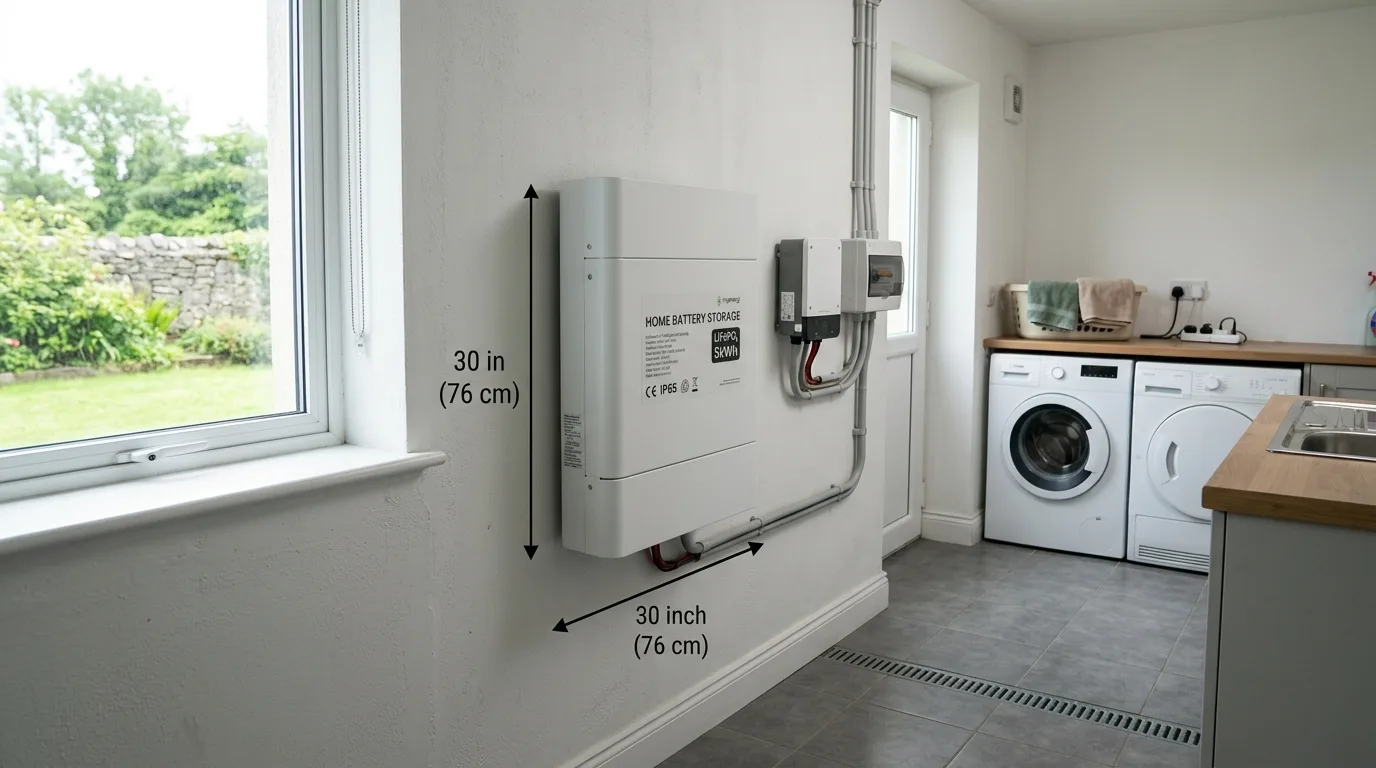
The utility room — that staple of the Irish semi-detached — is the best location for most home batteries. Typically positioned adjacent to the kitchen or near the back of the house, it offers:
- Stable temperature: Interior utility rooms in Irish homes typically maintain 10–18°C year-round — within the optimal operating range for LFP batteries (the industry sweet spot is 10–25°C).
- Proximity to consumer unit: Short cable runs to your distribution board reduce installation cost and energy losses.
- Concrete or block walls: Easy structural fixing for wall-mounted batteries (70–130 kg).
- Separation from sleeping areas: Most building regulations require batteries not to be installed in rooms used for sleeping; utility rooms are explicitly not sleeping areas.
- Adjacent to boiler and meter: Logical connection point for the battery management system.
Fire separation requirement: Irish building regulations (and most battery manufacturers' installation manuals) require the battery to be separated from combustible materials. In a utility room, ensure there's at least 300–600 mm clearance from tumble dryers, wooden shelving, or combustible wall cladding. A plasterboard wall with 12.5 mm board is considered fire-resistant; a bare block wall is ideal.
Space requirement: A typical 10 kWh battery (e.g., GivEnergy 9.5 kWh, 655 × 710 mm) needs approximately 1 m × 1 m of wall space with clearances. Hybrid inverter alongside adds another 500 mm width. Most utility rooms can accommodate this without difficulty.
2. Integral Garage
An integral garage (attached to the house with internal door access) is an excellent alternative, particularly when the utility room is too small.
Advantages:
- Larger wall space available
- Often adjacent to the consumer unit
- Concrete floor and block walls — inherently fire-resistant
- Separate from living areas (meeting fire separation requirements)
Considerations:
- Temperature variation: An unheated garage in Irish winter may drop to 3–8°C. Most LFP batteries operate to -10°C minimum, but efficiency is slightly reduced below 5°C. A simple draught-strip under the internal door usually keeps garages above this threshold.
- If the garage is used for vehicles: ensure adequate clearance from the car and no risk of impact damage to the battery unit.
- Security: ensure the garage is securely locked, as the battery inverter contains accessible settings.
3. Detached Garage or Outbuilding (with IP-rated battery)
For properties without a suitable utility room or integral garage, a detached outbuilding or free-standing garage can work — if the battery is rated for the environment.
IP rating requirements:
- Indoor (IP20 or IP30): GivEnergy modular battery — not suitable for unheated outdoor structures subject to condensation or water ingress.
- Sheltered outdoor (IP55): BYD Battery-Box — suitable for enclosed garages, carports with sides, or outbuildings that remain dry.
- All-weather outdoor (IP65+): Tesla Powerwall 3 (IP67) — suitable for direct outdoor wall mounting in all Irish weather conditions.
For detached garages and outbuildings, BYD Battery-Box (IP55) or Tesla Powerwall 3 (IP67) are the appropriate choices. Standard indoor batteries (GivEnergy, Sonnen indoor models) are not suitable unless the outbuilding is heated and sealed to maintain indoor-like conditions.
Acceptable But Non-Ideal Locations
4. Attic (Generally Not Recommended)
Irish attics experience significant temperature swings:
- Summer: attic temperatures can reach 40–60°C in direct sun with inadequate ventilation — outside most batteries' maximum operating temperature (typically 50–55°C).
- Winter: temperatures can drop to -5°C or below in poorly insulated attics.
Most battery manufacturers explicitly exclude attic installation from their warranty coverage. GivEnergy, BYD, and Sonnen all specify installation temperature ranges that standard Irish attics violate in summer.
Additionally, attics present cable routing challenges, limited wall mounting options (rafters not rated for 70–130 kg loads without additional reinforcement), and accessibility challenges for maintenance.
Verdict: Avoid attic installation unless the attic is fully insulated, heated, and confirmed within the battery's temperature specification.
5. Outdoor Wall (Front or Rear Garden)
Direct outdoor mounting on an exterior house wall is possible for IP65+ batteries (Tesla Powerwall 3, some Huawei LUNA configurations).
Irish outdoor considerations:
- Rain and wind exposure: batteries with IP67 handle this readily
- Temperature: outdoor ambient is typically 2–18°C in Ireland — within LFP operating range
- Direct sunlight: a south-facing outdoor wall can reach 35–40°C in summer sun; mounting on a north or east-facing wall avoids this
- Aesthetics: a large battery unit on a garden or front wall is visible; some local authorities may have views on this
- Security: outdoor units can be more accessible to tampering
Verdict: Acceptable for IP67-rated batteries on sheltered wall positions (north/east facing, under eaves preferred). Not suitable for indoor-only rated batteries.
6. Hotpress (Airing Cupboard)
Some homeowners ask about the hotpress (airing cupboard, usually around the hot water cylinder). Generally not recommended:
- Hotpresses are typically warm (30–40°C) — within battery operating range but at the upper end for continuous operation
- Very limited space: the volume occupied by cylinder, pipes, and shelving leaves little room for a 70+ kg battery
- Adjacent to combustible materials (shelving, clothes airing on the cylinder)
- Cable routing from hotpress to consumer unit often requires running through walls or floors
Verdict: Technically possible in some configurations but not a recommended primary choice. Discuss with your installer.
Practical Requirements for Any Location
Regardless of location, the installation must meet these requirements:
Structural
- Wall fixing: The wall must support the battery's weight (typically 70–130 kg for a 10 kWh unit). Solid masonry (block, brick, concrete) or timber stud with adequate noggins and structural screws. Confirm load-bearing capacity with installer.
Electrical
- Isolation point: A dedicated isolation switch within sight and reach of the battery (required for safe maintenance and emergency shutdown).
- Cable sizing: DC cables between battery and inverter must be correctly sized for the current and distance. Undersized cables create heat and efficiency losses.
- Earthing: The battery enclosure must be connected to the home's protective earth (PE) system — confirmed during ETCI certification.
Fire Safety
- 300–600 mm minimum clearance from combustible materials (wood, cardboard, plastic insulation)
- Not in rooms used for sleeping
- Fire stopping: Any cable routes through walls or floors must be fire-stopped
- Fire-rated door: If the battery is installed in an integral garage, the door between the garage and the house should be a 30-minute fire-rated door (FR30) — this is already required in most Irish building regulations for integral garages
Ventilation
Batteries generate some heat during charging and discharging. Most modern LFP batteries are passively cooled and do not require forced ventilation, but adequate air circulation (natural convection) is important. Avoid boxing the battery in tightly enclosed spaces with no air movement.
Asking Your Installer the Right Questions
Before signing a contract, confirm:
- What is the IP rating of the specified battery, and does it suit my chosen location?
- What is the minimum and maximum operating temperature, and does my location remain within this range year-round?
- What structural fixing method will be used, and is the wall rated for the load?
- Is there a fire-rated wall or adequate clearance between the battery and any combustible materials?
- Will an isolation switch be installed adjacent to the battery?
- Is the installation covered by an ETCI Completion Certificate?
Get 3 free battery storage quotes — free and no obligation.
Frequently asked questions
Can I install a home battery in my attic in Ireland?
Generally no — Irish attics exceed most batteries' maximum operating temperature (50°C+) in summer and fall below minimum operating temperatures in winter. Most manufacturers exclude attic installation from warranty. A utility room or garage is strongly preferred.
Can a home battery be installed outdoors in Ireland?
Only if the battery has an IP65 or higher rating. Tesla Powerwall 3 (IP67) and BYD Battery-Box (IP55) are suitable for sheltered outdoor locations. Indoor-only batteries (GivEnergy modular, IP20) must be installed inside. Outdoor mounting on a north- or east-facing wall under eaves is preferable to avoid direct sun heating.
How heavy is a 10 kWh home battery?
Typically 70–130 kg depending on brand. GivEnergy 9.5 kWh: ~76 kg. Tesla Powerwall 3: 130 kg. Sonnen eco 10: ~90 kg. The installation wall must be structurally capable of supporting this load — solid masonry is ideal; timber stud walls need structural reinforcement.
Does a home battery need to be in a fire-resistant location?
Yes. Installation should include 300–600 mm clearance from combustible materials, should not be in sleeping rooms, and should have fire-stopped cable routes. An ETCI completion certificate confirms compliance with Irish wiring regulations.
Can a battery be installed in an integrated garage in Ireland?
Yes — an integral garage is an excellent battery location, with adequate space, structural walls, and separation from living areas. Ensure the internal door between garage and house is a 30-minute fire-rated door (FR30), as required by most Irish building regulations.