Home Battery Warranties in Ireland: Your Legal Rights Explained
Irish consumers have strong statutory rights under the Sale of Goods and Supply of Services Act and the Consumer Rights Act 2022. Your battery warranty must meet these minimums — and your rights may be stronger than the manufacturer's document suggests.
By Smart Solar Editorial · Updated 15 May 2026 · 7 min read
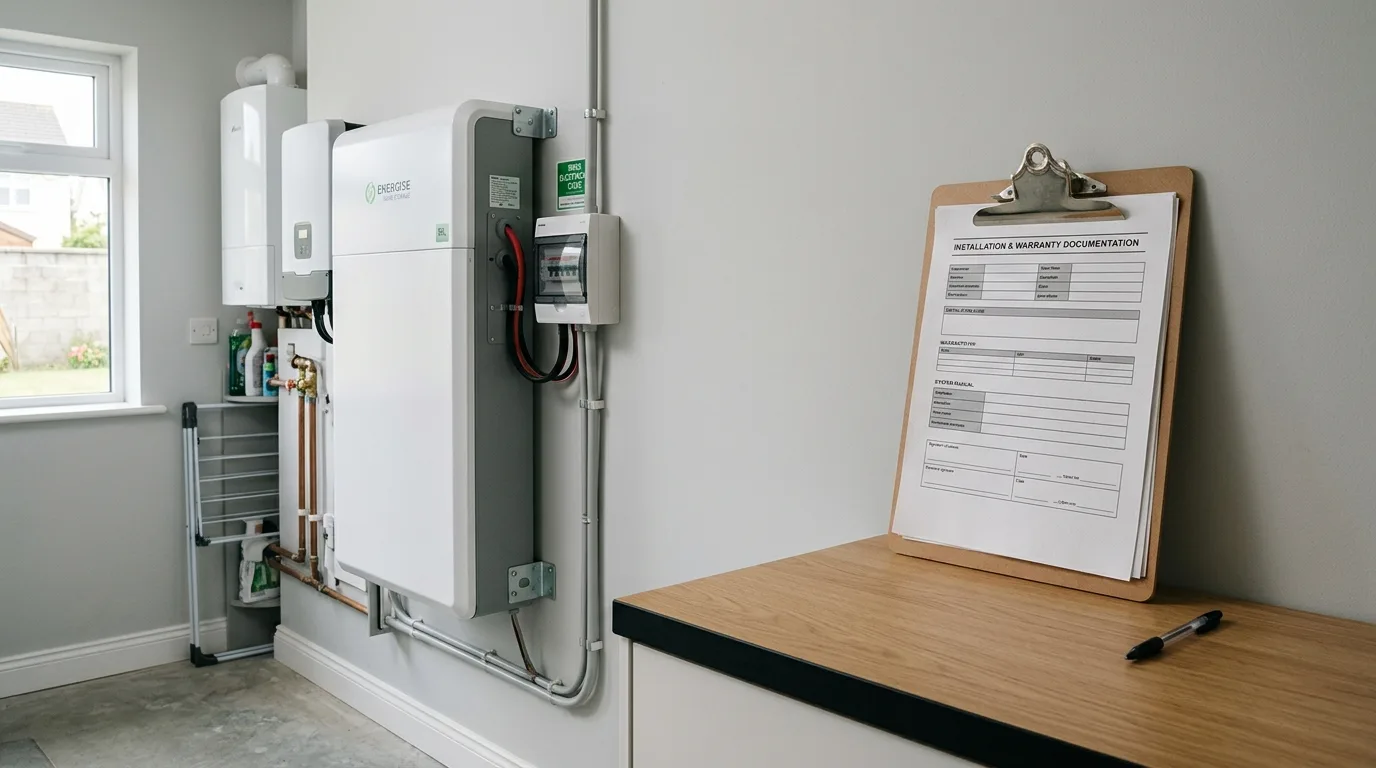
Two Layers of Protection for Irish Battery Buyers
When you purchase a home battery in Ireland, you have two distinct layers of legal protection:
-
The manufacturer's warranty: A voluntary contractual commitment from the battery manufacturer (BYD, GivEnergy, Tesla, etc.) specifying what they'll cover and for how long.
-
Irish statutory rights: Legal rights under the Consumer Rights Act 2022 (which replaced and enhanced the Sale of Goods and Supply of Services Act) that apply regardless of what the manufacturer's warranty says.
Your statutory rights under Irish law are minimum protections — they cannot be watered down by a warranty document. The manufacturer's warranty often provides additional coverage on top of your statutory baseline (cycle life guarantees, for example, go beyond statutory requirements). Understanding both gives you the strongest possible position if something goes wrong.
Statutory Rights Under the Consumer Rights Act 2022
The Consumer Rights Act 2022 (SI 578/2022, implementing EU Directive 2019/771) establishes the following minimum rights for consumers purchasing goods in Ireland:
Two-Year Statutory Guarantee
All goods sold to consumers in Ireland carry a minimum two-year guarantee of conformity. During this period, the seller (your battery installer or retailer) must remedy any lack of conformity (fault or defect) at no cost to you.
"Conformity" means the goods must:
- Match the description and specifications agreed
- Be fit for the purpose for which they are normally used
- Be of the quality you could reasonably expect
- Include all accessories and instructions promised
A battery that fails within two years, or that underperforms materially compared to its specifications, is presumed non-conforming unless the seller can prove otherwise.
Remedies Available
If your battery is non-conforming within the statutory period, you are entitled (in order of priority):
- Repair: The seller must repair the goods free of charge within a reasonable time.
- Replacement: If repair is impossible or disproportionate, you can request replacement.
- Price reduction: If repair/replacement is not possible, you may be entitled to a proportionate price reduction.
- Contract rescission (full refund): In cases of serious non-conformity, you may cancel the contract and receive a full refund.
For battery storage — a significant purchase of €5,500–€15,000 — these are substantial rights.
Who Is the "Seller" for Battery Warranty Purposes?
Your contract is with your installer (the company that sold and installed the battery). Under Irish law, your statutory rights run against the installer, not the manufacturer. The installer is responsible for ensuring the product conforms — they must deal with the manufacturer on your behalf if the battery fails.
This means:
- If your installer goes out of business, your statutory rights technically expire with that contract (though you may have routes against the manufacturer)
- Always choose an installer with a track record of longevity; a one-man-band who might not trade in 5 years provides weaker statutory protection than an established company
The Manufacturer's Warranty: What to Look For
Beyond your two-year statutory minimum, manufacturer warranties provide specific coverage periods and conditions.
Standard Battery Warranties in Ireland (2026)
| Brand | Warranty Period | Warranted Cycles | Capacity Retention |
|---|---|---|---|
| GivEnergy | 10 years | 6,000 | 80% |
| BYD Battery-Box | 10 years | 6,000 | 80% |
| Tesla Powerwall 3 | 10 years | ~3,700 (via MWh) | 70% |
| Sonnen eco | 10 years | 10,000 | 70% |
| Huawei LUNA 2000 | 10 years | 6,000 | 70% |
| Pylontech Force H2 | 10 years | 6,000 | 80% |
| FoxESS | 10 years | 6,000 | 80% |
Key Warranty Terms to Read Carefully
Whichever comes first: Warranties running for "6,000 cycles OR 10 years, whichever comes first" — if you barely use the battery (100 cycles per year), the 10-year calendar term is what limits you, not the cycle count.
Capacity retention threshold: "70% capacity retention" means the warranty covers you if the battery drops below 70% of original capacity within the warranty period. If the battery was 10 kWh and is now holding only 6.8 kWh (68%), that's a valid warranty claim. If it's holding 7.2 kWh (72%), it's within the 70% retention limit — no claim.
Installation requirements: Most warranties require installation by a certified installer, submission of warranty registration, and correct configuration within the manufacturer's guidelines. A battery installed incorrectly (wrong settings, wrong location outside temperature spec, DIY installation) may void the warranty.
Maintenance requirements: Some warranties require annual or biennial inspection/maintenance by a certified technician. Read the small print — this is more common in commercial warranties but can appear in residential terms.
Register your warranty: Most manufacturers require you to register the battery online within 30–90 days of installation. If you don't register, you may default to a shorter warranty period. Ask your installer to complete registration as part of commissioning, or do it yourself immediately after installation.
What Voids a Battery Warranty in Ireland
Installation Issues
- Installation by a non-certified installer
- Installation outside the specified temperature range (e.g., attic installation if manufacturer excludes this)
- Incorrect electrical configuration (wrong voltage, wrong fuse sizing)
- Physical installation location not meeting fire separation requirements (may be argued as non-compliant use)
Usage Issues
- Charging/discharging outside the specified parameters (deeper than warranted DoD, faster than maximum charge rate)
- Using the battery with a non-compatible inverter
- Modifications to the battery's BMS or hardware
- External damage (flood, fire from another cause, vehicle collision)
Neglect Issues
- Not maintaining required inspection intervals (if specified)
- Failing to register the warranty with the manufacturer
Making a Warranty Claim in Ireland
If your battery underperforms within the warranty period:
-
Document the issue: Screenshot your monitoring data showing the performance problem. Record the battery's stated capacity vs measured capacity. Note dates and conditions.
-
Contact your installer first: Your contract is with the installer. Give them the opportunity to diagnose and resolve the issue. Most legitimate installers will engage promptly — a warranty claim reflects on their installer certification with the manufacturer.
-
Contact the manufacturer's Irish distributor: If your installer is unresponsive or has ceased trading, contact the manufacturer's UK/Ireland distributor directly. Most major brands have accessible warranty claim processes.
-
Escalate to the Competition and Consumer Protection Commission (CCPC): If you cannot resolve the issue with the installer or manufacturer, the CCPC can provide guidance and, for traders not engaging in good faith, enforcement mechanisms.
-
Small Claims Court: For disputes up to €2,000, the Small Claims Court is available as a low-cost dispute resolution mechanism. For larger amounts, the District Court or Circuit Court may be appropriate.
Choosing an Installer for Warranty Security
The warranty is only as strong as the company behind it. Consider:
- Manufacturer certification: Is the installer certified by the battery manufacturer? Certified installers typically have direct warranty resolution pathways.
- Company longevity: A company trading for 5+ years with an established customer base is more likely to be around to handle your year-7 warranty claim than a startup or sole trader.
- Written warranty terms in the contract: The installer's contract should explicitly reference the battery's warranty and confirm their responsibility to facilitate warranty claims.
- Irish-registered company: Pursuing warranty claims against a foreign-registered company (UK or EU) is more complex under Irish law. Prefer Irish-registered installers.
Warranty and Building Energy Rating (BER)
Solar PV systems improve your home's BER rating. A battery's contribution to BER is not currently quantified in the SEAI BER methodology (as of 2026), though this may change. The warranty affects future buyers: if you sell your home before the battery warranty expires, the remaining warranty transfers to the new owner — a selling point worth highlighting.
Get 3 free battery storage quotes — free and no obligation.
Frequently asked questions
How long is an Irish consumer legally protected when buying a home battery?
Two years of statutory protection under the Consumer Rights Act 2022 — this is the minimum, enforceable against the installer regardless of what any manufacturer warranty document says. Most battery manufacturers additionally provide 10-year warranties covering cycle life and capacity retention.
What is a warranty claim on a home battery?
If your battery loses capacity below the warranted retention level (e.g., below 80% of original capacity) within the warranty period, you can make a claim for repair or replacement at no cost. Document the issue with monitoring data and contact your installer first.
Does my battery warranty transfer if I sell my house?
Generally yes — manufacturer warranties on home batteries are attached to the battery unit, not the original owner. The remaining warranty period transfers to the new homeowner. Confirm this with the specific manufacturer's warranty terms.
What voids a home battery warranty in Ireland?
Common warranty voiders include: DIY or uncertified installation, installation in an environment outside the temperature specification, physical damage, modification of the BMS, use with an incompatible inverter, and failure to register the warranty with the manufacturer within the required timeframe.
What do I do if my installer goes out of business and my battery is under warranty?
Contact the manufacturer's Irish or UK distributor directly — most major brands have direct warranty processes for when the original installer is no longer trading. Your statutory rights (two years) technically run against the seller/installer, but manufacturer warranties often have direct-to-consumer claims processes for exactly this scenario.