Battery Depth of Discharge and Cycle Life: What Irish Buyers Must Know
Depth of discharge and cycle life are the two specs that determine how long your battery investment lasts. Here's what they mean and what to look for in 2026.
By Smart Solar Editorial · Updated 15 May 2026 · 8 min read
Why Cycle Life and DoD Are Your Most Important Battery Specs
When you spend €5,500–€8,500 on a home battery in Ireland, you want it to last. Two specifications determine almost everything about your battery's longevity and long-term value: depth of discharge (DoD) and cycle life. Yet these are the specs most buyers pay the least attention to, focusing instead on brand name or price.
This guide explains both clearly and shows you how to use them to compare batteries properly.
What Is Depth of Discharge (DoD)?
Depth of discharge is the percentage of a battery's total capacity that is used in a single cycle before recharging. A battery discharged from 100% to 20% state of charge (SoC) has been discharged to an 80% DoD.
Why DoD Matters
Lithium battery cells degrade with use. Each time the cell's chemistry undergoes a charge/discharge cycle, the electrodes experience minor structural stress. Deeper cycles — using more of the cell's capacity — create more stress per cycle.
This is why manufacturers specify a maximum recommended DoD: they're telling you how deeply you can discharge without accelerating degradation beyond their warranty assumptions.
Typical DoD Values in 2026
| Battery | Maximum DoD | Usable Capacity (10 kWh gross) |
|---|---|---|
| BYD Battery-Box Premium LFP | 100% | 10.0 kWh |
| GivEnergy residential | 100% | 9.5 kWh (9.5 kWh gross) |
| Huawei LUNA 2000 | 100% | 10.0 kWh |
| Tesla Powerwall 3 | 100% | 13.5 kWh |
| Sonnen eco | 100% | 10.0 kWh |
| Pylontech US5000 | 90% | 4.56 kWh (5.12 kWh gross) |
Modern LFP batteries increasingly offer 100% DoD — meaning the manufacturer is confident enough in their battery management system (BMS) to allow full depth cycling within warranty. This is a significant advantage over older NMC systems that capped DoD at 80–85%.
Practical Effect of DoD on Your Energy Bill
If two batteries cost the same per kWh of gross capacity but one allows 100% DoD and the other 80% DoD, the 100% DoD battery delivers 25% more usable energy per cycle. Over a year of daily cycling, that's 25% more electricity supplied from storage rather than the grid — a meaningful difference to your bill.
What Is Cycle Life?
Cycle life is the number of complete charge/discharge cycles a battery can perform before its capacity degrades to a specified end-of-life threshold — usually 80% of original capacity (also called 80% capacity retention).
A battery warranted for 6,000 cycles to 80% capacity means that after 6,000 full cycles, it is guaranteed to still hold at least 8 kWh of its original 10 kWh.
Cycles Per Year in Irish Use Cases
| Use Pattern | Cycles per Day | Cycles per Year |
|---|---|---|
| Solar self-consumption (summer heavy) | ~0.8 | ~290 |
| Night-rate arbitrage (year-round) | ~1.0 | ~365 |
| Solar + arbitrage combined | ~1.2–1.5 | ~440–550 |
| Backup only (rare cycling) | ~0.1 | ~35 |
For most Irish homeowners doing solar self-consumption plus night-rate arbitrage, one full cycle per day is a reasonable assumption — meaning approximately 365 cycles per year.
What Cycle Life Means in Years
| Warranted Cycle Life | @ 365 cycles/yr | @ 500 cycles/yr |
|---|---|---|
| 3,000 cycles | 8.2 years | 6.0 years |
| 4,000 cycles | 11.0 years | 8.0 years |
| 6,000 cycles | 16.4 years | 12.0 years |
The difference between a 3,000-cycle NMC battery and a 6,000-cycle LFP battery is potentially 5–8 years of additional service life when cycling daily.
The Warranty Is the Contract — Read It Carefully
Manufacturers express their longevity guarantee through the warranty. Most home batteries carry a dual warranty: cycle life AND calendar years, with the battery being replaced if either limit is reached first.
A typical warranty reads: "6,000 cycles or 10 years, whichever comes first, with 70% capacity retention."
The "whichever comes first" clause is critical. If you only use your battery occasionally (100 cycles per year for backup use), the 10-year calendar limit will expire long before 6,000 cycles. Conversely, if you cycle twice per day, you'll hit 6,000 cycles in 8.2 years and the calendar warranty hasn't expired.
Capacity Retention vs Throughput Guarantees
Some manufacturers (notably Tesla) also express their warranty as a total energy throughput in MWh:
- Tesla Powerwall 3: 13.5 kWh × ~3,700 cycles = ~50 MWh warranted throughput
- GivEnergy 9.5 kWh (6,000 cycles): 9.5 × 6,000 = 57 MWh
Higher throughput means more total electricity you can move through the battery within warranty — useful for comparing systems with different capacities.
How Temperature Affects Cycle Life
Cycle life is specified at a standard temperature, typically 25°C. In reality:
- High temperatures (>35°C) accelerate degradation — each 10°C increase roughly doubles the rate of capacity fade.
- Low temperatures (<5°C) temporarily reduce available capacity but do not permanently damage LFP cells.
- Irish conditions (5–20°C in utility rooms year-round) are near-ideal for LFP longevity. Our cool climate is a genuine advantage for battery lifespan.
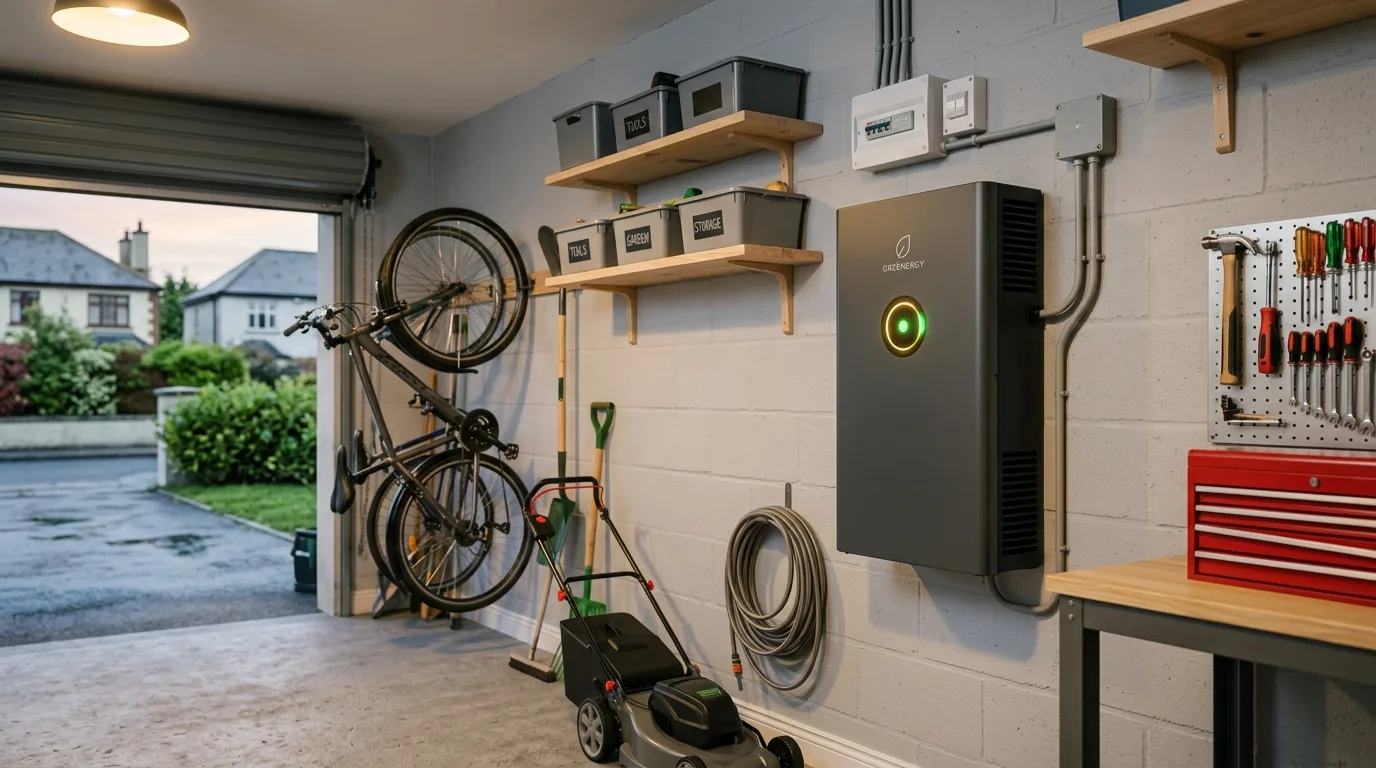
For this reason, avoid installing batteries in uninsulated south-facing sheds or in spaces that can exceed 35°C in summer. A north-facing utility room or interior garage wall is ideal.
Partial Cycling and Its Effect on Degradation
Not every cycle is a full 100% DoD cycle. On a sunny summer day, your battery might only cycle 40% (charge from solar, discharge to 60% SoC, then sit). Partial cycles are gentler on cells.
Most manufacturers use the "full equivalent cycle" (FEC) concept in their BMS. Three 33% cycles count as one FEC. This means the 6,000-cycle warranty accounts for partial cycling — it's not counting every small charge/discharge event as a full cycle.
Calculating the True Cost Per kWh of Storage
You can use cycle life and DoD to calculate the true levelised cost of storage (LCOS):
LCOS = Battery cost ÷ (Usable kWh × Warranted cycles)
Example for a 10 kWh LFP battery at €7,000 installed, 100% DoD, 6,000 cycles:
LCOS = €7,000 ÷ (10 × 6,000) = €7,000 ÷ 60,000 = €0.117 per kWh stored
If you're arbitraging night-rate electricity at 6.5 c/kWh and selling to yourself at the avoided peak rate of 38 c/kWh, your gross margin per kWh is 31.5 c. Your LCOS of 11.7 c leaves a net margin of 19.8 c/kWh — a positive economics case.
What to Look For When Comparing Battery Quotes
- Usable kWh (not gross) — confirm the DoD assumed
- Warranted cycles — 6,000 is the current benchmark for quality LFP
- Calendar warranty — 10 years minimum
- Capacity retention at end of warranty — 70% minimum, 80% better
- Total warranted throughput (MWh) — allows apples-to-apples comparison across sizes
- Temperature operating range — confirm the installation location stays within spec
Get 3 free battery storage quotes — free and no obligation.
Frequently asked questions
What depth of discharge should I set my battery to in Ireland?
For daily cycling with a modern LFP battery, 90–100% DoD is fine and is what manufacturers intend. Setting a conservative limit (e.g., discharge to 10% SoC) is unnecessary with LFP and simply reduces your usable capacity. For backup purposes, keeping a 20% reserve makes sense.
How many cycles does a home battery last in Ireland?
Quality LFP batteries are warranted for 4,000–6,000 cycles. At one cycle per day (typical for solar + night-rate use), that's 11–16 years. In Ireland's mild climate, real-world longevity often exceeds the warranty figure.
Does a battery lose capacity every cycle?
Yes, but very slowly. A quality LFP battery might lose 2–3% of total capacity per 1,000 cycles. After 3,000 cycles you'd have roughly 94–96% of original capacity remaining — well above the 80% end-of-life threshold most warranties specify.
What happens when my battery warranty expires?
The battery doesn't stop working — it simply falls outside the manufacturer's replacement guarantee. At 80% capacity retention, a 10 kWh battery would deliver 8 kWh of usable energy. Many homeowners continue using batteries for years beyond warranty at reduced but still useful capacity.
Is cycling twice per day bad for a battery?
Not inherently, as long as you stay within the warranted cycle count. Some manufacturers (e.g., BYD, Huawei) explicitly support two cycles per day in their warranty terms, which is useful for homes doing both solar self-consumption and night-rate arbitrage.