How Home Battery Storage Works in Ireland (2026 Guide)
A plain-English guide to home battery storage for Irish homeowners: how electricity is stored, when it charges, and how it saves you money on your ESB bill.
By Smart Solar Editorial · Updated 15 May 2026 · 8 min read
What Is a Home Battery Storage System?
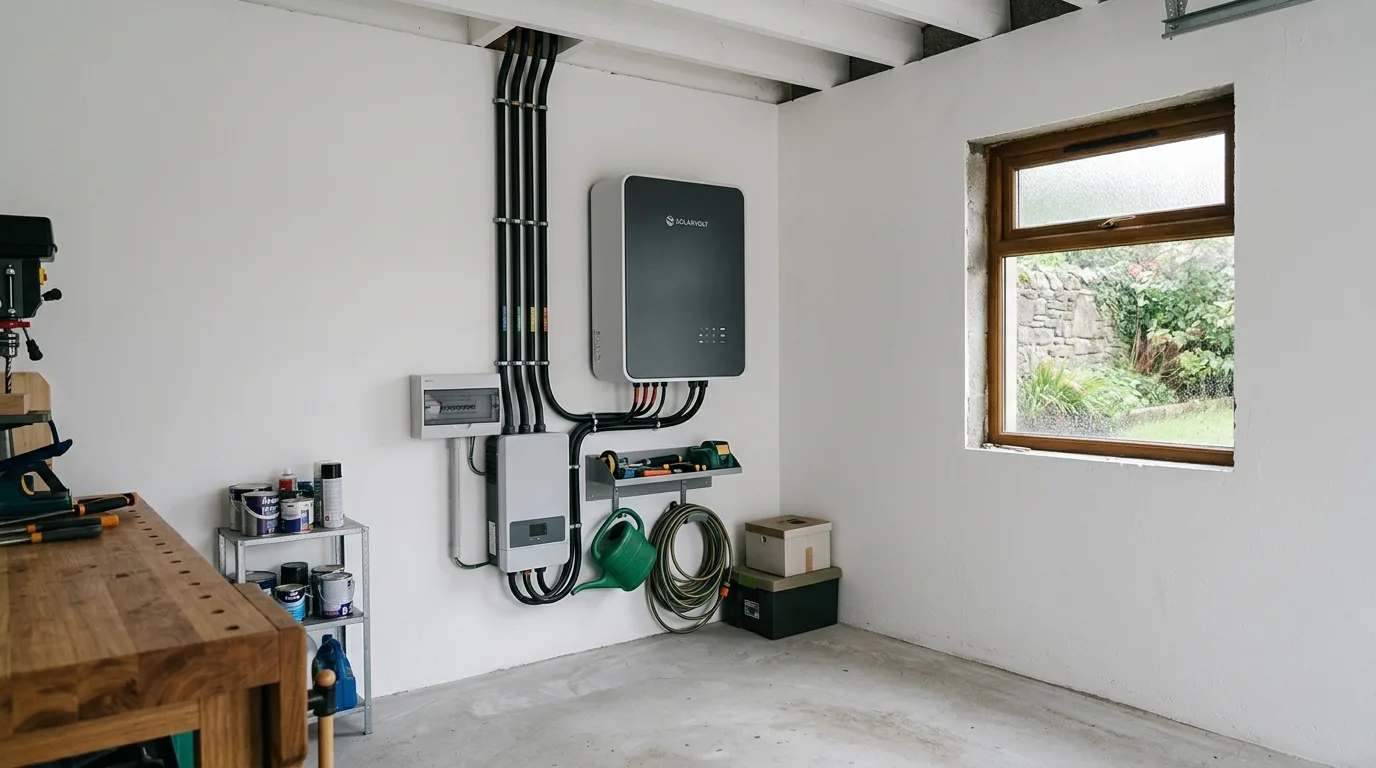
A home battery storage system is a rechargeable unit — typically mounted on a wall in your garage, utility room, or attic — that stores electrical energy and releases it on demand. In Ireland, most homeowners install batteries alongside solar PV panels, but a growing number are adding them as standalone units to exploit cheap night-rate electricity from smart tariffs.
At its core, a battery system consists of three components:
- The battery module — lithium cells (usually lithium iron phosphate, or LFP) packaged inside a weatherproof enclosure.
- The inverter/charger — converts DC energy stored in the cells to the 230 V AC your appliances use, and vice versa.
- The energy management system (EMS) — software that decides when to charge, when to discharge, and when to import or export to the grid.
How Does a Home Battery Charge?
From Solar Panels
When your solar panels produce more electricity than your home is using at that moment, the surplus would normally be exported to the grid. With a battery connected, the EMS diverts that surplus into the battery first. Only once the battery is full does excess energy flow to the grid under the Microgeneration Support Scheme (MSS) at roughly 18–21 c/kWh.
From the Grid (Night-Rate Arbitrage)
If you're on a smart tariff such as Electric Ireland's Smart Plan, you can set the battery to charge during the cheap off-peak window — typically 02:00–04:00 at around 6.5 c/kWh — and then discharge during peak daytime hours when electricity costs 35–45 c/kWh. The difference, roughly 28–38 c per kWh cycled, funds your payback.
How the Battery Discharges
When your home demands power — kettles, ovens, TVs, EV chargers — the EMS checks the battery state of charge (SoC) first. If there's stored energy available, it supplies the load from the battery rather than drawing from the grid. Most systems are configured to maintain a small reserve (often 10–20%) so you always have emergency backup capacity.
On-Grid vs Off-Grid Operation
Almost all Irish residential batteries are grid-tied. They work alongside your normal ESB Networks connection. You keep your grid supply as a backup and for heavy loads, but reduce how much you draw from it.
Fully off-grid systems do exist but are rare in Ireland — they require much larger battery banks and a backup generator, and you lose the ability to export under the MSS. Unless you're in a genuinely remote location without a grid connection, off-grid is rarely the right choice.
The Inverter: The Brain of Your Battery
Hybrid Inverter
If you're installing solar and a battery at the same time, a hybrid inverter handles both. It accepts DC power directly from the panels, charges the battery in DC, and inverts only what the house needs to AC. This is more efficient because it avoids unnecessary DC-to-AC-to-DC conversion losses.
Popular hybrid inverters in Ireland include the Solis S6, FoxESS T-Series, and GivEnergy's AIO (All-in-One).
AC-Coupled Battery
If you already have a solar PV system with a standard string inverter, an AC-coupled battery can be retrofitted. The battery has its own bidirectional inverter and connects at the AC distribution board. There's a slight efficiency penalty because the solar energy is converted DC→AC by the existing inverter, then AC→DC to charge the battery, then DC→AC again to supply the house. Round-trip losses add up to roughly 8–12% versus 5–8% for a hybrid setup.
Tesla Powerwall 3 and Sonnen eco use AC coupling and are popular retrofit choices in Ireland.
What Size Battery Do Irish Homes Need?
A typical semi-detached Irish home uses 4,000–5,500 kWh per year, or roughly 11–15 kWh per day. A 10 kWh battery covers most of that daily demand when combined with daytime solar generation. Most installers recommend 5–15 kWh for residential use.
For homes with electric heating, heat pumps, or EV charging, 10–15 kWh or a stackable system (two 5 kWh modules) makes more sense.
Grid Connection and Metering
Before commissioning a battery in Ireland, your installer must notify ESB Networks under the NC6 standard (for systems up to 11 kW inverter output). ESB Networks will assess whether your local transformer can handle the potential export. In some rural areas with weak network infrastructure, export may be limited or curtailed. Always confirm your grid connection capacity before sizing your inverter.
Your meter must also be upgraded to a smart meter if you haven't already. ESB Networks has been rolling out smart meters (ESBN Smart Meter) nationwide; as of 2026 the majority of homes have been upgraded. Smart meters allow half-hourly interval data, which enables time-of-use tariffs and accurate MSS export settlements.
How Long Do Home Batteries Last?
Modern LFP batteries are warranted for 4,000–6,000 full cycles — equivalent to roughly 10–15 years of daily cycling. At end of warranty, most batteries still hold 70–80% of their original capacity. NMC chemistry (used in older Tesla Powerwalls and some BYD units) degrades somewhat faster, especially in high-temperature environments.
Irish conditions — mild, rarely above 25°C — are actually ideal for battery longevity. Extreme heat is the primary enemy of lithium cells, so our climate gives Irish homeowners a natural advantage.
Safety Standards in Ireland
All batteries sold in Ireland must comply with IEC 62619 (safety requirements for secondary lithium cells) and installation must follow ETCI Wiring Regulations (IS 10101/HD 60364). Reputable installers will also follow the manufacturer's installation manual and ensure the unit has adequate ventilation and fire separation from combustible materials.
Lithium iron phosphate (LFP) chemistry is intrinsically safer than NMC — it does not undergo thermal runaway as readily. This is one reason it has become the dominant chemistry for home storage in Ireland and across Europe.
The Bottom Line
A home battery storage system in Ireland works by capturing cheap or free electricity — from solar panels or night-rate tariffs — and making it available when grid electricity is most expensive. Paired with a smart tariff and solar PV, a well-sized 10 kWh battery can cut your annual electricity bill by €700–€1,200 depending on usage patterns. Understanding the basics of how your system charges, discharges, and connects to the grid puts you in the best position to maximise those savings.
Get 3 free battery storage quotes — free and no obligation.
Frequently asked questions
Can a home battery work without solar panels in Ireland?
Yes. A standalone battery charges from the grid during cheap night-rate windows (e.g., 02:00–04:00 at ~6.5 c/kWh on Electric Ireland's Smart Plan) and discharges during expensive peak hours. Payback is slower than with solar but still viable, typically 10–14 years for a 10 kWh unit.
Does ESB Networks need to approve my battery installation?
Yes. Your installer must submit a G98/NC6 notification to ESB Networks before commissioning any grid-connected battery system. For systems up to 11 kW inverter output this is typically a straightforward notification, but ESB Networks may impose export limits in areas with weak grid infrastructure.
What happens to my battery during a power cut?
Standard grid-tied batteries go offline during a power cut for safety reasons (to protect ESB linesmen). Batteries with a backup or 'island mode' feature — such as Tesla Powerwall 3, GivEnergy AIO, and Sonnen — can disconnect from the grid and power your home independently during an outage.
How long does a home battery installation take?
A typical residential battery installation takes one day (4–8 hours). If it's a solar-and-battery combined installation, allow 1–2 days. Your installer must notify ESB Networks, which can take a few weeks to process — plan accordingly.
Is a home battery worth it in Ireland in 2026?
For homes with solar PV, yes — batteries typically add €700–€1,200 per year in savings and have payback periods of 6–10 years. For standalone battery use (night-rate arbitrage only), payback is longer at 10–14 years but the economics improve as electricity prices rise.
Sources & further reading
- Microgeneration Support Scheme — SEAI — SEAI
- NC6 Notification Process — ESB Networks — ESB Networks
- Smart Meter Rollout — ESB Networks — ESB Networks