Hybrid vs AC-Coupled Battery in Ireland: Which Is Right for You?
Hybrid (DC-coupled) and AC-coupled batteries work differently and suit different situations. For new solar installations, hybrid usually wins. For retrofits, AC coupling is often the better choice.
By Smart Solar Editorial · Updated 15 May 2026 · 8 min read
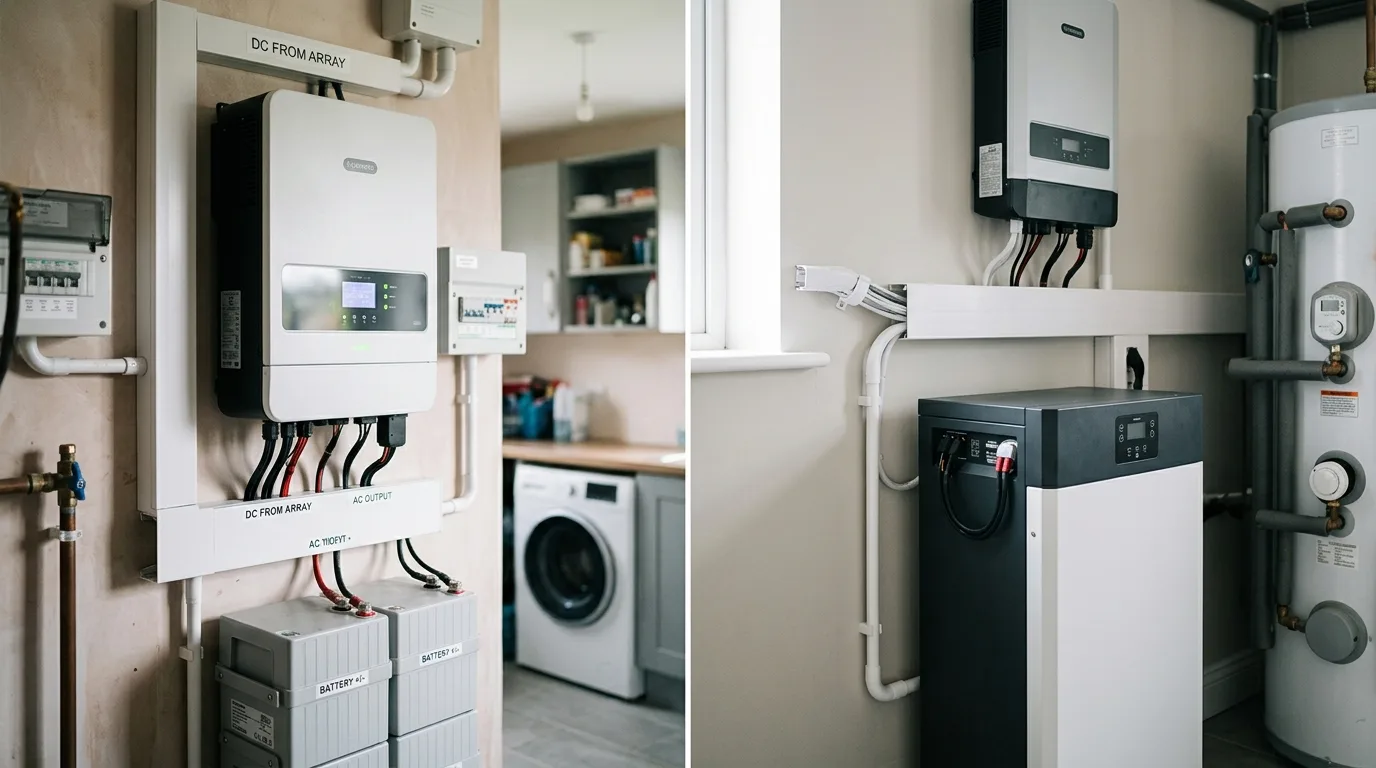
The Core Difference: Where the Battery Connects
When you install a solar+battery system, the battery can connect to your system in two fundamentally different ways. This choice affects efficiency, cost, installation complexity, and what batteries you can choose. Understanding it properly will help you ask the right questions when getting quotes.
DC-coupled (hybrid): The battery connects to the DC bus — between the solar panels and the inverter. Solar energy flows directly into the battery as DC, then exits as DC to the inverter which converts it to AC for your home. Only one conversion happens: DC → AC at the inverter stage.
AC-coupled: The battery connects to the AC side — after the existing inverter, at your distribution board. Solar energy is first converted to AC by the solar inverter, then converted back to DC to charge the battery, then converted to AC again to power your home. Three conversions happen.
The Efficiency Difference
Each DC-AC or AC-DC conversion has losses — typically 2–4% per stage. More conversions = more losses.
| System Type | Energy Conversions (Solar→House via Battery) | Approximate RTE |
|---|---|---|
| DC-coupled hybrid | 1 (DC→AC at hybrid inverter) | 93–97% |
| AC-coupled | 3 (DC→AC, AC→DC, DC→AC) | 85–93% |
Over a year at one cycle per day with a 10 kWh battery:
- DC-coupled at 95% RTE: delivers 3,468 kWh of usable energy per year
- AC-coupled at 88% RTE: delivers 3,212 kWh per year
- Difference: 256 kWh/year, worth approximately €102/year at 40 c/kWh avoided import
Over 15 years, the efficiency advantage of DC coupling is worth approximately €1,530 in additional savings — meaningful but not decisive.
Scenario 1: New Solar + Battery Installation
Recommendation: DC-coupled hybrid
When installing solar and battery together from scratch, a hybrid inverter is almost always the better choice. Here's why:
- Efficiency: The 5–10% efficiency advantage compounds over years.
- Cost: One hybrid inverter replaces both the solar inverter and battery inverter — total equipment cost is often lower than buying a separate string inverter plus AC-coupled battery inverter.
- Simplicity: One device to monitor, maintain, and configure.
- SEAI grant compatibility: The hybrid inverter qualifies as the solar inverter under the SEAI Solar Electricity Grant (up to €2,400).
- Space: One wall-mounted unit vs two.
Popular hybrid inverter options in Ireland for new installations:
- Solis S6 + BYD Battery-Box — best value
- GivEnergy AIO — best all-in-one
- Huawei SUN2000 + LUNA 2000 — premium ecosystem
- Fronius Primo GEN24 + BYD HVS — best monitoring
Scenario 2: Retrofitting a Battery to Existing Solar
Recommendation: AC-coupled battery (usually)
If you already have a solar PV system with a standard string inverter (fitted before 2022 when hybrids became widespread), you have two options for adding battery storage:
Option A: AC-Coupled Battery (Retrofit)
Add an AC-coupled battery (Tesla Powerwall 3, Sonnen eco, or a dedicated AC battery inverter + LFP pack) to your existing system. The battery connects at your distribution board, independent of the existing inverter.
Advantages:
- No changes to existing solar inverter or panels
- Compatible with any existing inverter brand
- Simpler installation (electrician adds battery circuit; no re-wiring of solar)
- Fast installation (1 day)
- Best choice when existing inverter is working well and under warranty
Disadvantages:
- Lower round-trip efficiency (85–93%)
- Two separate systems to monitor (solar inverter app + battery app)
- Battery inverter adds a separate cost
Popular AC-coupled retrofit batteries in Ireland:
- Tesla Powerwall 3 — all-in-one, seamless, expensive
- Sonnen eco — all-in-one, premium quality
- SolarEdge Home Battery — works with existing SolarEdge inverter
Option B: Replace Inverter with Hybrid (DC-Coupled Retrofit)
Replace the existing string inverter with a new hybrid inverter and reconnect the panels to it. Then add a DC-coupled battery.
Advantages:
- Higher efficiency (94–97% RTE)
- Single integrated monitoring platform
- Future-proof: one system handles solar, battery, EV charging management
Disadvantages:
- Higher cost: lose existing inverter (even if under warranty), buy new hybrid inverter
- More installation work: panels need re-wiring to new inverter's MPPT inputs
- Typically costs €2,000–€4,000 more than simple AC-coupling
When to consider: The existing inverter is at or near end of life (typically 10–15 years), or you want to add significantly more solar capacity alongside the battery.
The Third Option: Hybrid Retrofit with AC-Coupled Battery
Some newer AC-coupled battery inverters can "communicate" with the existing solar inverter to provide a pseudo-DC-coupled experience. Tesla Powerwall 3 uses this approach — it monitors the solar output via CT clamps and adjusts its charging to match, effectively acting as if it were solar-aware.
This hybrid approach doesn't fully recover the DC-coupling efficiency advantage but can improve on the basic 3-conversion AC-coupled system through smarter energy routing.
Making the Decision: A Decision Tree
Question 1: Are you installing solar for the first time?
- YES → Choose DC-coupled hybrid. Strong recommendation.
- NO → Go to Question 2.
Question 2: How old is your existing solar inverter?
- Less than 5 years old, working well → AC-coupled retrofit. Don't waste the existing inverter.
- 8–12 years old (approaching end of life) → Consider replacing with hybrid inverter.
- Over 12 years old (likely needs replacing soon) → Replace with hybrid inverter and add DC-coupled battery.
Question 3: How important is maximum efficiency to you?
- Efficiency is a top priority → DC-coupled hybrid (new or replacement inverter).
- Economics and simplicity matter more → AC-coupled retrofit is fine; the 5% efficiency difference costs about €100/year.
Question 4: Do you need whole-home backup at high power?
- YES → Consider Tesla Powerwall 3 (AC-coupled, 11.5 kW continuous backup).
- NO → Either type works; DC-coupled hybrid has more backup power options.
Cost Comparison for a Typical Irish Installation
Scenario: 4 kWp existing solar + adding 10 kWh battery
| Approach | Equipment | Installation | Total |
|---|---|---|---|
| AC-coupled battery (Tesla PW3) | Battery: €9,500 | €1,500 | ~€11,000 |
| AC-coupled (generic LFP + AC inverter) | Battery + inverter: €5,500 | €1,200 | ~€6,700 |
| Replace inverter + DC battery | Hybrid inverter: €1,500, Battery: €3,000 | €2,000 | ~€6,500 |
In this scenario, replacing the existing inverter with a hybrid is cost-competitive with AC coupling — and delivers 5–10% better efficiency. The decision often comes down to whether the existing inverter is worth keeping.
Summary Table
| Factor | DC-Coupled Hybrid | AC-Coupled |
|---|---|---|
| Best for | New installations | Retrofit to existing solar |
| Round-trip efficiency | 93–97% | 85–93% |
| Installation complexity | Moderate (one system) | Lower (add-on) |
| Cost (new install) | Lower (shared inverter) | Higher (extra inverter) |
| Cost (retrofit) | Higher (replace inverter) | Lower (keep existing) |
| Battery choice | Wider (any DC-compatible) | Limited to AC batteries |
| Monitoring | Unified | Two separate systems |
| Backup power | Configurable | Some options (Tesla, Sonnen) |
Get 3 free battery storage quotes — free and no obligation.
Frequently asked questions
Is a hybrid or AC-coupled battery better for Irish homes?
For new solar+battery installations: hybrid (DC-coupled) is better — higher efficiency, lower cost, unified monitoring. For retrofitting to existing solar: AC-coupled is usually simpler and more cost-effective unless the existing inverter is near end of life.
How much does the efficiency difference actually cost?
Approximately €80–€120 per year for a 10 kWh battery cycling daily. Over 15 years, the AC-coupled system costs roughly €1,200–€1,800 more in electricity imports due to conversion losses. Significant, but not decisive if the AC coupling avoids the cost of replacing a working inverter.
Can I retrofit a DC-coupled battery to my existing solar?
Yes, by replacing the existing inverter with a hybrid inverter. This costs €1,500–€2,500 extra (inverter replacement) but gives you the efficiency and monitoring benefits of a DC-coupled system. Worthwhile if the existing inverter is more than 8 years old.
Is Tesla Powerwall DC or AC-coupled?
Tesla Powerwall 3 is AC-coupled for retrofit use (it has a built-in AC/DC inverter) but also functions as an all-in-one solar inverter for new installations via its integrated solar inputs. For retrofit, it's AC-coupled. For new solar installations, it's a hybrid.
Does the SEAI grant apply to both hybrid and AC-coupled systems?
Yes. The SEAI Solar Electricity Grant covers the solar inverter as part of a new solar installation, regardless of whether it's a hybrid or standard string inverter. The battery is not separately grant-funded in either case.
Sources & further reading
- SEAI Solar Electricity Grant — SEAI
- ESB Networks — Micro-generation NC6 — ESB Networks
- CRU — Electricity Market and Smart Metering — CRU