Tesla Powerwall 3 Review Ireland: Is It Worth the Premium in 2026?
Tesla Powerwall 3 is the most capable home battery available in Ireland — but at €12,000–€15,000 installed, it costs nearly twice as much as comparable LFP systems. We assess whether the premium is justified.
By Smart Solar Editorial · Updated 15 May 2026 · 9 min read
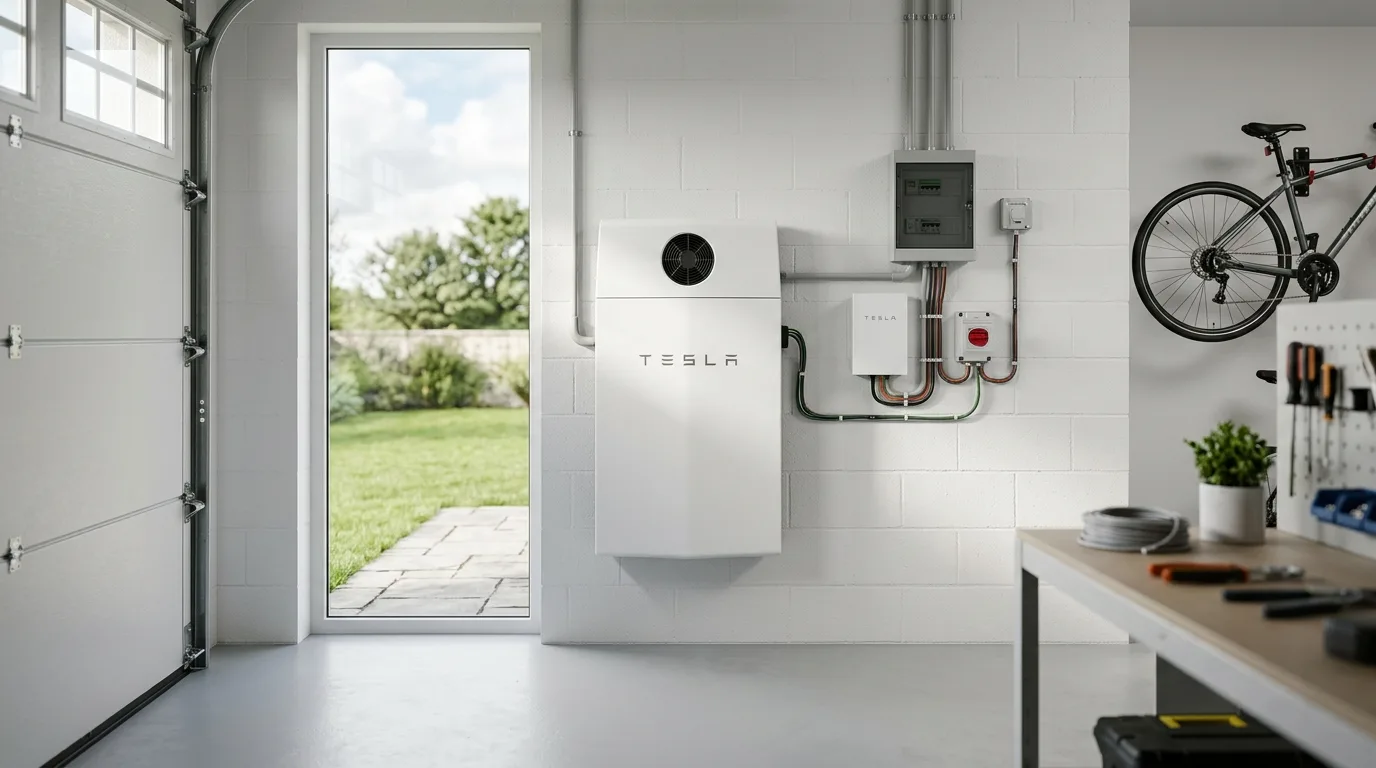
Tesla Powerwall 3: The Benchmark in Irish Home Storage
When Irish homeowners think of home batteries, Tesla Powerwall is often the first name that comes to mind. Tesla's brand recognition, vertical integration, and the sheer capability of the Powerwall 3 make it a genuine category leader — but also one of the most expensive options on the market.
This review assesses the Powerwall 3 honestly for Irish conditions in 2026: what it does exceptionally well, where it falls short, and whether the price premium is justified versus strong competitors like GivEnergy, BYD, and Huawei LUNA.
Specification Overview
| Specification | Tesla Powerwall 3 |
|---|---|
| Usable capacity | 13.5 kWh |
| Continuous power | 11.5 kW |
| Peak power | 22 kW (10 seconds) |
| Round-trip efficiency | 97.5% (claimed) |
| Chemistry | LFP (lithium iron phosphate) |
| Backup capability | Yes — whole-home backup |
| Solar inverter | Integrated hybrid (up to 6 strings) |
| Warranty | 10 years, 70% capacity retention |
| Warranty throughput | ~50 MWh |
| Operating temperature | -20°C to 50°C |
| Dimensions | 1,100 × 609 × 193 mm |
| Weight | 130 kg |
| IP rating | IP67 (indoor or outdoor) |
What's New in Powerwall 3 vs Powerwall 2
Tesla launched the Powerwall 3 internationally in 2024 and it became widely available in Ireland through 2024–2025. Key changes from Powerwall 2:
-
Integrated solar inverter: Powerwall 3 includes a built-in hybrid solar inverter supporting up to 6 independent MPPT strings. There is no need for a separate solar inverter, simplifying installation and reducing cost for new solar+battery setups.
-
Chemistry switch to LFP: Powerwall 2 used NMC chemistry. Powerwall 3 switched to LFP — safer, more thermally stable, and better suited to daily cycling.
-
Higher power output: Powerwall 3 delivers 11.5 kW continuous (vs 5 kW in Powerwall 2), enabling it to supply virtually any residential load including heat pumps, EV chargers, and electric cookers.
-
Superior backup: The 22 kW peak output can start even large motor loads during backup mode.
-
Higher efficiency: 97.5% vs ~90% RTE for Powerwall 2 — a significant improvement that narrows the efficiency gap with DC-coupled competitors.
Performance in Irish Conditions
Energy Storage
At 13.5 kWh usable, Powerwall 3 is 35% larger than the standard 10 kWh Irish battery. For a typical Irish semi-detached using 12–15 kWh/day, this means the Powerwall can supply 90%+ of daily demand from storage alone on a good solar day — essentially eliminating evening and morning grid imports.
The larger capacity also means more night-rate arbitrage per cycle: at 6.5 c/kWh night rate and 40 c/kWh avoided import, 13.5 kWh yields roughly €4.29/day savings from arbitrage — versus ~€3.18/day for a 10 kWh battery.
Backup Power
The 11.5 kW continuous backup is the Powerwall 3's most distinctive feature in the Irish market. It can power:
- Heat pump + EV charger simultaneously
- Full house during outages
- Electric oven or shower (briefly — within the continuous power rating)
No other mainstream home battery in Ireland matches this continuous power rating. Sonnen eco tops out at 3.3 kW; GivEnergy AIO at 3.6–6 kW. For homes with high-power loads, Powerwall 3 is the only option that provides whole-home backup.
Efficiency
Tesla claims 97.5% RTE. Real-world testing by European installers shows 92–96% depending on conditions — excellent but likely slightly below the marketing figure. Still the highest-efficiency system available in the Irish residential market.
App and Monitoring
Tesla's app is polished and well-regarded. It shows real-time energy flows, historical usage, Powerwall charge status, and allows configuration of backup reserve, time-based control, and storm watch (automatically charges to 100% before forecast severe weather).
The app integrates with the Tesla EV app for coordinated charging — if you drive a Tesla, this ecosystem integration is a genuine differentiator.
Pricing in Ireland (2026)
Tesla Powerwall 3 is sold exclusively through Tesla-certified installers in Ireland. Pricing is relatively standardised (Tesla controls installer margins more tightly than most brands):
- Powerwall 3 (13.5 kWh) with integrated solar inverter: €12,000–€15,000 installed, including solar inverter
- Additional Powerwalls (stacked, up to 4 per gateway): approximately €8,000–€10,000 each additional unit
For a home installing 4 kWp solar + 1 Powerwall 3, total cost: approximately €14,000–€18,000 (including panels, Powerwall 3 with integrated inverter, installation).
Compare with a GivEnergy or BYD 10 kWh + Solis hybrid inverter + 4 kWp solar: approximately €11,000–€14,000.
The Tesla premium is approximately €2,000–€4,000 for a combined solar+battery installation — primarily buying the 13.5 kWh vs 10 kWh capacity difference and the higher backup power capability.
Comparing Powerwall 3 to Competitors
| Feature | Tesla Powerwall 3 | GivEnergy 9.5 kWh | BYD BB 10 kWh | Sonnen eco 10 |
|---|---|---|---|---|
| Usable kWh | 13.5 | 9.5 | 10.0 | 10.0 |
| Continuous kW | 11.5 | 3.6–6.0 | 5.0 | 3.3 |
| RTE | 97.5% | 95% | 95%+ | 85–90% |
| Warranty cycles | ~3,700 (MWh limited) | 6,000 | 6,000 | 10,000 |
| Installed price | €12,000–€15,000 | €6,000–€7,500 | €5,800–€7,800 | €8,000–€11,000 |
Tesla's price-per-kWh is approximately €890–€1,110/kWh installed vs €580–€780/kWh for GivEnergy or BYD. The premium is real and significant.
Where Powerwall 3 wins: backup power, app ecosystem (especially for Tesla EV owners), integrated solar inverter, brand recognition.
Where competitors win: price per kWh, cycle life warranty (GivEnergy and BYD offer 6,000 cycles vs Tesla's ~3,700 cycle equivalent), pure arbitrage economics.
Who Should Choose Powerwall 3 in Ireland?
Ideal for:
- Tesla EV owners wanting ecosystem integration
- Homes with heat pumps and EV chargers needing high continuous backup power
- Homes where backup power during outages is a genuine priority (rural locations)
- Homeowners who value a single-brand, aesthetically cohesive system
- Homes with complex solar arrays (up to 6 strings handled natively by Powerwall 3's integrated inverter)
Not ideal for:
- Pure economics buyers — GivEnergy, BYD, and Huawei deliver better €/kWh and cycle life
- Homeowners whose primary goal is maximising arbitrage savings per euro invested
- Those on tight budgets who don't need whole-home backup
Installation Notes for Ireland
Powerwall 3 must be installed by a Tesla-certified installer. In Ireland (2026), Tesla-certified installers are concentrated in Dublin, Cork, Galway, and Limerick; rural customers may face installation delays or travel charges. Confirm installer availability in your area before committing.
ESB Networks NC6 notification is required before commissioning. With an 11.5 kW inverter output, ESB Networks may require a full G99 connection assessment (above 11 kW threshold) rather than the simpler G98/NC6 notification — confirm with your installer.
Verdict
Tesla Powerwall 3 is a premium product that justifies its premium for specific Irish buyers — particularly those wanting whole-home backup with high continuous power, Tesla EV integration, and the confidence of the Tesla brand. For these buyers, the extra €3,000–€5,000 over a GivEnergy or BYD equivalent is a rational choice.
For the majority of Irish homeowners focused primarily on electricity bill savings and return on investment, GivEnergy, BYD Battery-Box, or Huawei LUNA deliver equivalent or better economics at lower cost. The 6,000-cycle warranty from these competitors also represents more warranted throughput than Powerwall 3's MWh-limited warranty.
Smart Solar Rating: 4.2/5 — excellent product, premium pricing justified only for specific use cases.
Get 3 free battery storage quotes — free and no obligation.
Frequently asked questions
How much does Tesla Powerwall 3 cost in Ireland?
Tesla Powerwall 3 costs approximately €12,000–€15,000 fully installed in Ireland (including the integrated solar inverter but not solar panels). Adding 4 kWp of solar panels brings the total to €14,000–€18,000 depending on panel choice and installation complexity.
Is Tesla Powerwall 3 better than GivEnergy or BYD?
In terms of backup power (11.5 kW continuous) and efficiency (97.5% RTE), yes. In terms of price-per-kWh and cycle life warranty (6,000 cycles for GivEnergy/BYD vs ~3,700 for Powerwall 3), no. The best choice depends on your priorities.
Does Tesla Powerwall work with non-Tesla solar inverters?
Powerwall 3 has an integrated solar inverter built in — it doesn't need a separate inverter. It cannot DC-couple to a third-party inverter; it's an AC-coupled system for solar retrofit use (connecting after an existing string inverter). For new installations, Powerwall 3 is the all-in-one inverter+battery.
Can Tesla Powerwall keep my house running during a power cut?
Yes. Powerwall 3 provides whole-home backup automatically when the grid fails, switching in <20ms. With 11.5 kW continuous and 22 kW peak power, it can supply virtually any domestic load — including heat pumps and EV slow-charging.
Is Powerwall 3 eligible for the SEAI solar grant in Ireland?
The Powerwall 3's integrated solar inverter qualifies as the inverter component of a new solar installation, which is covered under the SEAI Solar Electricity Grant (up to €2,400). The battery portion is not separately grant-funded.
Sources & further reading
- Tesla Powerwall 3 Specifications — Tesla — Tesla
- ESB Networks — NC6 / G99 Notification Requirements — ESB Networks
- SEAI Solar Electricity Grant — SEAI