Solis Hybrid Inverter for Irish Home Battery Systems: Full 2026 Guide
Solis is the most widely installed hybrid inverter in Ireland. The S6 series works with all major battery brands, offers strong monitoring, and comes at a price that keeps whole-system costs competitive.
By Smart Solar Editorial · Updated 15 May 2026 · 8 min read
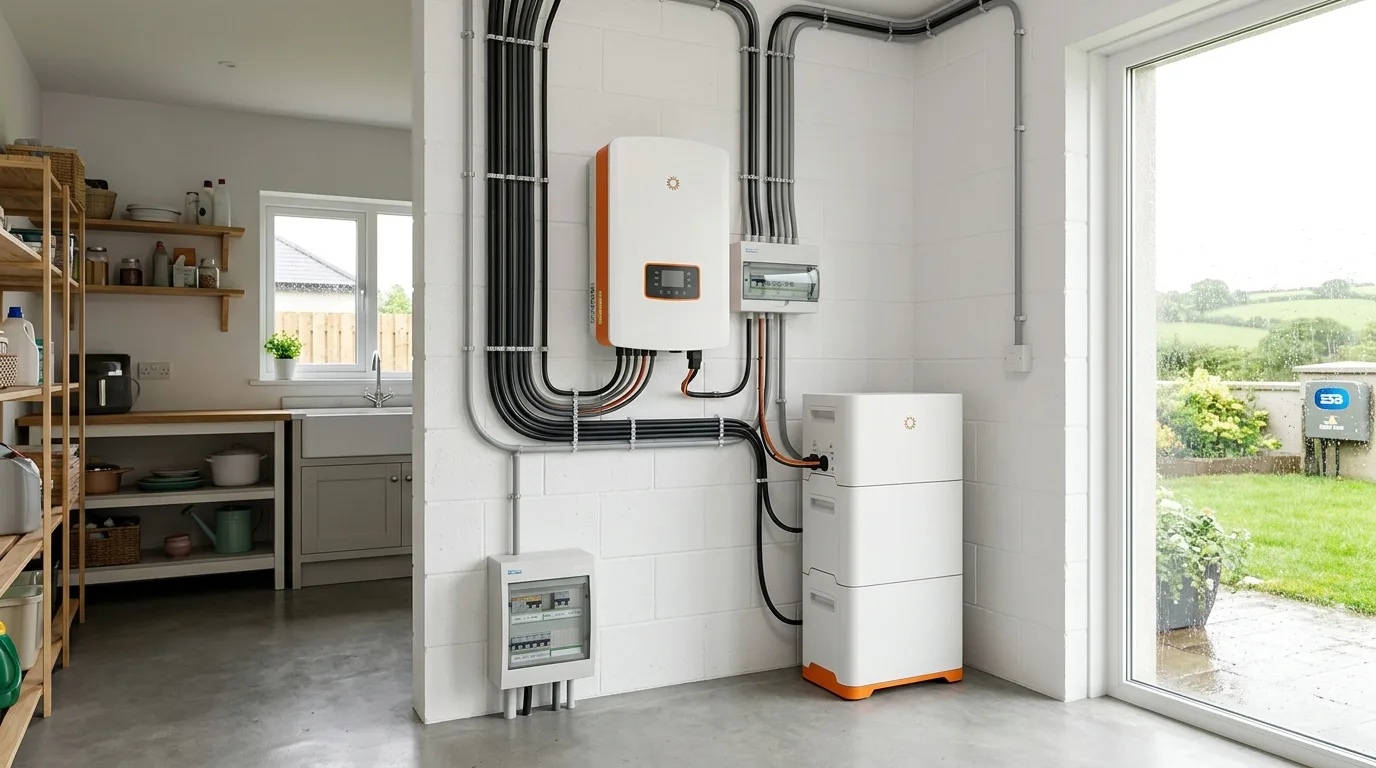
Solis: Ireland's Most Popular Hybrid Inverter
When Irish solar installers talk about hybrid inverters — the critical piece of hardware that connects your solar panels, battery, and home to the grid — Solis comes up more than any other brand. Manufactured by Ginlong Technologies (China), Solis has captured a dominant position in the Irish residential solar+battery market through competitive pricing, broad battery compatibility, and improving software.
This guide covers the Solis S6 hybrid inverter range in detail, including compatibility with Irish battery brands, performance, pricing, and where it excels and falls short.
Why an Inverter Is the Central Hub of Your Battery System
In a DC-coupled solar+battery system, the hybrid inverter is responsible for:
- Maximum Power Point Tracking (MPPT) from solar panels — maximising the power extracted from panels under varying light conditions
- Battery charge management — controlling when and how fast the battery charges from solar or grid
- Grid synchronisation — ensuring the system operates in phase with the ESB Networks grid
- Export limiting — capping grid export to any limits imposed by ESB Networks (important in constrained network areas)
- EPS / backup switching — disconnecting from the grid and forming an island during power cuts (if EPS-capable)
- Monitoring — reporting energy flows to a cloud platform and/or local display
The inverter's quality, compatibility, and software determine much of the real-world performance of your battery system — arguably as much as the battery itself.
Solis S6 Series: The Most Common Choice in Ireland
The Solis S6 Hybrid Inverter series is the current flagship for residential solar+battery in Ireland. Available in 3.6 kW, 4.6 kW, 5.0 kW, 6.0 kW, and larger sizes.
S6 Key Specifications
| Specification | Solis S6 5kW |
|---|---|
| Max AC output | 5.0 kW |
| Max solar input | 6.25 kW (2 MPPT inputs) |
| MPPT inputs | 2 (dual MPPT for two roof aspects) |
| Battery voltage | 48 V (HV version: 100–500 V) |
| Max battery charge/discharge | 5.0 kW |
| EPS (backup) | Yes — sub-panel |
| EPS switch time | <20ms |
| Efficiency (PV to AC) | 97.7% |
| Monitoring | SolisCloud (cloud) + WiFi local |
| IP rating | IP65 |
| Grid standards | IEC, G99 compatible |
| Dimensions | 384 × 464 × 193 mm |
| Weight | 23 kg |
The high-voltage (HV) version (100–500 V battery voltage) is required for BYD HVS, Huawei LUNA, and other high-voltage battery systems. The standard 48 V version is used with Pylontech, GivEnergy (some models), and other 48 V LFP batteries.
Solis S6 EH (Hybrid) vs Solis S6 RHI
Solis sells two main hybrid series for Irish residential:
- S6 EH1P (single-phase hybrid): Most common for Irish homes (standard single-phase grid connection)
- S6 EH3P (three-phase hybrid): For commercial or large residential properties with three-phase grid connection
- S6 RHI (retrofittable hybrid): Designed for adding battery to an existing Solis string inverter installation
Battery Compatibility in Ireland
One of Solis's biggest advantages is broad battery compatibility. Unlike some inverters that only work with the manufacturer's own battery, Solis S6 has certified compatibility with:
- BYD Battery-Box HVS (high-voltage version)
- BYD Battery-Box HVM
- GivEnergy batteries (some models)
- Pylontech US5000 / Force H2
- FoxESS batteries (limited crossover)
- Huawei LUNA (limited; Huawei prefers its own inverter)
- Generic LFP 48 V batteries (via BMS communication)
This compatibility means Irish installers can mix and match Solis inverters with whichever battery brand suits the customer's budget and requirements — a significant practical advantage for the Irish market.
SolisCloud Monitoring Platform
Solis's monitoring platform — SolisCloud — is a web and mobile app that provides:
- Real-time energy flow (solar generation, battery SoC, grid import/export, home consumption)
- Historical data with daily/weekly/monthly/annual views
- Remote setting changes (charge/discharge windows, export limits, EPS configuration)
- Alerts for fault conditions
- Integration with home assistant via community-developed integration
SolisCloud has improved significantly in recent years. It's not as polished as Fronius's SolarWeb or GivEnergy's MyGivEnergy, but is functional and improving.
Local datalogger option: For homes with unreliable broadband, Solis offers a local datalogger that stores monitoring data locally and syncs to SolisCloud when connectivity allows.
Setting Up Time-of-Use Battery Charging with Solis
For night-rate arbitrage, the Solis S6 can be configured directly via SolisCloud or the local inverter display:
- Navigate to Settings → Energy Storage → Charge/Discharge Time Settings
- Set Charge Window 1: 02:00–04:00 (or your tariff's off-peak window)
- Set Charge Power: 5 kW (or your battery's maximum safe charge rate)
- Set Charge Target SoC: 95% (or 100% if your battery supports it)
- Set Discharge Window 1: 07:00–22:00 (or your preferred discharge period)
- Set Minimum Discharge SoC: 10–20% (reserve for backup)
This configuration runs automatically once set. Most Irish installers configure this as part of commissioning; confirm with your installer that the TOU settings match your tariff.
Solis S6 Pricing in Ireland
Solis S6 inverters are widely stocked by Irish solar wholesalers. Approximate trade prices (before installer margin):
- Solis S6 5kW single-phase hybrid (48V): ~€600–€900 trade
- Solis S6 5kW HV hybrid (100–500V): ~€800–€1,100 trade
Installed with inverter, datalogger, and commissioning: typically €1,000–€1,800 as part of a complete solar+battery package.
This pricing is highly competitive versus equivalents from Fronius (€1,800–€2,500 inverter cost), SMA, and Sungrow (€700–€1,200).
Solis vs FoxESS vs GivEnergy Hybrid: Which Inverter?
| Feature | Solis S6 | FoxESS H3 | GivEnergy hybrid |
|---|---|---|---|
| Battery compatibility | Broad (BYD, Pylontech, GivEnergy, more) | Primarily FoxESS batteries | Primarily GivEnergy batteries |
| App / monitoring | SolisCloud (improving) | FoxESS Cloud (improving) | MyGivEnergy (strong) |
| EPS backup | Yes | Yes | Yes |
| Irish installer adoption | Very high | High | High |
| Price (inverter only) | Competitive | Competitive | Slightly higher |
| API openness | Community-supported | Limited | Open (Home Assistant) |
Solis wins on battery flexibility and price. GivEnergy wins on app quality and API openness. FoxESS is popular as a bundled FoxESS ecosystem choice.
Common Solis Issues Reported in Ireland
SolisCloud outages: Solis's cloud servers have experienced occasional outages in past years, causing monitoring blackouts. Data is stored locally on the datalogger and recovered when connectivity resumes. Actual inverter operation continues normally — it's a monitoring issue only.
Firmware updates: Solis releases firmware updates periodically for bug fixes and new features. Irish installers manage this remotely or on-site. Keeping firmware current is important for optimised TOU performance.
Export limiting configuration: ESB Networks may require export limiting for some connections. Confirm with your installer that the export limit is correctly configured in SolisCloud before going live — incorrect configuration can result in excess export and ESB Networks issues.
Who Should Choose Solis?
Ideal for:
- Homeowners pairing with BYD Battery-Box or Pylontech (Solis is the natural partner)
- Budget-conscious projects where inverter cost must be minimised
- Installers who want flexibility to use different battery brands
- Properties in constrained grid areas needing export limiting (Solis has robust export control)
Consider alternatives if:
- You want the best monitoring platform (GivEnergy or Fronius are stronger)
- You're building a GivEnergy ecosystem (use GivEnergy's own inverter)
- You want Tesla Powerwall (it has its own integrated inverter)
Verdict
Solis S6 is the workhorse hybrid inverter of the Irish solar+battery market in 2026 — popular because it works reliably with multiple battery brands at a price that keeps whole-system costs competitive. For most Irish homeowners, it's an excellent choice, particularly when paired with BYD or Pylontech. Its monitoring platform lags behind the best competitors but is improving.
Smart Solar Rating: 4.2/5 — best value hybrid inverter for most Irish solar+battery installations.
Get 3 free battery storage quotes — free and no obligation.
Frequently asked questions
Is Solis compatible with BYD Battery-Box in Ireland?
Yes. The Solis S6 HV hybrid inverter is fully compatible with the BYD Battery-Box HVS high-voltage series — one of the most popular pairings in the Irish market. The standard 48 V Solis S6 is compatible with BYD HVM and Pylontech batteries.
What is the price of a Solis S6 hybrid inverter in Ireland?
Solis S6 5kW hybrid inverters trade for approximately €600–€1,100 depending on voltage model. Installed with datalogger and commissioning as part of a solar+battery project, expect €1,000–€1,800 as the inverter installation cost component.
Can a Solis inverter manage night-rate battery charging in Ireland?
Yes. Solis S6 supports configurable time-of-use charging windows via SolisCloud or the inverter display. You can set a 02:00–04:00 charge window at 5 kW to align with Electric Ireland's Smart Plan off-peak rate.
Does Solis S6 provide backup power during a power cut?
Yes. The Solis S6 includes an EPS (Emergency Power Supply) function that switches to backup mode in <20ms when the grid fails. In EPS mode, the inverter supplies power from the battery to connected backup circuits.
Is the Solis S6 eligible for the SEAI solar grant?
Yes. As the inverter component of a new solar PV installation, the Solis S6 is eligible under the SEAI Solar Electricity Grant (up to €2,400 total for the solar system including inverter). The installation must be completed by an SEAI-registered installer.
Sources & further reading
- Solis Hybrid Inverters — Ginlong — Solis/Ginlong
- ESB Networks G99 / NC6 Connection Requirements — ESB Networks
- SEAI Solar Electricity Grant — SEAI