R290 vs R32 Refrigerant in Heat Pumps: What Irish Homeowners Need to Know
The refrigerant inside your heat pump matters more than most homeowners realise. R290 (propane) has a global warming potential 225 times lower than R32, is exempt from EU F-gas restrictions, and delivers excellent efficiency. Here is everything you need to know about the R290 vs R32 choice in Ireland.
By Smart Solar Editorial · Updated 15 May 2026 · 8 min read
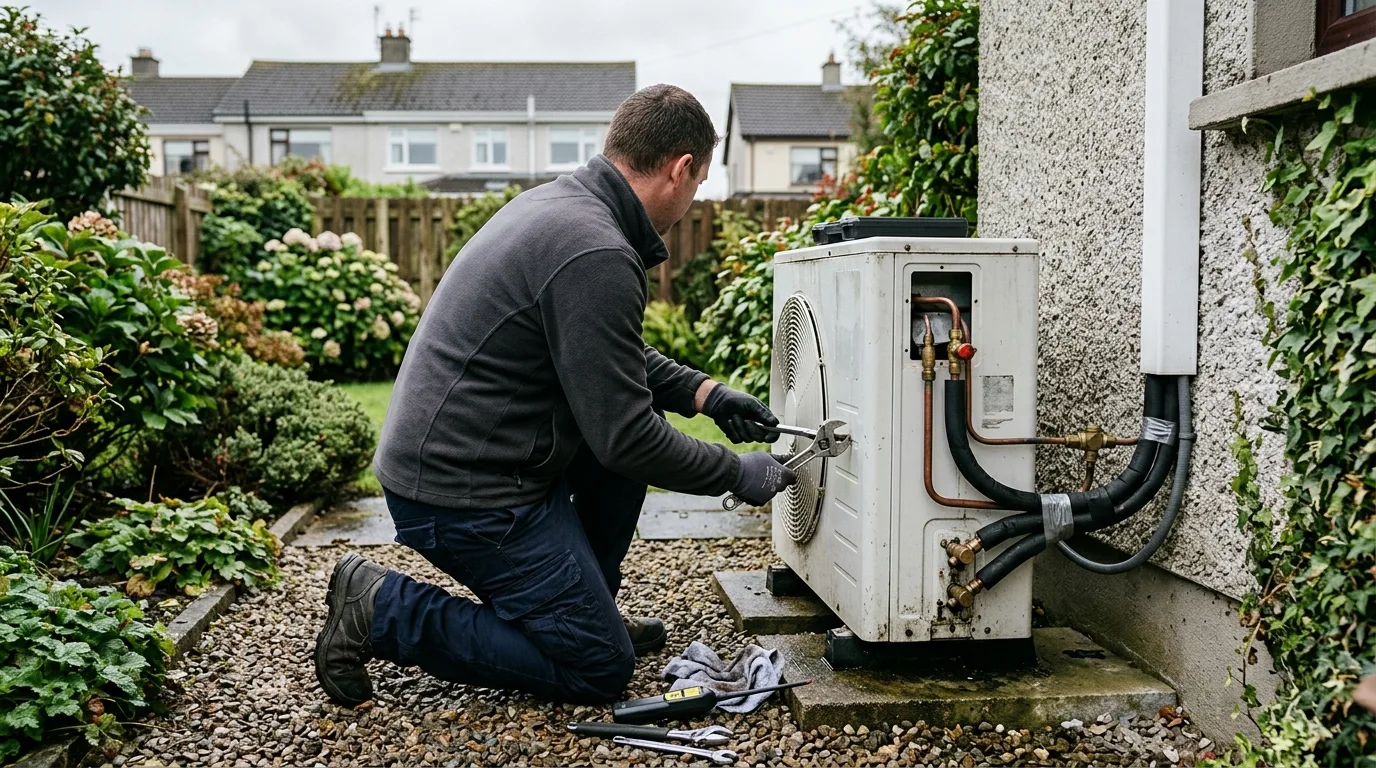
When choosing a heat pump in Ireland in 2026, the refrigerant it uses is an increasingly important consideration. Most heat pumps on the Irish market today use R32, while a growing number — including the Grant Aerona⁴ and newer models from Daikin, Panasonic, and others — are transitioning to R290 (propane). Understanding the differences helps you make a more future-proof and environmentally responsible choice.
What Is a Refrigerant and Why Does It Matter?
A refrigerant is the fluid that circulates through your heat pump's sealed circuit, absorbing heat at low pressure and releasing it at high pressure. The refrigerant's properties — boiling point, heat capacity, thermodynamic efficiency, and environmental impact — directly affect both the heat pump's performance and its environmental credentials.
The environmental concern with synthetic refrigerants is primarily their Global Warming Potential (GWP) — how much they contribute to climate change if released into the atmosphere. Older refrigerant R410A, used in heat pumps before 2015–2018, has a GWP of 2,088. This means 1 kg of R410A released into the atmosphere has the same warming effect as 2,088 kg of CO₂.
R32: The Current Mainstream
R32 (difluoromethane) is the refrigerant used in the vast majority of heat pumps sold in Ireland in 2026, including:
- Daikin Altherma 3 R and H HT
- Mitsubishi Ecodan (all models)
- Samsung EHS (all models)
- Panasonic Aquarea (most models)
R32 key data:
- GWP: 675 (compared to 2,088 for R410A)
- ODP (Ozone Depletion Potential): 0
- Flammability: Mildly flammable (A2L classification — lower flammability)
- Typical charge in domestic heat pump: 0.8–2.5 kg
- Regulatory status: Subject to EU F-gas Regulation quotas
R32 was a significant improvement over R410A, halving the GWP while improving efficiency. It has become the dominant replacement since around 2018 and is established, reliable, and well-understood by service engineers.
The F-gas concern: The EU F-gas Regulation (EU/2024/573) sets a declining quota for the production and import of high-GWP fluorinated gases in the EU. R32, with a GWP of 675, is subject to these quota restrictions. While R32 is not facing an imminent ban, the direction of travel is clearly toward lower-GWP or natural refrigerants. This creates some long-term uncertainty about R32 pricing and availability for servicing as the phase-down progresses.
R290: The Natural Alternative
R290 (propane) is a naturally occurring hydrocarbon that has been used as a refrigerant in refrigerators and heat pumps for decades. It is now becoming the refrigerant of choice for the next generation of heat pump designs.
R290 key data:
- GWP: 3 (essentially zero impact compared to R32 or R410A)
- ODP: 0
- Flammability: Flammable (A3 classification — higher flammability than R32)
- Typical charge in domestic heat pump: 0.5–1.5 kg (smaller charge needed due to better thermodynamic properties)
- Regulatory status: Exempt from EU F-gas phase-down quotas
Irish market R290 availability:
- Grant Aerona⁴ R290: Available now; the only major Irish-market air-to-water heat pump currently offering R290 across the full range
- Daikin: Has announced R290 versions of the Altherma range; some models available; broader availability expected 2025–2027
- Panasonic: R290 versions in development for European market
- Mitsubishi Electric: R290 products in pipeline for certain markets
- Samsung: R290 in larger commercial products but not yet mainstream residential
Efficiency Comparison: Does the Refrigerant Type Affect SCOP?
R290 has excellent thermodynamic properties and achieves efficiency comparable to or slightly better than R32 in well-matched systems.
Published SCOP comparison (similar unit sizes, EN 14825 H2):
| Refrigerant | Example Unit | SCOP at W35 |
|---|---|---|
| R32 | Daikin Altherma 3 R 8 kW | 4.81 |
| R32 | Mitsubishi Ecodan 8.5 kW | 4.48 |
| R290 | Grant Aerona⁴ 8 kW | 4.35–4.8 |
| R290 | Daikin Altherma 3 R290 (when available) | 4.5–5.0 (estimated) |
The difference in SCOP between R32 and R290 systems is generally small (0–5%) in comparable applications. The refrigerant choice will not meaningfully change your electricity bills.
Safety: R290 Is Flammable — How Much Does This Matter?
R290's flammability is the main practical concern raised by homeowners and installers. Propane is, of course, widely used in LPG systems in rural Ireland, so the concept is familiar. For heat pump applications, the key safety points are:
- The charge in a domestic heat pump is small (0.5–1.5 kg)
- The charge is entirely contained in the sealed outdoor unit circuit
- EU and Irish standards (IEC 60335-2-40) govern the safe installation of A3-refrigerant appliances
- Ventilation requirements for the outdoor unit area must be met
- SEAI-registered installers are trained in R290 installation
- Service requires R290-certified technicians
In practice, a properly installed Grant Aerona⁴ R290 in a well-ventilated outdoor location is perfectly safe. The risk is manageable with proper installation and qualified service.
Future-Proofing: R290 vs R32
Looking ahead to 2030 and beyond, R290 has a clear regulatory advantage:
R32:
- Subject to EU F-gas quota reductions
- May become more expensive as quotas tighten and demand from other sectors (air conditioning, etc.) competes
- Service costs for older R32 systems may increase as the refrigerant becomes harder to source
R290:
- Not subject to F-gas quotas — completely exempt
- Naturally abundant and inexpensively produced
- Price and availability will not be affected by F-gas regulation
- EU policy actively encourages natural refrigerant adoption
For a heat pump system that will be in service for 15–20 years, this regulatory outlook is a meaningful consideration. Installing R290 now avoids the possibility of expensive refrigerant service costs in the 2030s if R32 faces significant quota restrictions.
What Should Irish Homeowners Choose?
Choose R32 (current mainstream) if:
- You want the widest installer expertise and parts availability today
- You prefer the most established technology with the longest track record in Ireland
- Your installer does not yet have R290 certification
Choose R290 if:
- Environmental credentials are important to you (GWP 3 vs 675)
- You want future regulatory certainty (no F-gas risk)
- Grant Aerona⁴ suits your technical requirements and you have access to a certified installer
- Your installer is R290-certified and has experience with natural refrigerant systems
For most Irish homeowners in 2026, the practical differences between R32 and R290 are relatively small on a day-to-day basis. The environmental and future regulatory arguments favour R290, but R32 systems from Daikin, Mitsubishi, and Samsung are excellent products that will serve you well over the system's lifetime with qualified servicing.
The direction of the industry is clearly toward R290 and other natural refrigerants. As more manufacturers and installers become R290-certified in 2025–2028, the choice will become easier and more mainstream.
Get 3 free heat pump quotes — free and no obligation.
Frequently asked questions
Is R290 safer than R32 in a heat pump?
R290 is flammable (A3 classification) while R32 has lower flammability (A2L). However, in a properly installed heat pump, R290's small charge (0.5–1.5 kg) in a sealed outdoor unit poses minimal practical risk. Both must be installed by appropriately certified engineers and comply with relevant safety standards.
Which heat pumps available in Ireland use R290?
The Grant Aerona⁴ is currently the most widely available R290 air-to-water heat pump in Ireland. Daikin has announced R290 versions of the Altherma range, with broader availability expected in 2025–2027. Panasonic and Mitsubishi have R290 products in development for the European market.
Will R32 heat pumps be affected by F-gas regulations?
R32 (GWP 675) is subject to EU F-gas Regulation quota reductions. While R32 is not being banned immediately, quotas are being tightened progressively. This may affect R32 servicing costs over a 15–20 year heat pump lifespan as refrigerant prices potentially increase. R290 is entirely exempt from F-gas restrictions.
Does the refrigerant type affect heat pump efficiency?
The difference in SCOP between comparable R32 and R290 systems is generally less than 5%. In practice, system design (flow temperature, radiator sizing, insulation) has far more impact on real-world efficiency than refrigerant type.
Can I switch from R32 to R290 when my heat pump needs replacing?
You can install an R290 heat pump when replacing your existing R32 system. The heating circuit (radiators, cylinder, pipework) is refrigerant-agnostic — it is the outdoor unit and refrigerant circuit that change. A qualified R290 installer will manage the transition.
Sources & further reading
- EU F-Gas Regulation 2024/573 — Government of Ireland
- SEAI Heat Pump Technology — Sustainable Energy Authority of Ireland