Planning Permission for Heat Pumps in Ireland: What You Need to Know in 2026
Most domestic heat pump installations in Ireland are exempt from planning permission — but the exemption has specific conditions that must be met. This guide covers the rules, the exceptions, and what to do if your situation is more complex.
By Smart Solar Editorial · Updated 15 May 2026 · 7 min read
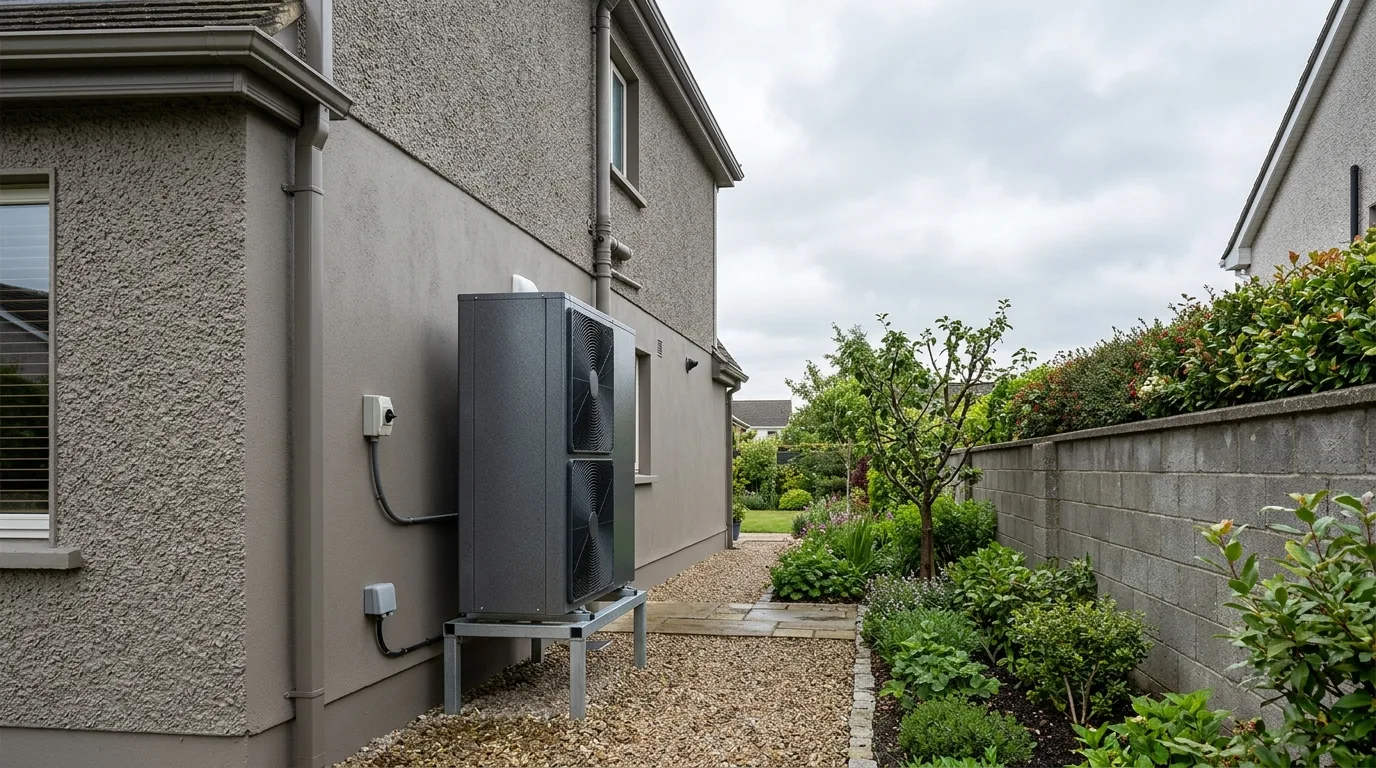
The good news for most Irish homeowners is that air source heat pump installations are exempt from planning permission in the majority of cases. The exemption is provided under the Planning and Development Regulations (as amended) and covers residential properties where specific conditions are met.
However, the exemption has conditions — and there are specific situations where planning permission may still be required. Understanding where the lines are drawn will help you plan your project correctly.
The Planning Exemption for Heat Pumps
Under SI 235 of 2011 and subsequent amendments to the Planning and Development Regulations 2001, the installation of a heat pump at a domestic dwelling (house or bungalow) is exempted development provided all of the following conditions are met:
1. One unit per property: Only one heat pump per dwelling qualifies for the exemption. A second unit at the same property would require planning permission.
2. Location restrictions:
- The heat pump may not be placed on or to the front of the building
- It must be sited on the side or rear of the property
- It may not be positioned in a front garden
3. Height restrictions:
- The outdoor unit must not exceed 2 metres above ground level
4. Setback from boundaries:
- The unit must be at least 1 metre from any boundary of the property
- For terraced or semi-detached houses with small side passages, this setback may create practical challenges — the rear garden is usually the only viable location
5. Noise threshold:
- The heat pump must not cause the average sound level (LA90) at the nearest neighbour's habitable room window to exceed 45 dB(A)
6. Not a protected structure:
- If your home is a protected structure (listed building, recorded monument, or in an Architectural Conservation Area), the exemption does not automatically apply and planning permission may be required
7. Not in certain special planning areas:
- Some areas have special planning conditions (e.g., certain coastal areas, An Bord Pleanála appeal areas) that override general exemptions
When Planning Permission IS Required
Despite the general exemption, planning permission must be sought in the following situations:
Protected structures (listed buildings): Homes on the Record of Protected Structures (RPS) maintained by local authorities, or those in Architectural Conservation Areas (ACAs), require planning permission for any material alteration to the external appearance. A heat pump outdoor unit on the exterior wall would typically constitute such an alteration. Contact your local county council's planning department for guidance specific to your property.
Second heat pump at one dwelling: If you are replacing a heat pump (the old unit is removed) and installing a new one, this should still qualify under the single-unit exemption. But if you are adding a second unit at the same property (e.g., separate heating zones served by separate outdoor units), planning permission is required.
Development exceeding the exemption conditions: If your proposed installation cannot meet the noise threshold, height, or setback conditions, you must apply for planning permission. Common reasons include:
- The only viable location for the outdoor unit is at the front of the property
- A semi-detached home where the side garden is too narrow for the 1 m setback
- A unit that would exceed 2 m in height (unusual but possible for large roof-mounted systems)
Certain condominiums and apartment blocks: Heat pump installations in multi-unit buildings (apartments, duplexes with shared walls, managed estates) may be subject to management company consent and planning conditions beyond the standard exemption. Check with the management company and local authority.
Practical Steps for Checking Your Situation
Step 1: Check if your property is a protected structure: Search your local county council's online planning portal for your property's protected structure status. Most councils publish their Records of Protected Structures online.
Step 2: Check for ACAs or special designations: Your county council's online planning map (ePlanning.ie and individual county council portals) shows Architectural Conservation Areas and other special planning areas.
Step 3: Identify the proposed unit location: Confirm that the proposed outdoor unit location is:
- At the side or rear of the property
- More than 1 metre from all boundaries
- Below 2 metres in height
- Not likely to exceed 45 dB(A) at the nearest neighbour's window
Step 4: Consult your installer: A reputable SEAI-registered installer will carry out a site assessment that includes confirming planning compliance. Ask them explicitly: "Does this installation qualify for the planning exemption?" and "Have you assessed the noise level at the neighbour's window?"
What If You Need Planning Permission?
If planning permission is required, you must submit a planning application to your local county council before installation begins. Key points:
- Application fee: €65 for a domestic development
- Consultation period: 5 weeks for public and third-party observations
- Decision period: 8 weeks from valid application receipt
- Likely outcome: For a standard semi-detached home where the exemption conditions cannot be technically met (e.g., front placement required due to access), permission is usually granted with conditions
Protected structure applications: These require more documentation, including heritage impact assessment. Engage a conservation architect for guidance.
An Bord Pleanála appeal: If your application is refused, you have 4 weeks to appeal to An Bord Pleanála. Professional planning consultant advice is recommended for appeals.
Special Case: Heat Pumps on Terraced Houses
Terraced houses present specific planning considerations because the rear garden is the only eligible location (front placement is excluded), and the 1 metre boundary setback must be achieved within what may be a small rear garden.
For a typical Irish terraced house with a 6 m × 8 m rear garden:
- 1 m setback from rear boundary: unit must be within 7 m of house
- 1 m setback from each side boundary: limits unit to central area
- Most modern heat pump units (700 mm wide) fit comfortably within these constraints in a standard Irish rear garden
Where the rear garden is very small (e.g., a Dublin city terraced house with a 4 m × 5 m yard), the 1 m setback from all boundaries may leave insufficient room. In this case, discuss alternatives with your installer — sometimes a wall-mounted bracket configuration can satisfy the setback from one boundary while meeting the other conditions.
SEAI Grant and Planning Permission
Planning compliance is not assessed by SEAI as part of the grant application. The SEAI grant application does not require planning permission evidence. However, if your installation is subsequently found to breach planning conditions, the local authority can issue an enforcement notice requiring removal — so it is essential to confirm compliance before proceeding.
Your heat pump installer is responsible for ensuring the installation meets planning exemption conditions. This should be confirmed in writing as part of your contract.
Get 3 free heat pump quotes — free and no obligation.
Frequently asked questions
Do I need planning permission for a heat pump in Ireland?
In most cases, no. Domestic heat pump installations are exempt from planning permission provided the unit is at the side or rear of the property, is not a protected structure, is more than 1 m from all boundaries, does not exceed 2 m height, and meets the 45 dB(A) noise threshold at the neighbour's window.
Can I install a heat pump on a listed or protected structure in Ireland?
Not under the standard planning exemption. Protected structures (on the local authority's Record of Protected Structures) require planning permission for external alterations, which includes heat pump installation. Consult your local council's planning department for guidance.
What if I cannot place the heat pump at the rear of my terraced house?
You must apply for planning permission if the only viable location for the heat pump cannot meet all exemption conditions. Planning permission for a front-of-property heat pump installation may be granted with conditions — consult your local authority.
Does the SEAI grant require planning permission?
No. SEAI does not assess planning compliance as part of the grant application. However, your installer must ensure the installation meets planning exemption conditions. If it does not, you may face an enforcement notice from the local authority even if the grant was paid.
Is a heat pump in an apartment in Ireland subject to planning permission?
Apartments may be subject to different rules and management company consent requirements. The standard residential exemption applies to houses and bungalows. For apartment complexes, check with your management company and local authority before proceeding.
Sources & further reading
- Planning and Development Regulations — Exempted Development — Department of Housing, Local Government and Heritage
- SEAI Heat Pump Grant — Sustainable Energy Authority of Ireland