String Inverter vs Microinverter in Ireland: Which Is Right for Your Home?
The choice between a string inverter and microinverters is one of the most consequential decisions in your solar PV system design. This guide explains the difference, when each system excels in Irish conditions, and how to decide.
By Smart Solar Editorial · Updated 15 May 2026 · 7 min read
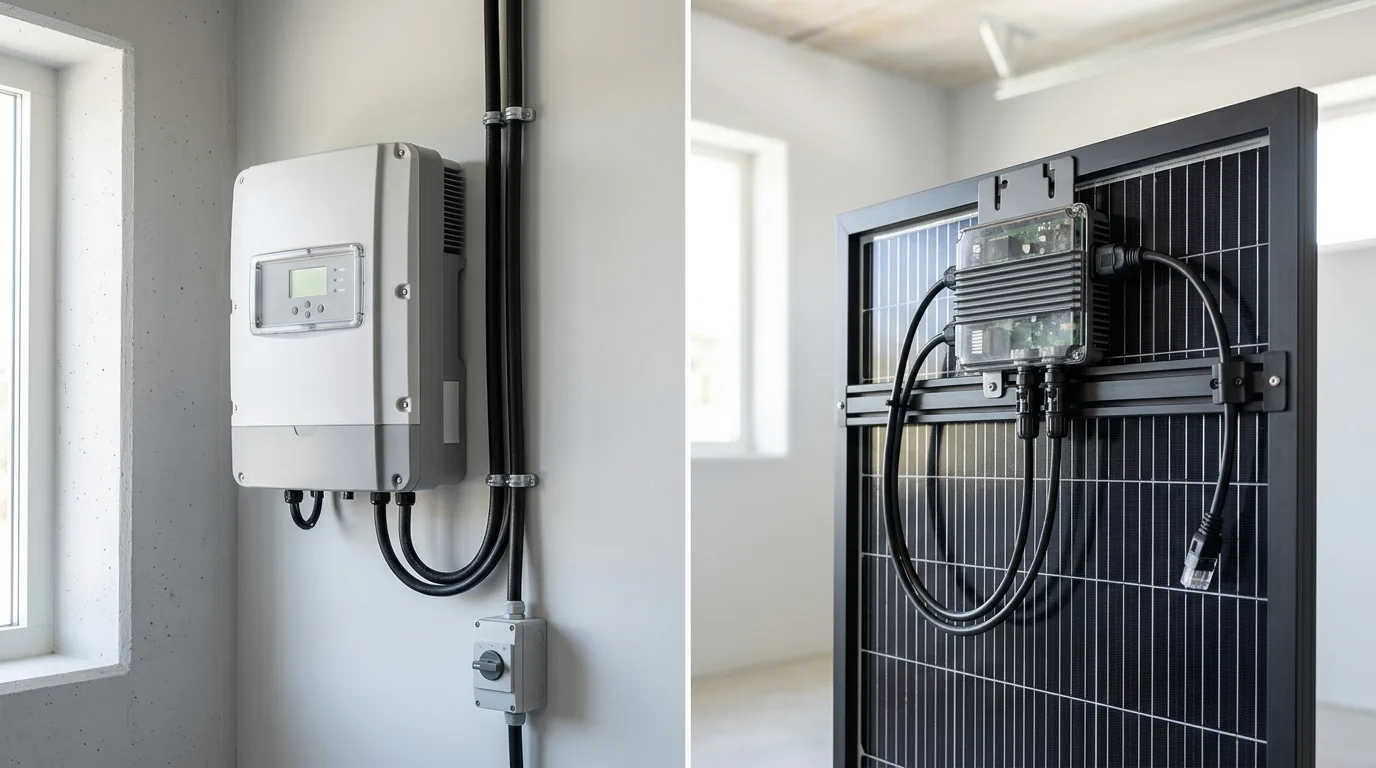
The string inverter vs microinverter debate is one of the most important technical decisions in residential solar PV design — and in Ireland's specific climate and housing conditions, it has a clear and nuanced answer. Understanding the difference helps you assess your installer's recommendation and ensure your system is right for your roof.
What Is a String Inverter?
A string inverter is a centralised unit — typically mounted indoors on a wall (utility room, garage, or understairs cupboard) — that receives DC electricity from multiple solar panels wired together in one or more "strings." It converts the combined DC input to AC electricity.
How string wiring works: In a series string, panels are wired positive-to-negative like batteries in a torch. The total string voltage equals the sum of individual panel voltages (typically 30–40 V each × 10 panels = 300–400 V DC input to the inverter). The current is limited by the lowest-performing panel in the string.
This last point is the key limitation of string inverters — the Christmas light effect: if one panel produces less (due to shading, soiling, or defect), the whole string's current is limited to that panel's output.
Leading string inverter brands in Ireland: Fronius (Primo, Symo), SolarEdge (when used without optimisers — rare), Huawei (SUN2000), Sungrow (SH series), Growatt.
What Is a Microinverter?
A microinverter is a small inverter attached to each individual solar panel, typically mounted on the back of the panel or on the mounting rail directly beneath it. Each microinverter independently converts one panel's DC output to AC electricity.
Because the conversion happens at the panel, each panel operates completely independently. Shading, soiling, or defects on one panel have no impact on other panels.
Leading microinverter brands in Ireland: Enphase (IQ7, IQ8 series) dominates the Irish and European microinverter market. Hoymiles and APS are emerging alternatives.
String Inverter vs Microinverter: Head-to-Head Comparison
| Feature | String Inverter | Microinverter |
|---|---|---|
| Unit cost | Lower (1 central unit) | Higher (1 per panel) |
| Total system cost | €500–€1,500 lower | €700–€2,000 more |
| Shading performance | Poor (one shade = string limited) | Excellent (panel independence) |
| Monitoring granularity | String-level or with optimisers | Per-panel output |
| Installation complexity | Simpler | More roof-top components |
| Safety | Standard (300–400V DC on roof) | Safer (AC at panels, lower DC voltage) |
| Reliability | One failure affects whole system | One failure affects one panel only |
| Inverter warranty | 10–12 years (extendable) | 25 years (Enphase IQ8) |
| Battery compatibility | Good (with hybrid inverter) | Good (Enphase IQ Battery) |
| Monitoring app | Varies by brand | Enphase Enlighten (excellent) |
| Fire safety | DC isolator required | Lower DC voltage risk |
When String Inverters Excel
String inverters are the right choice for:
1. Simple, unshaded south-facing roofs A clean south or SW-facing slope with no chimneys, dormers, or neighbouring building shading is the sweet spot for string inverters. Without shade losses, the Christmas light effect is irrelevant, and the lower system cost is a pure advantage.
2. Large, single-orientation arrays A 6–10 kWp installation on a uniform south-facing roof benefits from the simplicity of one or two string inverters. Microinverters on 15+ panels add significant component count and cost without proportional benefit on an unshaded roof.
3. Budget-conscious installations If the goal is maximum financial return and roof shading is minimal, a string inverter delivers excellent performance at lower total system cost. The extra €1,000–€2,000 saved versus microinverters improves payback period.
4. Battery storage priority Modern hybrid string inverters (Fronius GEN24 Plus, SolarEdge StorEdge, Sungrow SH) integrate battery storage cleanly. If battery storage is the priority, a string hybrid inverter is often simpler than a microinverter + AC-coupled battery setup.
When Microinverters Excel
Microinverters are the right choice for:
1. Shaded roofs If any part of your panel array is shaded during the day — by chimneys, dormers, trees, satellite dishes, or neighbouring buildings — microinverters eliminate the shading cascade problem. Each panel operates independently, so a shaded panel only loses its own output, not the entire string's.
2. Complex, multi-orientation roofs Dormer bungalows, L-shaped roofs, or systems spanning both east and west slopes benefit enormously from panel independence. Each panel tracks its own maximum output point regardless of neighbouring panels' orientation.
3. Safety-conscious installations Microinverter systems operate at much lower DC voltages — typically 30–60 V at the panel — because AC conversion happens immediately. Traditional string systems carry 300–600V DC through the roof and down to the inverter. Lower DC voltage means lower arc flash and fire risk, which matters to some homeowners.
4. Peace of mind and monitoring Enphase Enlighten's per-panel monitoring shows exactly what each panel is producing in real time. If a panel is underperforming due to shading, soiling, or early cell degradation, you see it immediately. This level of visibility is not available with standard string inverters.
5. Long-term reliability preference Enphase IQ8 microinverters carry a 25-year warranty — matching the solar panels. With a string inverter, you're budgeting for one replacement during the system's lifetime. With Enphase, no central inverter replacement is needed.
Enphase IQ8: The Irish Market Microinverter
The Enphase IQ8 series is the dominant microinverter choice in Ireland. Key specifications for the IQ8M (most common residential model):
- Max input power: 355–460 W panel range
- AC output: 245 W continuous
- Efficiency: 97.5% CEC weighted
- Grid profile: Pre-configured for Irish grid (230V/50Hz)
- Monitoring: Enphase Enlighten platform (real-time, per-panel)
- Warranty: 25 years
- Sunlight Backup: IQ8 models can provide power during grid outages (with IQ System Controller — useful for Irish storm resilience)
The IQ8 Sunlight Backup feature — the ability to supply power during grid outages from solar panels (without a battery) during daylight — is a unique advantage in Irish conditions where storm-related grid outages occur, particularly in rural counties.
Hybrid Option: String Inverter + Power Optimisers
For homeowners who want panel-level performance on a budget, the SolarEdge system (string inverter + DC power optimisers on each panel) is a useful middle ground:
- DC optimisers address shading at panel level (like microinverters)
- Central string inverter handles DC-to-AC conversion (like a string inverter)
- Per-panel monitoring through SolarEdge platform
- Cost intermediate between pure string and pure microinverter
See our full SolarEdge vs Fronius comparison and power optimisers guide.
Cost Comparison for a 4 kWp Irish Installation
| Inverter System | Indicative Cost (Inverter Sub-System) |
|---|---|
| Fronius Primo string (no optimisers) | €750–€950 |
| Huawei SUN2000 string | €650–€900 |
| SolarEdge + 10 P-optimisers | €1,800–€2,600 |
| Enphase IQ8M (10 microinverters) | €1,600–€2,400 |
| Fronius GEN24 Plus (hybrid) | €1,200–€1,600 |
Our Recommendation for Irish Homeowners
Start with a shading analysis. Before recommending string vs microinverter, any competent Irish installer should assess your specific roof for shading from chimneys, dormers, and neighbouring structures at different times of day and seasons.
- If shading losses are below 3–5% with a string inverter: String inverter (Fronius, Huawei, or Sungrow) is the better value choice
- If shading losses are 5–20%: SolarEdge with optimisers or Enphase microinverters are worth the premium
- If you want panel-level monitoring, 25-year inverter warranty, and storm resilience: Enphase IQ8 microinverters
- If you're adding a battery and want simplicity: Fronius GEN24 Plus hybrid or SolarEdge StorEdge
Get 3 free solar quotes — free and no obligation.
Frequently asked questions
Are microinverters worth it for Irish homes?
Yes, for homes with shading from chimneys, dormers, or neighbouring buildings. Enphase IQ8 microinverters eliminate the shading cascade problem and offer 25-year warranties and per-panel monitoring. For simple unshaded south-facing roofs, a quality string inverter (Fronius, Huawei) offers better value.
Do microinverters work better in Irish diffuse light?
Marginally. Microinverters are individually optimised at panel level, which can give a small advantage in low-light conditions. The real advantage in Ireland is shading performance on constrained roofs, not diffuse-light performance per se.
What is the lifespan of a microinverter?
Enphase IQ8 microinverters carry a 25-year warranty — the same as solar panels. In contrast, string inverters typically warrant for 10–12 years (extendable) and need replacement once during a 25-year panel lifetime. The microinverter's 25-year warranty eliminates this replacement cost.
Can I add microinverters to my existing solar system?
Adding microinverters to an existing string inverter system is complex and rarely cost-effective. If your string inverter fails, replacing with a new string inverter of the same capacity is simpler and cheaper than retrofitting microinverters. However, if you're expanding a system significantly, microinverters can be added for the new panels.
What happens if a microinverter fails?
If one microinverter fails, only that one panel goes offline. The rest of the system continues operating normally. With a string inverter failure, the entire system stops generating. Enphase provides a replacement microinverter under warranty. The modular failure characteristic of microinverters is a significant reliability advantage.
Sources & further reading
- Enphase IQ8 Microinverter Specifications — Enphase Energy
- Fronius Solar Inverter Range Ireland — Fronius International