SolarEdge vs Fronius Inverter: Which Is Better for Irish Homes in 2026?
SolarEdge and Fronius are the two inverter brands you'll see on almost every Irish solar quote. They take fundamentally different approaches to system design. This guide explains which works better for different Irish homes and why.
By Smart Solar Editorial · Updated 15 May 2026 · 8 min read
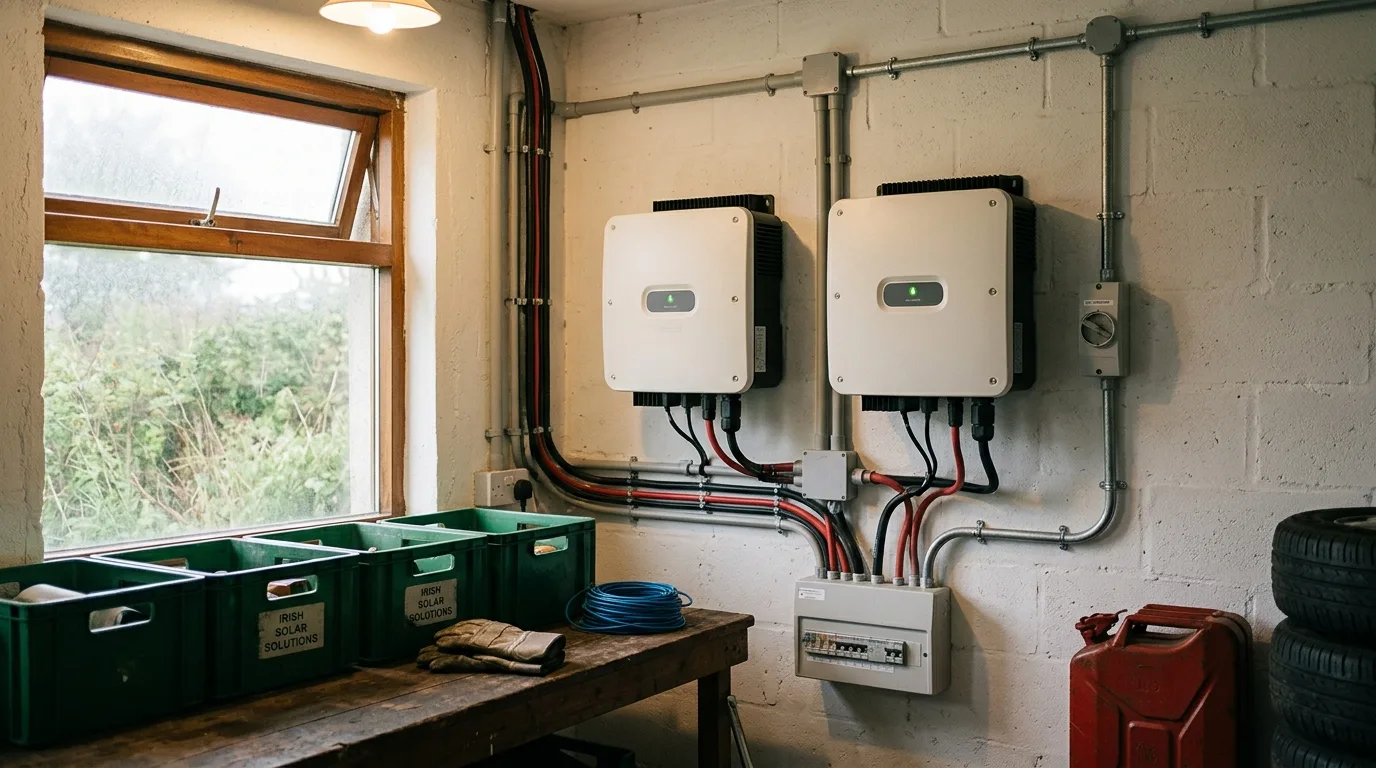
When you get solar PV quotes in Ireland, you'll notice one thing immediately: almost every quote specifies either a SolarEdge or a Fronius inverter. Both are excellent products. Both are widely serviced in Ireland. But they're built on fundamentally different engineering philosophies — and that difference matters for how your system performs, what it costs, and how you interact with it over 25 years.
This guide gives you the complete SolarEdge vs Fronius comparison from an Irish homeowner's perspective.
Architecture: The Core Philosophical Difference
SolarEdge: Distributed Intelligence
SolarEdge's defining innovation is the DC power optimiser attached to each solar panel. Instead of panels wired in a simple series string (where one underperforming panel drags down the whole string), SolarEdge optimisers condition each panel's DC output independently before passing it to the central inverter.
What this achieves:
- Each panel operates at its own maximum power point (MPPT)
- Shade on one panel does not reduce other panels' output
- Per-panel monitoring — you can see the exact output of every panel in real time
- Safe DC voltage at panel level (SolarEdge SafeDC™) — panels output only ~1 V when the inverter is off, improving fire safety
The SolarEdge system consists of:
- P-series or S-series DC power optimiser on each panel
- A SolarEdge HD-Wave or single-phase/three-phase inverter
- Optional: SolarEdge Energy Bank battery
Fronius: Traditional String Inverter Excellence
Fronius takes a different approach — high-quality central inverters with multiple independent MPPT inputs that can manage different array orientations and shading conditions at the string level. The Fronius Primo (single-phase, 3–10 kW) and Symo (three-phase) are the flagship residential models in Ireland.
What this achieves:
- Simpler installation (no optimisers on every panel)
- Lower total system cost (no optimiser hardware)
- Excellent reliability record — Fronius inverters are Austrian-engineered with a strong service network in Ireland
- Dual MPPT allows two separate roof sections (e.g., south + southeast) at optimal performance
- Fronius Solar.web monitoring platform provides detailed system performance data
The Fronius system consists of:
- Fronius Primo or Symo GEN24 inverter
- Panels wired in conventional string(s)
- Optional: Fronius wattpilot EV charger integration; battery via GEN24 Plus hybrid
Performance Comparison
On a Simple South-Facing Roof with No Shading
For an unobstructed south-facing roof, the performance difference between SolarEdge and Fronius is minimal — both will deliver very similar annual kWh output.
Fronius typically delivers DC-to-AC efficiency of 97–98%. SolarEdge optimisers add a small conversion loss of about 1–2% at the optimiser level, partially offset by better MPPT performance. Net real-world efficiency difference: negligible.
On a Shaded or Complex Roof
This is where SolarEdge has a clear advantage. If your roof has:
- Chimney shading (common on Irish semi-detached houses)
- Neighbouring roof ridge shading (Dublin suburban estates)
- Multiple orientations (dormer bungalow, L-shaped roof)
- Varying pitch sections
...then SolarEdge's panel-level MPPT can improve annual output by 5–25% compared to a standard Fronius string inverter without optimisers.
Fronius with Shade Management: Fronius has introduced its own shade management software, and the GEN24 with multiple MPPT inputs handles multi-orientation arrays well. But it does not match SolarEdge's granular panel-level optimisation for heavily shaded roofs.
Monitoring Systems
SolarEdge Monitoring Portal
- Per-panel output data in real time
- Dashboard showing individual panel performance (critical for fault detection)
- Mobile app with energy flow diagrams
- Alerts for underperforming panels
- Integration with smart home systems
- Consumption monitoring with CT clamp
Fronius Solar.web
- String-level monitoring (not individual panel unless SolarEdge-style optimisers are added)
- Excellent production forecasting using weather data
- Energy flow diagrams
- Mobile app (iOS/Android)
- Integration with Fronius Smart Meter for consumption monitoring
- Open API for third-party integration
Verdict on monitoring: SolarEdge's per-panel monitoring is a significant practical advantage for troubleshooting. If a panel is dirty, shaded, or failing, you'll see it immediately as one panel showing lower output than its neighbours. With Fronius, a failing panel might not be obvious until overall output is noticeably down.
Battery Compatibility
SolarEdge + Battery
SolarEdge's StorEdge system integrates with the SolarEdge Energy Bank battery (5–10 kWh), BYD B-Box HV battery, and LG Chem RESU series. The hybrid inverter (SolarEdge StorEdge inverter or SE-Energy Hub) is required for DC battery coupling, though AC-coupled batteries can also be used.
The SolarEdge ecosystem is well-integrated — the inverter, optimisers, battery, and monitoring all communicate through one platform.
Fronius + Battery
Fronius Symo GEN24 Plus is a purpose-built hybrid inverter that accepts battery connections from multiple brands (BYD, Pylontech, SolarEdge, Sonnen). The GEN24 Plus is AC and DC coupled, offering maximum flexibility for battery addition.
Fronius's battery compatibility is arguably broader than SolarEdge's more proprietary approach.
Verdict on battery: Both work well. If you want a tightly integrated all-Fronius ecosystem, the GEN24 Plus is excellent. If you're on SolarEdge hardware and want to add a battery later, check specific battery compatibility with your installer.
Warranty Comparison
| Feature | SolarEdge | Fronius |
|---|---|---|
| Inverter warranty (standard) | 12 years | 10 years |
| Inverter warranty (extended) | Up to 25 years (purchasable) | Up to 20 years (purchasable) |
| Power optimiser warranty | 25 years | N/A |
| Irish/UK distributor | Yes | Yes |
| Irish service network | Strong | Strong |
SolarEdge's 25-year optimiser warranty is a compelling feature — it means your panel-level components have the same longevity as the panels themselves. The 12-year base inverter warranty beats Fronius's 10-year standard.
Cost Comparison
For a 4 kWp system in Ireland in 2026:
| System Type | Inverter + Optimiser Cost | Typical Premium over Basic |
|---|---|---|
| Fronius Primo (string, no optimisers) | €700–€900 | Baseline |
| Fronius Primo + 10 SolarEdge P-optimisers | €1,800–€2,600 | +€1,100–€1,700 |
| SolarEdge HD-Wave + 10 P-optimisers | €1,800–€2,800 | +€1,100–€1,900 |
| Fronius GEN24 Plus (hybrid, battery-ready) | €1,200–€1,600 | +€500–€700 |
A full SolarEdge system adds roughly €800–€1,500 to the total system cost compared to a Fronius string system on the same roof — but with the shade mitigation and monitoring benefits.
Which Should You Choose?
Choose SolarEdge if:
- Your roof has shading from chimneys, dormers, or neighbouring buildings
- Your roof has multiple orientations (complex layout)
- You want per-panel monitoring for maximum transparency
- You're on a single-story bungalow or dormer with complex roof geometry
- You want the 25-year optimiser warranty peace of mind
Choose Fronius if:
- Your roof is a simple south or SE/SW face with no shading
- You want the lowest system cost without compromising quality
- You're planning battery storage and want maximum battery brand flexibility (GEN24 Plus)
- You value the Fronius Austrian engineering and established Irish service network
- You're installing a large multi-phase system (Fronius Symo series excels here)
The Honest Assessment
Both SolarEdge and Fronius are excellent inverter choices for Irish conditions. Neither is categorically "better" — the right choice depends on your specific roof. A shaded south Dublin semi-detached? SolarEdge. An unshaded rural bungalow with a clean south slope? Fronius may be the better value.
Our recommendation: Have your installer conduct a shade analysis for your specific roof before recommending either system. If the shade analysis shows shading losses above 5% without optimisers, SolarEdge is worth the premium. Below 5% shading loss, Fronius gives excellent value.
Don't dismiss Huawei SUN2000 or Sungrow as alternatives — both are technically strong and increasingly popular with Irish installers at competitive price points.
Get 3 free solar quotes — free and no obligation.
Frequently asked questions
Is SolarEdge or Fronius better for Irish homes?
Both are excellent. SolarEdge is better for shaded or complex roofs because its panel-level power optimisers prevent shading from dragging down whole strings. Fronius is the better value choice for simple, unshaded south-facing roofs. For most new-build or bungalow installations with clean south-facing roofs, Fronius offers excellent reliability at a lower cost.
What is a SolarEdge power optimiser?
A SolarEdge power optimiser is a DC device attached to each solar panel that allows the panel to operate independently at its maximum output point. It prevents the 'Christmas light effect' where shading on one panel reduces the entire string. Optimisers also enable per-panel monitoring through the SolarEdge platform and carry a 25-year warranty.
Can I add a battery to a Fronius inverter?
Yes. The Fronius Symo GEN24 Plus is a hybrid inverter designed for battery integration. It works with batteries from BYD, Pylontech, SolarEdge, and others. If you have an older standard Fronius Primo, you can still add an AC-coupled battery (like a Powerwall or GivEnergy AC unit) without replacing the inverter.
How long does a Fronius inverter last in Ireland?
Fronius inverters are well-regarded for longevity. The standard warranty is 10 years, extendable to 20 years. Real-world Irish installations show Fronius inverters regularly lasting 12–18 years. Budget for one replacement over a 25-year panel lifetime.
Is SolarEdge available in Ireland?
Yes. SolarEdge has a strong Irish and UK distribution network, with authorised installers and service partners throughout the country. Warranty claims can be processed through the Irish distribution network. Most SEAI-registered solar installers are familiar with SolarEdge systems.
Sources & further reading
- SolarEdge Technologies — Product Catalogue — SolarEdge Technologies
- Fronius Solar Inverter Range — Fronius International