Solar PV System Sizing Guide for Ireland: How Many Panels Do You Need?
Sizing your solar PV system correctly is as important as choosing the right panels and inverter. Too small and you miss savings; too large and you're paying for capacity that adds no economic return. This guide walks through the complete Irish system sizing methodology.
By Smart Solar Editorial · Updated 15 May 2026 · 8 min read
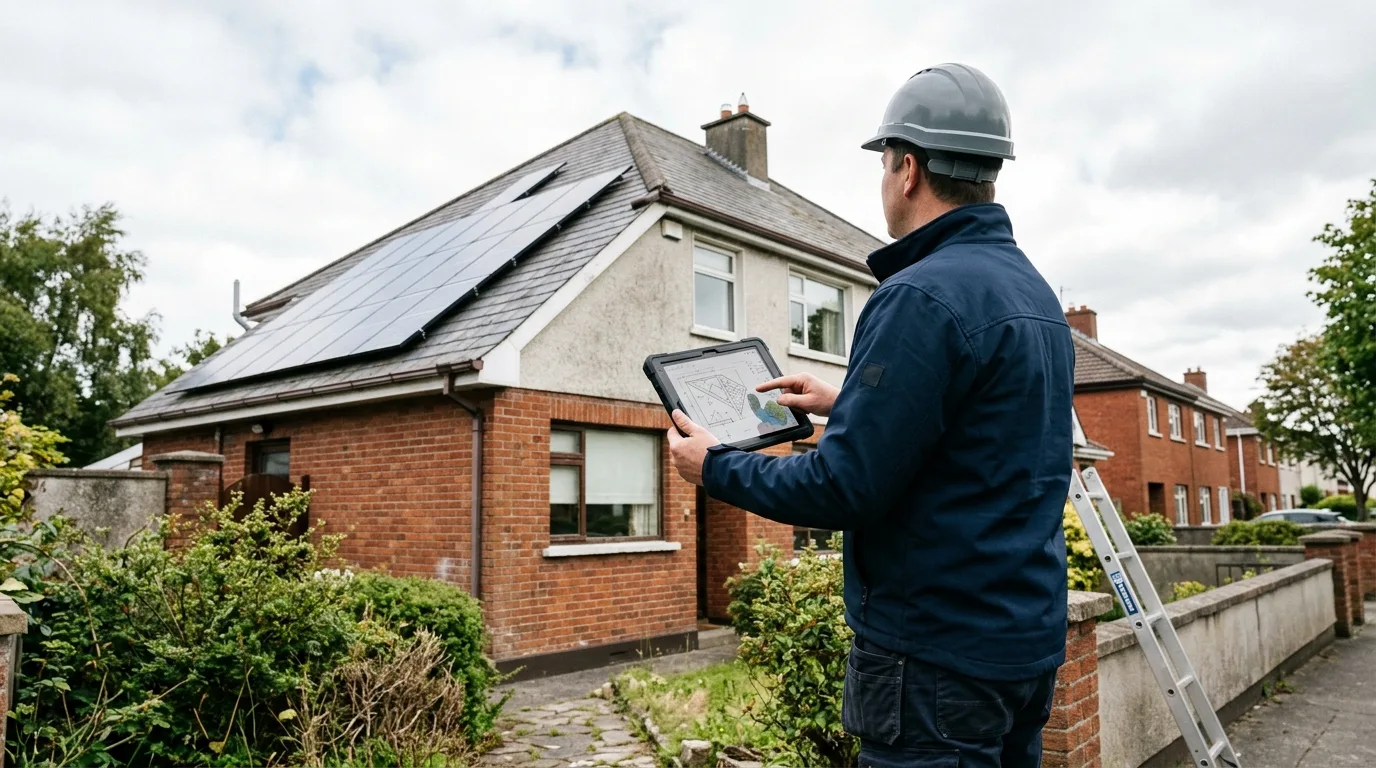
Getting solar PV sizing in Ireland right is the most important decision in your solar installation process. Undersized systems don't generate enough savings to pay back quickly. Oversized systems waste money on capacity that generates surplus you can't use effectively. The right size maximises your return within the constraints of your roof, your household's consumption, and your budget.
This guide walks you through the professional methodology for sizing a residential solar PV system in Ireland.
Step 1: Understand Your Electricity Consumption
Your starting point is your annual household electricity consumption in kWh. Find this on your electricity bills (annual statement) or add up 12 monthly bills.
Typical Irish household consumption (2026):
| Household Type | Annual Consumption |
|---|---|
| Small 2-person home | 2,500–3,500 kWh |
| 3-bed semi, family of 4 | 4,000–5,500 kWh |
| 4-bed house, family of 5 | 5,000–7,000 kWh |
| Home with electric car (15,000 km/yr) | +2,500–4,000 kWh |
| Home with heat pump (replacing gas) | +2,500–5,000 kWh |
| Home with both EV and heat pump | +5,000–9,000 kWh |
Action: Pull your last 12 months of electricity bills. Calculate total annual consumption. If you're planning to add an EV or heat pump within 3–5 years, add the expected load from the table above.
Step 2: Determine Available Roof Area and Orientation
Your roof constrains how large a system you can install. For south-facing pitched roofs in Ireland:
Panel dimensions (2026 standard):
- Typical 400–430 W monocrystalline panel: approximately 2.0–2.1 m² per panel
- Safety and access clearance required: minimum 30 cm from eaves, ridge, valleys, and roof windows
Roof space per kWp:
- 1 kWp ≈ 2.5 panels ≈ 5.0–5.3 m² of roof area
- 4 kWp ≈ 10 panels ≈ 20–21 m²
- 6 kWp ≈ 14–15 panels ≈ 28–32 m²
Practical limits by house type:
| House Type | Typical South-Facing Area | Maximum System Size |
|---|---|---|
| Terraced house | 15–22 m² | 3–4 kWp |
| Semi-detached (3-bed) | 20–30 m² | 4–5 kWp |
| Semi-detached (4-bed) | 25–38 m² | 5–7 kWp |
| Detached two-storey | 30–50 m² | 6–10 kWp |
| Bungalow (gable end) | 35–60 m² | 7–12 kWp |
| Dormer bungalow | 20–40 m² (minus dormers) | 4–8 kWp |
Step 3: Apply the Self-Consumption Sizing Rule
The self-consumption rule is the most important sizing principle:
The ideal system size is the one where the annual solar output roughly matches your daytime electricity consumption — the electricity you would use if you were home all day.
Why? Because:
- Every kWh you self-consume saves ~30 c (grid electricity rate)
- Every kWh you export earns ~20 c (MSS rate)
- Therefore, additional capacity beyond your self-consumption sweet spot generates lower returns per kWh
Daytime consumption estimation: A typical Irish household uses approximately 40–60% of their electricity during daytime hours (8am–6pm). For a household consuming 5,000 kWh/year:
- Daytime consumption: 2,000–3,000 kWh/year
- The "sweet spot" system size generates roughly this amount: 2,000–3,000 kWh/year
- At 900 kWh/kWp (Dublin average), this suggests a 2.2–3.3 kWp system
But this calculation is too conservative. Because:
- An immersion diverter can redirect surplus to hot water (equivalent to self-consumption)
- An EV charger can absorb surplus during the day
- A battery can store surplus for evening use
With an immersion diverter: Add an equivalent 1,000–1,500 kWh/year of effective "self-consumption" (hot water that no longer needs to be heated by immersion or boiler)
With a battery (10 kWh): Add 1,200–1,800 kWh/year of storage that acts as self-consumption at the battery charge/discharge efficiency
With an EV: Add 2,500–4,000 kWh/year that can be meaningfully timed to solar production
Step 4: The Sizing Formula
Recommended system size (kWp) = Target annual output (kWh) ÷ Specific yield (kWh/kWp)
Target annual output:
- Without battery/EV/diverter: 1.2–1.5 × daytime consumption
- With immersion diverter: 1.5–2.0 × daytime consumption
- With battery + diverter: 2.0–2.5 × daytime consumption
- With EV + battery + diverter: 2.5–3.5 × annual consumption (limited only by roof space)
Specific yield: Use local figure from our solar panel output guide — typically 880–1,020 kWh/kWp in Ireland.
Worked example — family of 4, south Dublin, 9-to-5 workers, no battery yet:
- Annual consumption: 5,000 kWh
- Daytime consumption (40%): 2,000 kWh
- With immersion diverter (adds 1,000 kWh "consumption"): effective target 3,000 kWh
- At 1.5× multiplier: target output = 4,500 kWh
- At 950 kWh/kWp (Dublin): 4,500 ÷ 950 = 4.7 kWp → round to 5 kWp (12–13 panels)
Step 5: SEAI Grant vs System Size Optimisation
The SEAI grant caps at €1,800 for systems 2 kWp and above. This means:
- A 2 kWp system and a 6 kWp system receive the same grant amount (€1,800)
- The grant per kWp decreases rapidly above 2 kWp
Should you install exactly 4 kWp to match the grant "cap"? No — this is a common misconception. The economics of larger systems (5–7 kWp) are typically still excellent even without additional grant support above 4 kWp, because the incremental output (at 900 kWh/kWp) generates real savings each year. The grant cap at 4 kWp simply means you don't get extra subsidy — you don't lose anything by going larger.
Exception: If your usable roof area genuinely limits you to 4 kWp, don't force a larger system. The grant structure happens to align with the natural limitation of many Irish roofs.
Sizing for EV Charging
If you have or are planning an electric vehicle, sizing up is strongly recommended. A typical EV driven 15,000 km/year consumes approximately 2,500–4,000 kWh. If you can charge the EV at home from solar surplus (using a smart EV charger like the myenergi Zappi that detects solar surplus and adjusts charge rate accordingly), this effectively becomes additional daytime self-consumption.
Example with EV: A family driving 20,000 km/year consuming 4,000 kWh for EV. Add this to base consumption of 5,000 kWh = 9,000 kWh total. A 7–8 kWp system can cover a large portion of this in summer while also offsetting winter import.
Sizing for Heat Pumps
A heat pump's electricity consumption is highly seasonal — concentrated in winter when solar output is lowest. This means solar PV cannot power a heat pump's full annual load.
Rule of thumb: Solar PV can cover approximately 20–35% of a heat pump's annual electricity consumption through spring/autumn direct use and summer hot water heating. This is still significant.
For new builds with heat pump: A 4–5 kWp system is typically specified — meeting regulatory NZEB requirements while providing the economic benefits. Going to 6–7 kWp doesn't add disproportionately more value for the heat pump load, but provides more summer surplus for EV charging.
Practical Size Recommendations by House Type
| House & Occupancy | Loads | Recommended System |
|---|---|---|
| 2-bed semi, retired couple | Standard | 3–4 kWp |
| 3-bed semi, family, 9-to-5 | + immersion diverter | 4 kWp |
| 3-bed semi, work from home | + immersion diverter | 4–5 kWp |
| 4-bed semi, family + EV | + EV charger + diverter | 5–6 kWp |
| Detached 5-bed, EV + heat pump | + battery + EV + diverter | 6–8 kWp |
| Rural bungalow, EV + heat pump | + battery + EV + diverter | 7–10 kWp |
Oversizing: When It's Not Worth It
A system becomes economically oversized when the incremental kWp generates electricity that will almost always be exported (at 20 c/kWh) rather than consumed (at 30 c/kWh). The "diminishing returns zone" starts when:
- Your annual export exceeds 60% of total generation (without battery)
- Your roof space would push you past 6 kWp but you have no battery, EV, or heat pump
- The extra panels cost more than the export income they generate over 7 years
In these cases, money is better spent on a battery, EV charger, or immersion diverter — all of which convert more of your generation into higher-value self-consumption.
Get 3 free solar quotes — free and no obligation.
Frequently asked questions
How many solar panels do I need for an average Irish home?
An average Irish family home (3–4 bedroom, 4,500–5,500 kWh annual consumption) typically needs 10–14 panels (4–5.6 kWp) for a well-balanced system. Homes with EVs or heat pumps may benefit from 14–18 panels (5.5–7.2 kWp).
Is 4 kWp the right solar system size for Ireland?
4 kWp is the most popular system size in Ireland because it aligns with the SEAI grant cap and suits most 3-bed semi-detached houses. But it's not universally correct — households with EVs, heat pumps, or large bungalows often benefit from 5–8 kWp systems, which are still financially excellent even without incremental grant funding above 4 kWp.
Should I oversize my solar system in Ireland?
Moderate oversizing (sizing 20–30% larger than pure self-consumption would suggest) is usually worthwhile because the extra kWp is cheap at the margin, and export income (18–21 c/kWh) still provides a positive return. Significant oversizing beyond your roof's natural capacity is rarely economical — better to spend the money on a battery or EV charger.
How many panels fit on a south-facing semi-detached house in Ireland?
A typical 3-bed Irish semi with a south-facing slope of 25–35 m² can fit 8–12 panels (3.2–4.8 kWp), depending on chimney placement and roof obstructions. A 4-bed semi with 30–42 m² can fit 10–14 panels (4–5.6 kWp).
Does adding an EV change my ideal solar panel system size?
Significantly, yes. An EV driven 15,000 km/year adds roughly 2,500–3,500 kWh to your annual electricity demand. If you use a smart EV charger (myenergi Zappi, Ohme) that charges from solar surplus, this effectively increases your self-consumption and justifies sizing up by 1.5–2 kWp.
Sources & further reading
- SEAI Solar PV Grant — Eligible System Sizes — Sustainable Energy Authority of Ireland
- PVGIS System Sizing Tool — European Commission Joint Research Centre
- SEAI Electricity Statistics Ireland — Sustainable Energy Authority of Ireland