Solar Battery Storage in Ireland 2026: Complete Guide for Homeowners
A home battery storage system can transform a solar PV installation from a daytime-only power source to an around-the-clock energy asset. This guide covers every aspect of solar battery storage in Ireland — costs, brands, sizing, and the honest financial case.
By Smart Solar Editorial · Updated 15 May 2026 · 9 min read
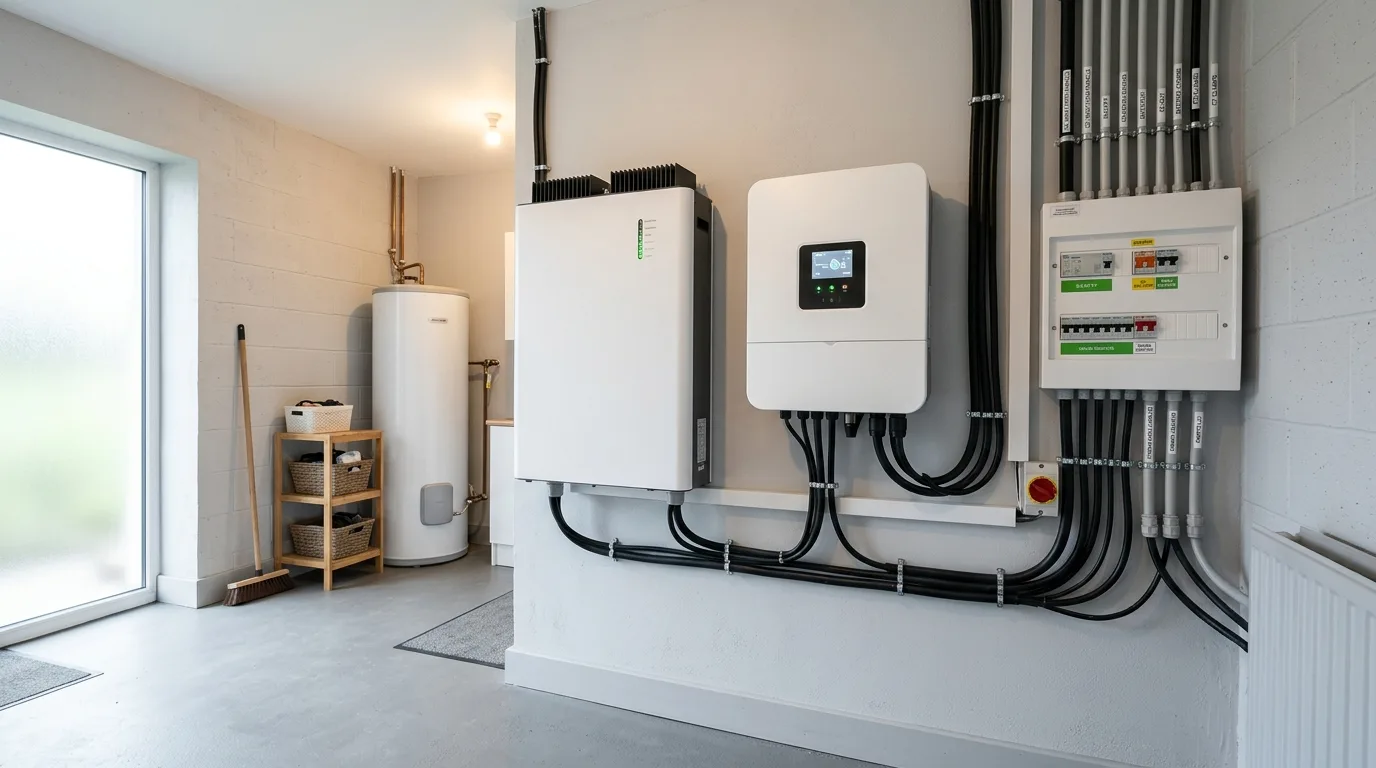
Solar battery storage in Ireland has reached a tipping point in 2026. Falling battery prices, rising electricity tariffs, and the availability of smart time-of-use tariffs have made home battery systems genuinely compelling — not just for energy independence enthusiasts, but for mainstream Irish homeowners looking to maximise their solar investment.
This guide covers everything you need to know: how battery storage works with solar PV, which batteries suit Irish homes, realistic costs, and an honest assessment of the financial case.
How Solar Battery Storage Works
A home battery system stores surplus solar electricity generated during the day for use in the evening and overnight. Without a battery, any solar electricity you generate at midday but don't immediately consume flows to the grid (earning only 18–21 c/kWh MSS export rate). With a battery, that surplus electricity is stored locally and displaces grid imports in the evening (worth 28–33 c/kWh avoided cost).
The charging and discharging cycle:
- Morning (pre-sunrise): Battery may discharge to power early morning loads (kettle, shower, heating)
- Morning rising sun: Solar panels start generating; early surplus begins charging battery
- Midday: Maximum solar generation. Battery charges rapidly; any excess beyond battery capacity is exported
- Afternoon: Battery approaches full state of charge; export increases
- Evening: Solar generation falls off; battery discharges to power household
- Night: Battery depleted; household imports from grid (but less than without battery)
A well-sized battery can shift 1,500–2,500 kWh per year from grid import to battery-stored solar — saving €450–€825 per year at 2026 electricity prices.
Battery Sizing for Irish Homes
The sizing principle: Match battery capacity to your evening and night-time electricity consumption, bounded by what your solar system can realistically charge in a day.
Rule of thumb:
- A 4 kWp solar system in Ireland generates approximately 10–14 kWh/day in summer, 2–5 kWh/day in winter
- A 5–10 kWh battery is practical for most family homes
- Batteries above 15 kWh are only worthwhile if you have an EV or heat pump load
Household sizing guide:
| Household Size | Evening/Night Use | Recommended Battery Size |
|---|---|---|
| 2-person home | 3–5 kWh | 5 kWh (usable) |
| Family of 4 | 6–9 kWh | 8–10 kWh (usable) |
| Family with EV | 10–15 kWh | 10–15 kWh (usable) |
| Large home, heat pump | 15–25 kWh | 15–20 kWh (usable) |
Important: Usable vs total capacity. Battery manufacturers quote total capacity, but usable capacity (respecting minimum state of charge to preserve battery life) is typically 80–95% of total for modern lithium iron phosphate (LFP) batteries.
Battery Chemistry: LFP vs NMC
Almost all home battery systems sold in Ireland in 2026 use one of two lithium battery chemistries:
Lithium Iron Phosphate (LFP)
- Safety: Non-flammable cathode material — dramatically lower fire risk than NMC
- Cycle life: 3,000–6,000 full cycles (8–16 years at one cycle per day)
- Energy density: Lower than NMC — larger/heavier batteries
- Calendar life: Excellent — degrades slowly even when partially charged
- Leading brands: BYD (B-Box HV), Pylontech, GivEnergy, sonnenBatterie, Solax, Solis
Lithium Nickel Manganese Cobalt (NMC)
- Energy density: Higher — more compact for the same kWh
- Safety: Greater thermal runaway risk than LFP — requires active cooling systems
- Cycle life: 1,500–3,000 cycles typically
- Historical use: Tesla Powerwall 2, earlier LG Chem RESU models
Our recommendation for Ireland: Choose LFP chemistry. The safety advantage is significant for indoor installation in Irish homes (utility rooms, garages). The cycle life advantage means the battery lasts longer than a typical mortgage term. Most new products from leading Irish installers are now LFP.
Leading Battery Brands in the Irish Market
BYD B-Box HV Premium (5–22.1 kWh)
BYD (Build Your Dream) is one of the world's largest EV and battery manufacturers. The B-Box HV Premium uses LFP chemistry in a scalable high-voltage system.
- Usable capacity: 4.6–21 kWh (scalable in modules)
- Warranty: 10 years, 80% capacity retention
- Compatibility: SolarEdge StorEdge, Fronius GEN24 Plus, Huawei, Sungrow, Goodwe
- Price (10 kWh): ~€4,500–€6,500 installed
GivEnergy (2.6–22.4 kWh)
GivEnergy is a British-headquartered battery company with strong Irish market presence and a good local support network.
- Usable capacity: ~95% of rated capacity (excellent)
- Warranty: 10 years
- Compatibility: GivEnergy hybrid inverters, AC-coupled with any inverter
- Price (9.5 kWh): ~€4,000–€6,000 installed
- Smart features: GivEnergy portal, octopus agile tariff integration
Pylontech (Force H1 series)
Pylontech is one of the largest LFP battery manufacturers globally. The Force H1 series offers modular stacking from 7.1 to 28.5 kWh.
- Warranty: 10 years, 80% capacity
- Compatibility: Virtually all hybrid inverters (Fronius, SolarEdge, Sungrow, Huawei)
- Price (7.1 kWh): ~€3,500–€5,500 installed
- Note: Wholesale pricing makes Pylontech a popular installer choice for price-conscious projects
SolarEdge Energy Bank
Purpose-built for integration with SolarEdge inverters. Uses LFP chemistry.
- Capacity: 9.7 kWh per unit, up to 3 units (29.1 kWh)
- Warranty: 10 years
- Compatibility: SolarEdge StorEdge inverters only
- Price (9.7 kWh): ~€5,000–€7,000 installed
Enphase IQ Battery 5P / 10T
Specifically designed for Enphase microinverter systems. AC-coupled LFP battery.
- Capacity: 5 kWh (5P) or 10 kWh (10T)
- Warranty: 15 years (5P), 10 years (10T) — industry-leading 15-year warranty
- Compatibility: Enphase IQ8 systems (best); AC-coupled with other inverters
- Price: 5P ~€3,500–€5,000; 10T ~€6,000–€8,500 installed
sonnenBatterie eco (5–15 kWh)
The sonnen (an Eon company) brand has a premium reputation for smart home energy management integration.
- Warranty: 10 years or 10,000 cycles (generous cycle warranty)
- Smart features: Virtual power plant capabilities, excellent software
- Price: Premium tier — expect €8,000–€12,000 for 10 kWh
Battery Costs in Ireland 2026
Total installed cost (battery unit + compatible inverter upgrade if needed + installation):
| Battery Size | Typical Installed Cost |
|---|---|
| 5 kWh (usable) | €2,500–€4,500 |
| 7.5–10 kWh (usable) | €4,000–€7,000 |
| 12–15 kWh (usable) | €6,000–€10,000 |
| 20+ kWh (usable) | €9,000–€16,000 |
Battery prices have fallen approximately 40% since 2022 and are expected to continue falling by 10–15% per year through 2028.
Note on grants: There is currently no SEAI grant specifically for home battery storage in Ireland. Battery systems can be included in broader home energy upgrade loans.
Is a Battery Worth It? The Financial Analysis
For a 4 kWp solar system, 10 kWh battery, south Dublin family home:
- Additional electricity shifted from export (20 c/kWh) to self-consumption (30 c/kWh): ~1,800 kWh/year
- Value of shift: 1,800 × (30 c - 20 c) = €180/year
- Reduced evening grid imports (battery replaces grid): 1,500 kWh × 30 c = €450/year
- Total annual battery benefit: ~€630/year
- Battery cost (10 kWh installed): €5,500
- Battery-specific payback: €5,500 ÷ €630 = 8.7 years
Battery payback periods of 7–12 years are typical for correctly sized Irish systems in 2026, compared to battery lifespan warranties of 10 years and likely operational life of 12–18 years. With rising electricity prices, payback improves each year.
Time-of-use tariffs (where cheaper night-rate electricity is available, e.g., Energia night boost or SSE Economy 7) add another dimension: the battery can be charged with cheap night-rate electricity and discharged during expensive peak hours. This "grid charging" use case can add €150–€300/year in additional value.
Key Takeaways
- A 10 kWh LFP battery added to a 4–6 kWp Irish solar system is a worthwhile investment in 2026
- LFP chemistry is the preferred choice for Irish home installations — safer and longer-lived than NMC
- Leading brands in Ireland: BYD, GivEnergy, Pylontech, Enphase IQ Battery, SolarEdge Energy Bank
- Typical cost: €4,000–€7,000 for a 10 kWh installed system
- Payback periods of 7–12 years — financially positive over the 10–15 year battery lifespan
- No SEAI grant for batteries, but green loans are available
- Consider a battery if: you're home in evenings, you have an EV, or you want grid resilience
Get 3 free solar quotes — free and no obligation.
Frequently asked questions
Is a home battery worth it in Ireland?
For most families with a solar PV system, a 7.5–10 kWh battery adds genuine value — payback of 7–12 years and meaningful additional bill savings of €500–€700/year. It's most worthwhile if you have high evening electricity loads (EV charging, heat pump, cooking) and a well-sized solar system (4 kWp+). Families who are rarely home in evenings get less benefit.
What is the best home battery for Ireland in 2026?
There is no single 'best' battery for all Irish homes. BYD B-Box HV, GivEnergy, and Pylontech Force H1 offer excellent value. Enphase IQ Battery is best for Enphase microinverter systems. SolarEdge Energy Bank is best for SolarEdge inverter systems. All reputable options use LFP chemistry, which is safer and longer-lived than NMC.
How long does a home battery last in Ireland?
Quality LFP home batteries are warranted for 10 years at 80% of original capacity (some, like Enphase, offer 15 years). In practice, a 10 kWh battery warranted for 6,000 cycles at one cycle/day has a theoretical life of 16+ years. Actual lifespan depends on usage pattern and temperature.
Is there a grant for home battery storage in Ireland?
No, there is currently no SEAI grant specifically for home battery storage in Ireland. Battery systems can be included in the SEAI Home Energy Upgrade Loan (green loan) financing. The government has discussed extending grant support to batteries — check the SEAI website for updates.
Can I add a battery to my existing solar PV system?
Yes, in most cases. An AC-coupled battery (like GivEnergy AC, Enphase IQ Battery, or sonnenBatterie) can be added to any existing solar system without replacing the inverter. DC-coupled batteries require a compatible hybrid inverter — if your existing inverter is not hybrid-ready, you'd need to replace it. Your installer can assess compatibility.
Sources & further reading
- SEAI Home Battery Information — Sustainable Energy Authority of Ireland
- CRU Electricity Tariff Information — Commission for the Regulation of Utilities
- IEA Battery Storage Market Update 2024 — International Energy Agency