Solar + Battery Economics in Ireland: Does the Numbers Stack Up in 2026?
Adding a battery to your solar PV system improves self-consumption and reduces grid imports — but does it actually pay back? This guide provides the complete financial analysis of solar plus battery economics for Irish homes in 2026.
By Smart Solar Editorial · Updated 15 May 2026 · 8 min read
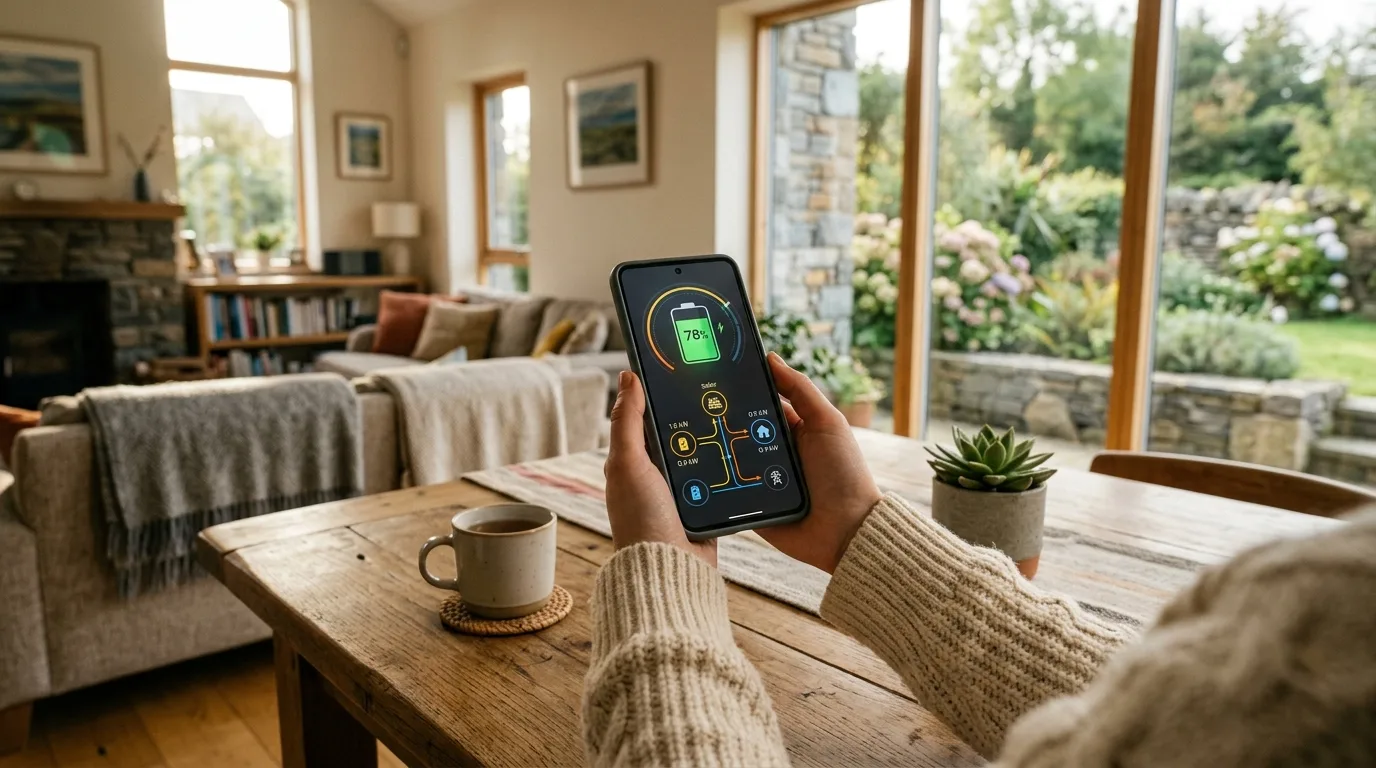
The question of whether solar battery payback in Ireland makes financial sense is one of the most nuanced in the Irish home energy market. The honest answer in 2026: it depends, and this guide gives you the specific variables that determine whether a battery is financially worthwhile for your household.
The Core Financial Mechanism
A solar battery earns its return through one primary mechanism: the arbitrage between export value and self-consumption value.
Without a battery:
- Surplus solar exported at 18–21 c/kWh (MSS rate)
With a battery:
- Surplus solar stored and self-consumed later at 28–33 c/kWh avoided grid import
The net value per kWh diverted by the battery = 30 c (avoided grid import) - 20 c (foregone export) = 10 c/kWh
Secondary benefit: electricity the battery prevents importing in the evening at peak-rate tariffs.
Battery Value Calculation: The Three-Part Model
For Irish solar + battery economics, the annual battery value comes from:
Part 1: Solar Surplus Diversion (Daytime)
Solar electricity that would otherwise be exported is stored in the battery and used in the evening.
Value = kWh diverted × 10 c/kWh (arbitrage margin)
For a 4 kWp system (3,700 kWh/year) with a 9-to-5 household:
- Without battery: self-consumption 35% → 1,295 kWh used, 2,405 kWh exported
- With 10 kWh battery: self-consumption 70% → 2,590 kWh used, 1,110 kWh exported
- kWh diverted from export to battery: ~1,295 kWh
- Part 1 value: 1,295 × 10 c = €129.50/year
Part 2: Avoided Evening Grid Imports
The battery discharges in the evening to power the home instead of importing from the grid.
Value = kWh discharged × 30 c/kWh (full avoided import rate)
The 1,295 kWh stored replaces 1,295 kWh of evening grid imports:
- Part 2 value: 1,295 × 30 c = €388.50/year
Wait — doesn't this double-count?
The actual combined net value is: kWh diverted × (30 c avoided grid - 0 c for battery self-charge). But we must subtract the foregone export income from Part 1. So:
- Total battery value = (1,295 × 30 c) - (1,295 × 20 c foregone) = 1,295 × 10 c = €129.50
No, this is wrong. Let me restate correctly:
The true incremental value of the battery:
- For each kWh the battery intercepts (stores instead of exporting): the household gains 10 c (30 c avoided grid import - 20 c foregone export)
- But the battery also covers evening grid consumption that was never going to be covered by solar anyway
The comprehensive approach:
Total battery annual value = Extra self-consumed kWh × (avoided import rate)
Without battery: consumes 1,295 kWh solar + imports 7,205 kWh grid = 8,500 kWh total With battery: consumes 2,590 kWh solar + imports 5,910 kWh grid = 8,500 kWh total
Battery reduces grid imports by 1,295 kWh:
- Grid imports avoided: 1,295 kWh × 30 c = €388.50/year saved
- Export income lost: 1,295 kWh × 20 c = €259/year lost
- Net battery benefit: €388.50 - €259 = €129.50/year
Part 3: Time-of-Use Tariff Arbitrage
Irish electricity suppliers are introducing time-of-use (TOU) tariffs where night-rate electricity is cheaper than daytime. Examples:
- Energia Night Boost: Night rate ~15 c/kWh (11pm–8am)
- SSE Airtricity Economy 7: Off-peak rate ~14 c/kWh
A battery on a TOU tariff can charge from the grid at night at 14–15 c/kWh and discharge during peak daytime at 28–33 c/kWh:
Net arbitrage value per kWh: 30 c - 15 c = 15 c/kWh
With a 10 kWh battery cycling once daily, 200 days/year on grid charging:
- Grid-charged kWh: 10 kWh × 200 days = 2,000 kWh/year
- Additional value: 2,000 × 15 c = €300/year
This "grid charging" use case can double the battery's annual financial contribution.
Complete Worked Examples
Scenario A: Standard 9-to-5 Family, 4 kWp + 10 kWh Battery, No TOU Tariff
- Solar self-consumption increase: +1,295 kWh/year
- Net battery benefit (solar arbitrage): €129.50/year
- Battery cost: €5,500 installed
- Battery payback: €5,500 ÷ €129.50 = 42 years — not financially justified
This is the 'naive' calculation that makes batteries look bad. It ignores Part 3.
Scenario B: 9-to-5 Family, 4 kWp + 10 kWh Battery, WITH TOU Tariff
- Solar arbitrage benefit: €129.50/year
- TOU grid charging benefit: €300/year
- Total annual benefit: €429.50/year
- Battery cost: €5,500
- Battery payback: €5,500 ÷ €429.50 = 12.8 years — borderline but viable given battery lifespan of 12–18 years
Scenario C: Work-from-Home Family, 6 kWp + 10 kWh Battery, TOU Tariff
- Self-consumption rate without battery: 55% → 3,135 kWh solar consumed
- With battery: 80% → 4,560 kWh solar consumed
- Extra solar consumed: 1,425 kWh
- Solar arbitrage net benefit: 1,425 × 10 c = €142.50/year
- Reduced export income: already low (high daytime consumption)
- TOU grid charging: €300/year
- Total annual benefit: €442.50/year
- Battery cost: €5,500
- Battery payback: 12.4 years — similar
Scenario D: EV Household, 6 kWp + 10 kWh Battery, Smart EV Charging
When you add an EV charged from solar surplus + battery, the self-consumption rate can reach 85–90%:
- Avoided EV charging at grid rate (vs solar): significant uplift
- At 30 c/kWh for 3,000 kWh of solar-charged EV driving vs 15 c/kWh night-rate charging: €450/year additional value
- Total battery + EV system benefit: €750–€1,000+/year
- Battery payback (including EV synergy): 5.5–7.3 years — genuinely compelling
Sensitivity Analysis
| Variable | Impact on Battery Payback |
|---|---|
| Electricity prices rise 5%/year | -2 to -3 years (improves case) |
| TOU tariff available | -5 to -8 years (major improvement) |
| EV at home | -4 to -6 years |
| Heat pump (winter-heavy) | -1 to -2 years |
| 9-to-5, no EV, no TOU | +8 to +15 years (poor case) |
When Is a Battery Financially Worthwhile in Ireland?
Strongly justified (payback 6–9 years):
- Household with EV and smart solar charging
- TOU tariff + active battery management
- Work-from-home household with moderate-high electricity use
- Large solar system (6+ kWp) with low daytime occupancy
Marginally justified (payback 10–14 years):
- Standard 4 kWp system, 9-to-5 household, TOU tariff
- With rising electricity prices, borderline cases become financially positive
Difficult to justify purely financially (payback 15+ years):
- Small 2–3 kWp system with high daytime self-consumption already
- No TOU tariff, standard import rate
- Household with very low evening electricity use
Non-financial reasons to add a battery regardless of pure payback:
- Grid resilience (Enphase Sunlight Backup, or battery backup during outages)
- Energy independence value
- EV flexibility (charge from any-time solar, not just daytime)
- Time-shift electric heating loads
The Rising Electricity Price Argument
Irish electricity prices have risen substantially over the past decade and continue rising due to:
- Carbon tax escalation (legislated to €100/tonne by 2030)
- Network infrastructure costs
- Gas price volatility pass-through
Every 1 c/kWh increase in electricity price adds approximately €13/year to a 10 kWh battery's annual value (at 1,300 kWh annual throughput). If prices rise by 5 c/kWh over the next 5 years, battery annual value improves by ~€65/year — cutting payback by 1–2 years.
Conclusion
Solar battery payback in Ireland in 2026 ranges from 6–15+ years depending on your usage profile. The battery makes clear financial sense for EV-driving households and those on TOU tariffs. It's borderline for standard 9-to-5 families on standard tariffs. Battery prices continue falling, improving the case year by year.
For most Irish families already committed to solar PV, adding a battery at the time of installation (when installation is already in place) is cheaper than retrofitting later — making the integrated solar + battery decision more attractive than the numbers alone suggest.
Get 3 free solar quotes — free and no obligation.
Frequently asked questions
Is a solar battery financially worthwhile in Ireland?
It depends heavily on your usage pattern. With a TOU tariff and smart battery management, payback of 10–14 years is achievable. Add an EV charged from solar and payback improves to 6–9 years. For a standard 9-to-5 household on a standard tariff with no EV, the pure financial case is marginal — non-financial benefits (resilience, energy independence) may tip the balance.
What is the best time-of-use tariff for a solar battery in Ireland?
Energia Night Boost and SSE Airtricity Economy 7 are the main TOU tariffs available in Ireland. Night rates of 14–15 c/kWh allow the battery to charge cheaply overnight and discharge at 28–33 c/kWh during peak hours, adding €200–€350/year in additional value to a battery system.
Does adding a battery increase my solar panel payback period?
Yes, technically. The combined solar + battery system has a longer payback period than solar alone because the battery adds cost with a moderate return. However, solar payback is typically 6–9 years, and the combined system payback is typically 10–15 years — both within the lifetime of the technology. The battery extends payback but adds value, resilience, and improved self-sufficiency.
When should I install a battery — at the same time as solar or later?
Installing a battery at the same time as solar is usually cheaper (combined installation saves €300–€800 in labour vs separate installations). However, battery prices are falling, so waiting 2–3 years before adding a battery gets you more capacity for less money. If you specify a hybrid-ready inverter at installation, you preserve the option to add a battery later at lower cost.
How much does a 10 kWh battery cost in Ireland in 2026?
A 10 kWh usable capacity battery (BYD, GivEnergy, or Pylontech) costs approximately €4,500–€7,000 installed in 2026, depending on brand, inverter compatibility, and whether the inverter needs upgrading. Prices have fallen roughly 40% since 2022 and are expected to continue falling.
Sources & further reading
- CRU Smart Meter and TOU Tariff Framework — Commission for the Regulation of Utilities
- IEA Global Battery Storage Costs Report — International Energy Agency