Monocrystalline vs Polycrystalline Solar Panels in Ireland: Which Should You Choose?
Monocrystalline panels dominate the Irish market — but is the higher efficiency worth the cost difference? This guide explains what monocrystalline vs polycrystalline means in practice for Irish rooftops, Irish light conditions, and Irish budgets.
By Smart Solar Editorial · Updated 15 May 2026 · 7 min read
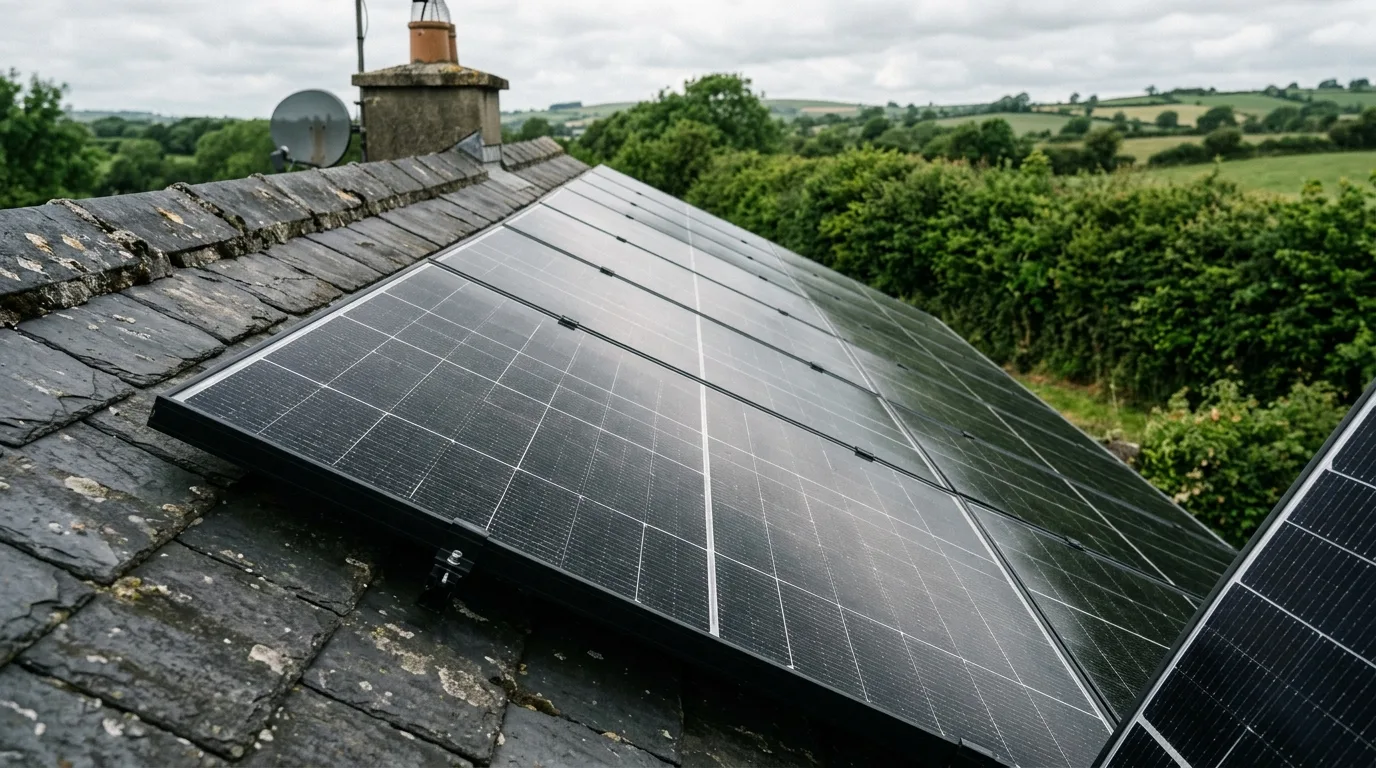
One of the first technical choices when buying solar panels in Ireland is the cell technology: monocrystalline vs polycrystalline. The terminology sounds complex, but the practical difference comes down to how the silicon is manufactured — and what that means for efficiency, appearance, and cost in Irish conditions.
The short answer for 2026: monocrystalline panels have won. The price gap between mono and poly has largely closed over the past five years, while mono's efficiency advantage has grown. Virtually every SEAI-registered installer in Ireland now installs monocrystalline panels as standard, and leading brands — REC, Longi, JA Solar, Jinko Solar, Panasonic — have discontinued most of their polycrystalline lines. But understanding the reasons why gives you important context for evaluating your quote.
What Is a Monocrystalline Solar Panel?
Monocrystalline solar cells are cut from a single, continuous crystal of silicon grown using the Czochralski process. The result is a highly uniform crystal structure that allows electrons to flow through with minimal resistance. You can identify monocrystalline cells by their uniform black or dark navy colour and slightly rounded corners (which are trimmed from the circular silicon boule during manufacturing).
Key characteristics:
- Efficiency: 19–24% for standard residential panels (top-tier models reach 22–24%)
- Appearance: Uniform dark black or navy, cleaner look on roof
- Temperature coefficient: ~-0.30 to -0.35% per °C (better than poly)
- Performance in diffuse light: Excellent
- Lifespan: 25–30+ year performance warranty standard
What Is a Polycrystalline Solar Panel?
Polycrystalline cells are made by melting multiple silicon fragments together and allowing them to cool in a mould. This process is cheaper and wastes less silicon, but the resulting crystal structure is fragmented, which creates boundaries that impede electron flow.
Key characteristics:
- Efficiency: 15–18% for standard residential panels
- Appearance: Blue speckled/iridescent look (from multiple crystal reflections)
- Temperature coefficient: ~-0.40 to -0.45% per °C (worse than mono)
- Performance in diffuse light: Good, but slightly lower than mono
- Lifespan: 20–25 year performance warranty typically
Why Does Efficiency Matter for Irish Roofs?
Roof space is a real constraint for many Irish homes, particularly semi-detached houses, terraced houses, and bungalows with hipped roofs or limited south-facing pitch. Higher efficiency means more watts per square metre — so you can fit a larger system into the same roof area.
A 400 W monocrystalline panel typically measures 1.75 m × 1.1 m (1.92 m²). A 320 W polycrystalline panel of similar size might measure 1.65 m × 0.99 m. In the same 20 m² of south-facing roof space:
| Panel Type | Panels Possible | Total Capacity |
|---|---|---|
| Mono 420 W (21% eff.) | 10 panels | 4.2 kWp |
| Poly 320 W (17% eff.) | 10 panels | 3.2 kWp |
That extra kilowatt-peak generates approximately 850–1,050 kWh more electricity per year — worth €250–€350 in avoided electricity costs plus export income.
Performance Under Irish Diffuse Light Conditions
This is where monocrystalline vs polycrystalline differences become particularly relevant for Ireland. Irish irradiance is characterised by a high proportion of diffuse radiation — light scattered through clouds — rather than direct beam radiation.
Research and real-world monitoring data consistently show that monocrystalline panels have a slight advantage in diffuse light conditions, primarily because:
- The uniform crystal structure reduces internal resistance under low-intensity light
- Modern PERC (Passivated Emitter Rear Contact) monocrystalline technology adds a rear reflector layer that recaptures photons that would otherwise be lost
- Mono's better temperature coefficient means it performs closer to rated output on the cool-but-overcast days that dominate Irish winter
The difference is modest — perhaps 3–5% better real-world output per kWp under Irish conditions — but it's consistent year-round.
Modern Monocrystalline Technologies
The monocrystalline category has evolved significantly. In 2026, almost all new panels installed in Ireland use one or more of these enhanced technologies:
PERC (Passivated Emitter Rear Contact)
A passivation layer on the rear of the cell reflects unabsorbed photons back through the cell for a second pass. PERC adds 1–2 percentage points of efficiency over standard mono. Most mainstream brands (Longi, JA Solar, Jinko) now use PERC as standard.
Half-Cut Cells
The silicon cell is laser-cut into two halves, reducing resistive losses. Half-cut panels also perform better under partial shading because the top and bottom halves operate as separate circuits. Standard on almost all 2024–2026 panels from major brands.
TOPCon (Tunnel Oxide Passivated Contact)
The next generation after PERC. TOPCon adds a thin tunnel oxide layer to further reduce recombination losses. Efficiency reaches 21–23%. Longi Hi-MO6, JA Solar Deep Blue 4, and REC Alpha Pure-R use TOPCon technology. Expect to pay a 5–10% premium but gain measurably higher output.
HJT (Heterojunction Technology)
Combines crystalline silicon with amorphous silicon layers for efficiencies up to 22–24%. REC Alpha, Panasonic EverVolt, and Meyer Burger White use HJT. Best-in-class for Irish diffuse light performance. Premium priced but increasingly mainstream.
IBC (Interdigitated Back Contact)
All contacts moved to the rear, eliminating shading from front bus bars. Sunpower and REC Alpha Pure-R use IBC. Very high efficiency (22–24%) but premium cost — mainly used where roof space is severely limited.
Brand Guide for Irish Buyers
| Brand | Technology | Typical Module | Irish Market Position |
|---|---|---|---|
| Longi Solar | PERC / TOPCon | Hi-MO6 (425–435 W) | Volume leader, excellent value |
| JA Solar | PERC / TOPCon | Deep Blue 4 (415–430 W) | Strong mid-market |
| Jinko Solar | PERC / TOPCon | Tiger Neo (420–440 W) | High volume, competitive pricing |
| REC Group | TOPCon / HJT | Alpha Pure-R (430–450 W) | Premium, Norwegian brand, popular in Ireland |
| Panasonic | HJT | EverVolt (410–430 W) | Premium, 25-yr product warranty |
| Q CELLS | Q.ANTUM (PERC) | Q.PEAK DUO (405–425 W) | German quality, mid-premium |
All brands above carry a minimum 25-year linear performance warranty guaranteeing at least 80% of original output at year 25.
Cost Comparison in 2026
Polycrystalline panels are rarely installed in Ireland now, but when quoted, expect:
- Polycrystalline: €0.25–€0.35 per Wp (module only)
- Standard PERC monocrystalline: €0.28–€0.38 per Wp
- TOPCon monocrystalline: €0.32–€0.42 per Wp
- HJT monocrystalline: €0.40–€0.55 per Wp
In a complete installed system of 4 kWp, the panel cost difference between PERC mono and HJT might be €300–€500. Given HJT's better performance over 25 years, it usually represents better value in space-constrained installations.
The Verdict for Irish Homeowners
Choose monocrystalline every time in 2026. Specifically, look for PERC or TOPCon technology from reputable brands like Longi, JA Solar, REC, or Jinko. The price difference versus any remaining polycrystalline options is minimal, while the efficiency, aesthetics, diffuse-light performance, and warranty quality are meaningfully better.
If your roof has generous south-facing space and budget is tight, a good PERC panel from Longi or Jinko offers outstanding value. If your roof is limited to 10–12 m² of south-facing space, step up to a TOPCon or HJT panel to extract maximum output from every square metre. See our guide on solar system sizing in Ireland to work out exactly how many panels your roof can accommodate.
When comparing quotes, always check:
- The specific panel model and wattage
- The efficiency percentage
- The product warranty (12–25 years)
- The performance warranty (25 years, minimum 80% at year 25)
- Whether the manufacturer has a UK/Ireland distribution presence for warranty claims
Get 3 free solar quotes — free and no obligation.
Frequently asked questions
Are polycrystalline panels still available in Ireland?
Polycrystalline panels are largely discontinued by major manufacturers in 2025–2026. Some budget suppliers still stock older poly stock, but SEAI-registered installers almost universally recommend monocrystalline PERC or TOPCon panels for new installations. There is no meaningful cost advantage to poly anymore.
What efficiency should I look for in a solar panel for Ireland?
For most Irish roofs, look for panels with efficiency of at least 20% (PERC or TOPCon technology). Premium HJT panels reach 22–24% efficiency and are worth considering if roof space is limited. Efficiency above 22% delivers diminishing returns for most standard-sized roofs.
What is a half-cut cell panel and should I get one?
Half-cut cell panels split each silicon cell into two halves, reducing resistive losses and improving shade performance. They are now the standard technology — virtually every new panel installed in Ireland in 2026 uses half-cut cell technology. You don't need to specifically request them; they should be standard in any quality quote.
Which solar panel brand has the best warranty for Ireland?
REC Group and Panasonic offer market-leading 25-year product warranties (covering defects) alongside the standard 25-year performance warranty. Longi, JA Solar, and Q CELLS offer 12–15 year product warranties with 25-year performance guarantees. For a complete Irish installation, confirm the installer carries warranty liability too.
Does panel colour affect performance?
Colour (black vs blue) is mainly aesthetic. Black monocrystalline panels are more efficient than blue polycrystalline panels, but that's a function of the technology, not the colour. Some homeowners in conservation areas prefer all-black panels (with black frames and backsheet) for aesthetics — these are available at a small premium.
Sources & further reading
- SEAI Solar PV Grant — Panel Requirements — Sustainable Energy Authority of Ireland
- European Commission PVGIS Solar Irradiance Data — European Commission Joint Research Centre