Energy audit for commercial heating: when, how and what it costs in Ireland
Before you sign a six- or seven-figure heat pump contract, an energy audit is the single most valuable few thousand euro you'll spend — and SEAI requires it for EXEED-funded projects.
By Smart Solar Editorial · Updated 15 May 2026 · 10 min read
Every commercial heat pump project worth its capex starts the same way: with an energy audit. Not because the brochure says so — because without one you'll oversize the plant, miss low-cost wins, and most importantly fail the EXEED grant gate that SEAI imposes on every funded project over €10,000.
This is the practical Irish guide to commercial heating energy audits in 2026 — what they involve, who can do them, what they cost, and how they feed into a heat pump business case.
Why energy audits matter before a heat pump project
Heat pumps are sized to the building's peak heat demand. Get that wrong and you over-spec by 30–60%, paying twice for capacity you'll never use and running the units inefficiently at low part-load most of the year. Get it right and you can often drop a planned 400 kW system to 250 kW after envelope improvements — saving €150,000–€250,000 in equipment alone.
The audit gives you:
- Verified annual heat demand in MWh/year, broken down by space heating, domestic hot water (DHW), process heat and ventilation
- Peak load in kW (the number that sizes the heat pump)
- Load duration curve — how many hours per year the building actually needs the peak
- BER (Building Energy Rating) and the recommendations to reach SEAI's B-rating heat pump grant threshold
- Building fabric condition — U-values, air-tightness, insulation gaps
- Existing system performance — boiler efficiency, distribution losses, control strategy
- Pre-investment baseline that EXEED needs for its monitoring & verification (M&V) plan
Without that data, every EPC contractor tendering will hedge their bets and quote you a different (and usually larger) system.
SEAI requires it for EXEED
The EXEED programme (Excellence in Energy Efficient Design) funds up to 30% of qualifying capex — capped at €3M — for non-domestic energy projects. To qualify you must follow the EXEED protocol, which includes a documented design process anchored in a baseline energy audit.
Specifically, EXEED requires:
- A certified energy auditor (SEAI registered) to complete the baseline
- Audit data aligned with ISO 50001 / SI 215 energy-management principles
- A measurement and verification plan (typically IPMVP Option C — whole-facility metering)
- Post-project verification within 12–18 months of commissioning
Skip or short-cut the audit and your EXEED application gets rejected at desk review. Worse, you lose the right to claim the grant retrospectively — EXEED only funds projects designed under its protocol from the start.
The three audit levels you'll hear about
ASHRAE defines three audit levels that have become the de-facto standard in Ireland for commercial work:
Level 1 — walk-through audit
A surveyor spends half a day on site, reads recent ESB bills, eyeballs the plant room, and writes a 5–10 page summary of obvious opportunities. Cost: €1,500–€3,500. Useful for a quick yes/no on whether deeper investigation makes sense — not enough on its own for a heat pump business case.
Level 2 — detailed energy audit
Two to five days on site, detailed sub-metering review (or temporary metering installed), building fabric assessment, occupancy interviews, control-system review, full BER if not already certified, and a 30–80 page report with prioritised recommendations and indicative paybacks. Cost: €5,000–€15,000 for a mid-sized commercial building (1,000–5,000 m²). This is the level you need for an EXEED-funded heat pump project.
Level 3 — investment-grade audit
Adds detailed measurement campaigns (typically 4–12 weeks of half-hourly logging on each major end-use), engineering calculations on each retrofit option, life-cycle costing, and a financial model accurate enough to underpin a debt facility or guaranteed savings contract. Cost: €15,000–€40,000+. Used for projects over €1M or where third-party finance (e.g., Energy Performance Contracting) is involved.
For a typical Irish commercial heat pump retrofit, you want a Level 2 audit — sometimes upgraded with temporary kWh metering on the existing boiler if no half-hourly sub-meter exists.
Who can do an audit in Ireland
You want one of these:
- SEAI Registered Auditor under the Triple E or SME audit programme (search the SEAI register before signing)
- CEM (Certified Energy Manager) from the Association of Energy Engineers (AEE)
- Engineers Ireland Chartered Engineer with energy specialism
- ISO 50001 lead auditor if you're aligning with formal energy-management certification
Many Irish MEP consultancies and EPC contractors offer the audit in-house — but be cautious about audit-and-install conflicts of interest. The cleanest setup is to engage an independent auditor first, take the report to tender, and let three EPC contractors quote against the same brief.
Common independent firms working the Irish commercial heat pump market: Energy Action, Energia Customer Solutions, Mercury Engineering's energy services arm, Climote, EPS Group, and the in-house teams at ESB Smart Energy Services and Bord Gáis Energy Solutions.
What an audit looks like on site
A typical Level 2 audit for a 2,500 m² office or warehouse takes 2–3 site days plus 1–2 weeks of desk analysis. Expect the auditor to:
- Pull 24 months of utility data — electricity (half-hourly if MIC > 30 kVA), gas/oil/LPG delivery records, water for cross-reference
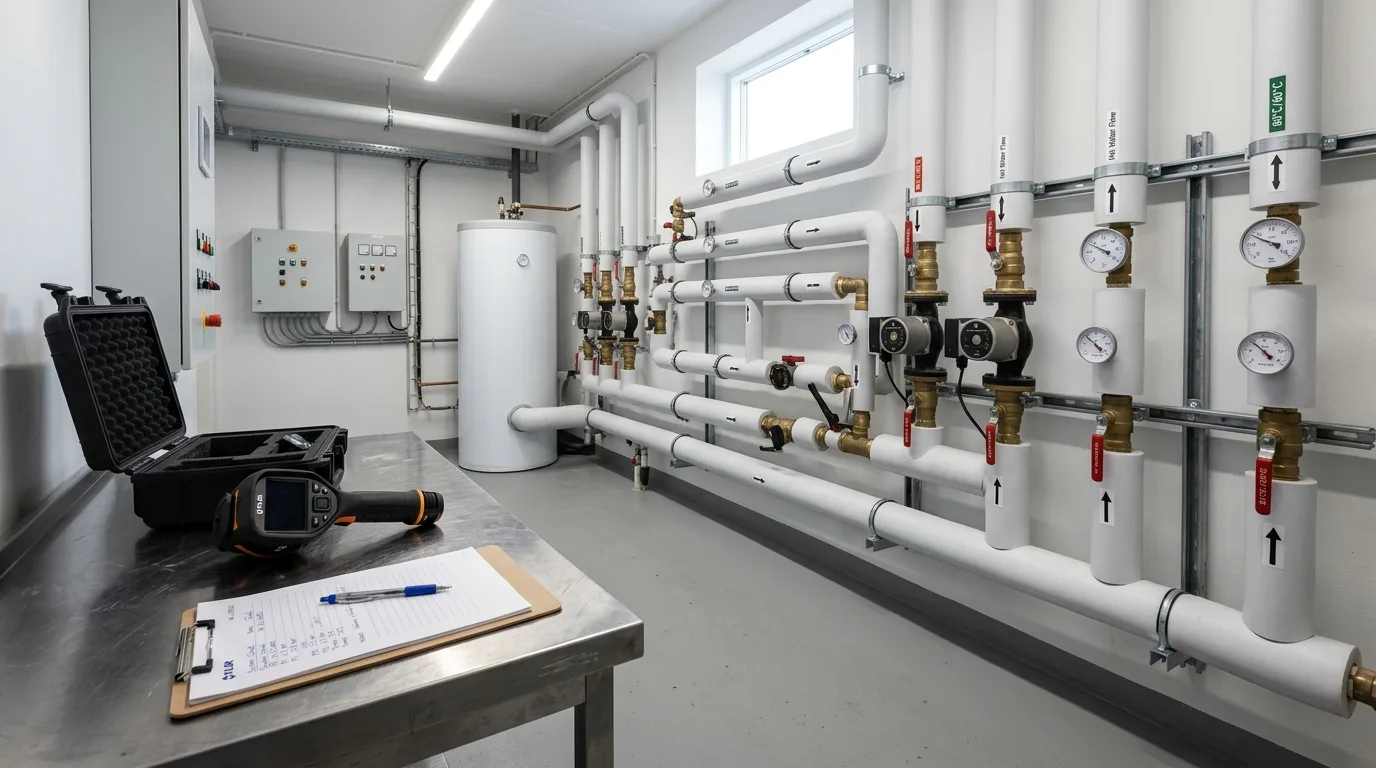
- Walk the building floor by floor with a thermal-imaging camera, noting fabric condition, glazing, air-tightness clues (curtains, draughts), and existing controls
- Sit with the FM for an hour to understand operational hours, complaints, summer/winter setbacks
- Inspect the plant room — boiler nameplates, age, last service report, distribution temperatures, valve positions
- Sub-meter major loads if not already in place — often a CT clamp on the boiler feed for a week
- Take photos and U-value samples for the BER recalculation
- Run the energy model (often DEAP for BER + IES VE or a simpler spreadsheet for HVAC)
The deliverable is a report with:
- Energy use intensity (EUI) in kWh/m²/year benchmarked against CIBSE TM46 for Irish buildings of that type
- Top 5–10 ranked retrofit measures with capex, savings, payback and CO₂ impact
- Recommended heat pump capacity range and refrigerant suitability
- BER rating today and projected after fabric + plant retrofit
- M&V plan ready for EXEED submission
Typical findings — what audits surface that surprise clients
In Irish commercial buildings auditors routinely find:
- Boilers oversized by 50–100% — installed for a worst-case design day that never actually occurs. Result: short-cycling, low part-load efficiency
- Distribution losses of 10–20% — uninsulated pipework in unheated voids, leaky valves
- Heating during unoccupied hours — controls set to "always on" because nobody knows the BMS password
- Domestic hot water tanks at 65°C when 55°C with Legionella controls would suffice (matters for heat pump COP)
- Existing radiators sized for 80/60 °C flow — a heat pump at 50/45 °C will under-deliver unless rads are upsized or replaced
- Air-tightness worse than building regs — adding 10–20% to the design heat load you'd otherwise calculate
Each of these is either a no-cost fix you should do before sizing the heat pump, or a critical input that changes the equipment you specify.
What the audit costs and how it pays back
A Level 2 audit on a 2,500 m² Irish commercial building costs €6,000–€10,000. SEAI offers a Support Scheme for Energy Audits (SSEA) that grants up to €2,000 per audit for SMEs — search "SEAI energy audit voucher" on seai.ie.
The audit pays back through:
- Right-sized equipment (typical saving €50k–€200k on heat pump capex for a 250 kW project)
- No-cost operational fixes identified during the walk-through (typical 5–15% bill reduction in year one)
- EXEED eligibility (up to €3M grant per project)
- ACA acceleration — qualifying heat pump assets can be written off at 100% in year one under the Accelerated Capital Allowance scheme, but only with documented energy data
For most projects the audit cost is recovered in the first 6–18 months — long before the heat pump is even commissioned.
Where audits intersect with the heat pump tender
Once the audit is in hand, you take the data to a competitive tender. The audit gives the heat pump EPC tenderers the same starting point:
- Peak load (kW)
- Annual demand (MWh)
- Required flow temperature
- DHW load profile
- Space constraints (plant room, refrigerant route, external unit location)
- Electrical capacity (MIC, distribution voltage)
- Existing distribution status (radiators, AHUs, fan coils)
You should expect EPC quotes that match within ±10% on equipment sizing. If they vary by 30%+ it's because the brief wasn't tight enough — and that's the audit's job to fix.
Audit pitfalls to avoid
- Don't accept an audit done by the same EPC who'll quote — at least not without explicit independence safeguards
- Don't pay for a Level 1 walk-through and call it a feasibility study — you'll under-spec the brief and over-pay the EPC
- Don't skip sub-metering if half-hourly data isn't already available — a week of CT-clamp logging costs €500–€1,500 and is worth 100× that in tender accuracy
- Don't let the BER lapse — heat pump grant eligibility hangs on a current B rating (or technical assessment alternative)
- Don't audit without ISO 50001 alignment if you'll later certify the management system — re-auditing is expensive
A pragmatic 8-week audit-to-tender timeline
| Week | Activity |
|---|---|
| 1 | Issue audit RFP to 3 SEAI-registered auditors, evaluate proposals |
| 2 | Appoint auditor, sign NDA, request 24 months of utility data |
| 3 | Site visits, BER fieldwork, plant room walk-through |
| 4 | Temporary metering install + 7–14 days logging |
| 5 | Desk analysis, energy modelling, draft report |
| 6 | Report review meeting with FM and finance, agree retrofit priorities |
| 7 | Finalise audit, lock M&V plan, submit EXEED Phase 1 (Design) application |
| 8 | Issue heat pump EPC tender pack based on audit brief |
By week 8 you have a fully-specified brief, an EXEED Design Stage submission in flight, and a clear path to a heat pump quote you can actually compare.
Bottom line
An energy audit is not a tick-box exercise — it's the document that determines whether your heat pump retrofit lands a 30% EXEED grant or gets sent back as ineligible, whether you buy 250 kW or 400 kW of equipment, and whether the system delivers the SCOP you signed up for in the contract.
For commercial heat pumps in Ireland in 2026, the rule is simple: no audit, no tender. Spend €6k–€10k now to save €50k–€200k later — and unlock €100k–€3M of EXEED grant in the process.
Read about EXEED grant conditions or how to size a commercial heat pump next.
Get 3 free commercial heat pump quotes — free and no obligation.
Frequently asked questions
Is an energy audit really mandatory for an EXEED grant?
Yes, in practice. EXEED follows the SEAI Excellence in Energy Efficient Design protocol, which requires a documented baseline energy audit, a measurement and verification (M&V) plan and a structured design process. Without these, the Phase 1 (Design) application is rejected.
Can my EPC contractor do the audit?
They can — but the EXEED programme prefers independence between the auditor and the installing contractor. The safest setup is to engage an independent SEAI-registered auditor first, then take their report to a competitive EPC tender. Some EPCs offer a 'design and install' bundle with the audit included — be alert to the conflict of interest and ask for transparent assumptions.
How long does a commercial energy audit take?
A typical Level 2 audit for a 1,000–5,000 m² Irish commercial building takes 6–8 weeks from kick-off to final report — including 2–3 site days, 1–2 weeks of temporary sub-metering, and 2–3 weeks of desk analysis and report writing.
What if my building doesn't have a BER cert?
Your auditor will produce one as part of the audit. A non-domestic BER (NEAP-based assessment) is required for the SEAI heat pump grant and is normally rolled into the Level 2 audit deliverables for 2,000–5,000 m² buildings. Larger or more complex buildings may need a separate certified BER assessor.
Do small businesses get any grant help for the audit itself?
Yes. SEAI's Support Scheme for Energy Audits (SSEA) offers SMEs a voucher worth up to €2,000 toward a qualifying audit. Check current eligibility on seai.ie/business — the scheme has been continuously available since 2020 but capped funding can pause new applications mid-year.