EirGrid DS3 System Services Explained: Complete 2026 Reference
DS3 is EirGrid's flagship system services market - 14 distinct products designed to keep the Irish grid stable as renewables dominate generation. Here is the full reference.
By Smart Solar Editorial · Updated 15 May 2026 · 10 min read
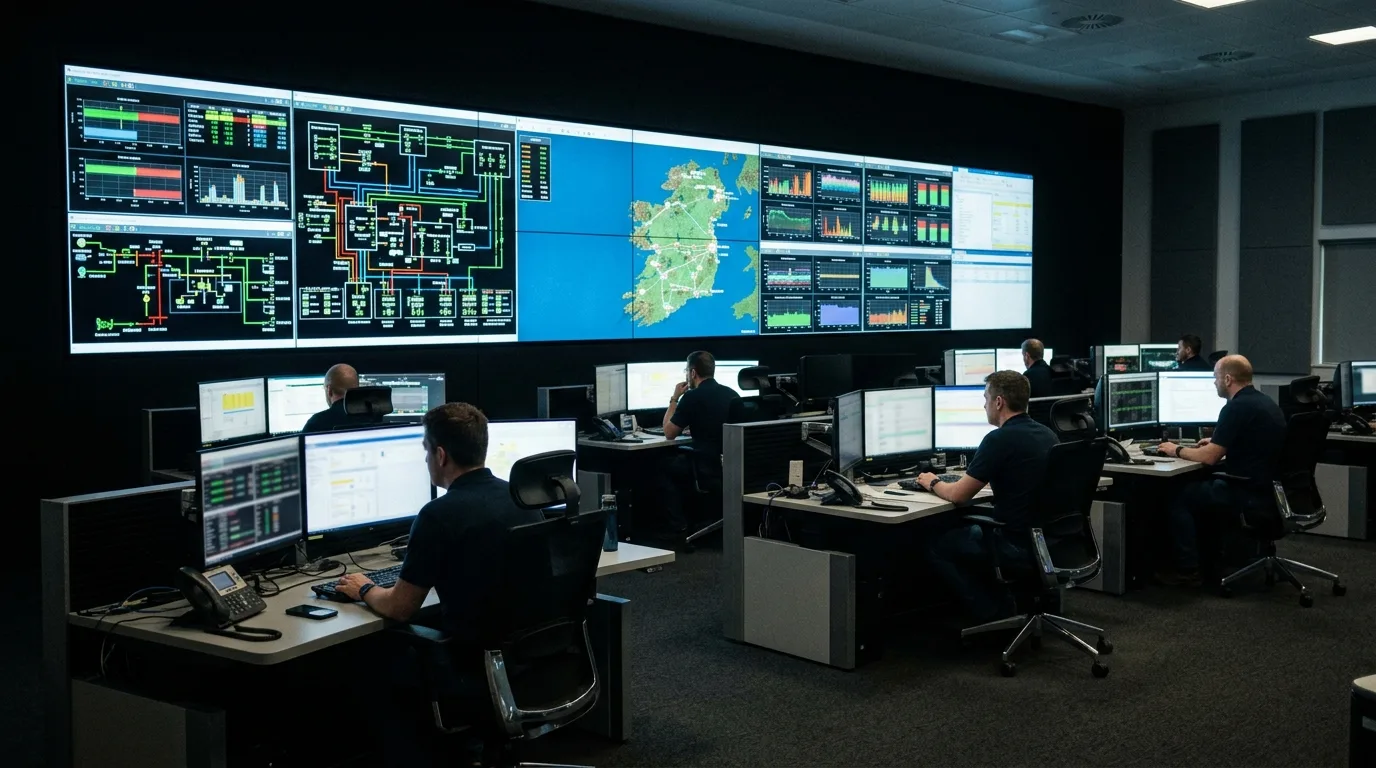
DS3 - "Delivering a Secure Sustainable Electricity System" - is EirGrid's framework for procuring the system services needed to operate the Irish grid at world-leading levels of renewable penetration. Where conventional power systems rely on the inertia and reactive support of large synchronous generators, DS3 unbundles these services into 14 distinct products that can be supplied by batteries, demand response, renewable inverters and conventional plant. This article is the complete 2026 reference for the DS3 product set, written for commercial battery owners and operators.
Why DS3 exists
The Irish grid regularly operates with over 70% of generation from non-synchronous renewables (wind and solar inverter-based). Without targeted procurement of system services, this would compromise frequency stability, voltage support, and fault response. DS3 was designed to:
- Maintain frequency stability as inertia from synchronous generators declines
- Provide fast-acting reserves to handle generation loss
- Support voltage and reactive power across the network
- Enable continued growth in renewable penetration toward 80%+ targets
DS3 has been operating since 2014, with multiple market reforms and expansions through 2024-2026. It is one of the most active and lucrative system services markets in Europe.
The 14 DS3 products
DS3 procures 14 distinct services, grouped into four categories:
Frequency response services
1. FFR - Fast Frequency Response
- Response time: 2 seconds, full delivery for 8 seconds
- Triggered by frequency deviation > 200 mHz
- Highest paying per MW for fast assets (BESS-favoured)
- Typical 2026 payment: €25k-€38k per MW per year
2. POR - Primary Operating Reserve
- Response time: 5 seconds, full for 5-15 seconds
- Triggered by frequency dip below 49.8 Hz
- Pairs naturally with FFR
- Typical 2026 payment: €8k-€14k per MW per year
3. SOR - Secondary Operating Reserve
- Response time: 15 seconds, full for 15-90 seconds
- Sustains response from POR
- Typical 2026 payment: €5k-€10k per MW per year
4. TOR1 - Tertiary Operating Reserve 1
- Response time: 90 seconds, full for 90 seconds to 5 minutes
- Replaces SOR after initial event
- Typical 2026 payment: €4k-€8k per MW per year
5. TOR2 - Tertiary Operating Reserve 2
- Response time: 5 minutes, full for 5-20 minutes
- Longer-duration response
- Typical 2026 payment: €3k-€6k per MW per year
Ramping margin services
6. RM1 - Ramping Margin 1 Hour
- Capability available within 1 hour
- Typical 2026 payment: €3k-€6k per MW per year
7. RM3 - Ramping Margin 3 Hours
- Capability available within 3 hours
- Typical 2026 payment: €2k-€5k per MW per year
8. RM8 - Ramping Margin 8 Hours
- Capability available within 8 hours
- Typical 2026 payment: €1k-€3k per MW per year
Inertia and reactive services
9. SIR - Synchronous Inertial Response
- Synchronous mass response to frequency change
- Supplied by spinning generators only - BESS cannot provide native SIR
- Synthetic inertia via grid-forming inverters increasingly accepted as equivalent
10. FPFAPR - Fast Post-Fault Active Power Recovery
- Recovery to pre-fault active power output after voltage fault
- BESS-favoured (fast inverter response)
- Typical 2026 payment: €3k-€7k per MW per year
11. DRR - Dynamic Reactive Response
- Reactive power injection in response to voltage faults
- BESS PCS can provide if specified
- Typical 2026 payment: €3k-€6k per MW per year
12. SSRP - Steady-State Reactive Power
- Continuous reactive power capability
- Supplied via inverter reactive compensation
- Typical 2026 payment: smaller, often within other contracts
Other system services
13. SOR Energy Reservoir (in some contracts)
- Capability to deliver energy beyond short reserve windows
14. NWFP - Negative Withdrawal-Free Period (related to wind curtailment)
- Capability to absorb energy during high wind events
Which DS3 products suit BESS
Commercial and grid-scale BESS in Ireland typically contract:
- FFR - the highest-value product per MW
- POR - natural stack with FFR
- SOR - extends the response window
- TOR1 - extends further
- FPFAPR - fast active power recovery
- DRR - if PCS has reactive capability
Stacked together, a fully-available 1 MW BESS in 2026 typically earns €40k-€70k gross per year from DS3, less 15-25% aggregator fees.
Products less suited to BESS:
- SIR - synchronous spinning mass only (BESS can provide synthetic via grid-forming, but native SIR is conventional)
- RM8 - long-duration ramping rarely matches BESS economics
DS3 product tariff structure
DS3 payments combine several elements:
1. Volume Scalar (annual). EirGrid adjusts payment rates each tariff year based on portfolio tightness.
2. Performance Scalar. Adjusted up or down based on actual performance vs commitment - top performers earn premium scalars.
3. Location Scalar. Some products have geographic premiums where local needs are higher.
4. Time-of-Day Scalar. Some products pay more during peak demand hours.
5. Stacking allowances. Maximum cumulative payment across stacked products.
Realistic 2026 blended FFR+POR+SOR+TOR1 stacked payment for a top-performing 1 MW BESS: €40k-€60k gross per year.
DS3 contract types
Three contract types exist:
1. Annual tariff contract. Standard - prices set by tariff window, paid for availability throughout the year. Most common for BESS.
2. Fixed Contract (multi-year). Locked-in payment rates for 6 years - offered through periodic Fixed Contract Procurement (FCP) windows. Provides revenue certainty for project finance.
3. Volume Contract. Annual or multi-year volume-based payments. Less common.
Most Irish commercial behind-the-meter BESS use annual tariff contracts via aggregators. Larger utility-scale projects often secure Fixed Contracts to support project debt.
Qualification process
To participate in DS3, a BESS (and its aggregator) must complete:
- Registration with EirGrid as a system service provider
- Telemetry installation (5-second granularity typical)
- Communications testing with EirGrid market systems
- Qualification trials - controlled events demonstrating product capability
- Performance baseline establishment
- Ongoing compliance reporting
Qualification typically takes 8-16 weeks for a new asset. Aggregators handle this for portfolio assets, simplifying the process for individual owners.
DS3 settlement
EirGrid settles DS3 contracts monthly via the SEMO (Single Electricity Market Operator) framework:
- Detailed settlement statements published per asset and per product
- Performance scalars applied for the prior month
- Payment within 30-45 days of period end
- Aggregator deducts contracted fee and remits balance to BESS owner
Settlement transparency has improved significantly through 2024-2026 - top aggregators now provide owner portals with daily revenue dashboards.
Future of DS3
EirGrid signalled in 2024-2025 multiple DS3 reforms:
- New product designs for grid-forming inverters and synthetic inertia
- Adjusted tariff scalars to manage portfolio tightness
- Tighter performance requirements as the asset base matures
- Integration with European balancing markets (PICASSO, MARI) where applicable
The direction of travel: DS3 remains the core system services framework, with ongoing refinement to maintain value signals as the asset base grows.
Combining DS3 with other revenue streams
A typical 2026 behind-the-meter Irish commercial BESS stacks DS3 with:
- MIC reduction (capacity charges)
- Time-of-use arbitrage
- Solar self-consumption
- CEG export of stored PV
- Capacity market (for larger systems registered as DSU)
DS3 is rarely the largest single revenue stream for sub-2 MW behind-the-meter BESS, but is the most consistent across all hours of the year. The combination delivers strong project IRR.
Bottom line
DS3 is the most active grid services market in Europe and a key revenue pillar for commercial BESS in Ireland. For BESS owners, the most relevant products are FFR, POR, SOR, TOR1, FPFAPR and DRR - stacked through an aggregator like Statkraft, GridBeyond, Veri or Power Capital. Typical 2026 net DS3 revenue for a 1 MW BESS is €30k-€55k per year after aggregator fees. Understanding the products and tariff structure helps owners negotiate better aggregator contracts and model realistic returns.
Get 3 free commercial battery quotes — free and no obligation.
Frequently asked questions
What is EirGrid DS3?
DS3 (Delivering a Secure Sustainable Electricity System) is EirGrid's procurement framework for system services. It buys 14 distinct ancillary services - frequency response, reserves, ramping margin, inertia and reactive support - to maintain Irish grid stability at high renewable penetration.
How many DS3 products can a battery provide?
A commercial BESS typically stacks 4-6 DS3 products simultaneously: FFR, POR, SOR, TOR1, FPFAPR and DRR. The PCS responds to dispatch signals for each product within its physical constraints, with the EMS arbitrating between them.
Which DS3 product pays the most?
FFR (Fast Frequency Response) typically pays the highest per MW - €25k-€38k per year for fast-responding assets. BESS dominates FFR provision because of sub-second response times. POR, SOR and TOR1 stack on top.
How does DS3 settlement work?
EirGrid via SEMO settles DS3 contracts monthly. Aggregators receive payment for portfolio performance, deduct contracted fees (typically 15-25%), and remit balance to BESS owners. Settlement statements detail performance per product and apply tariff scalars.
Can a battery provide SIR (synchronous inertia)?
Not natively - SIR is provided by synchronous spinning mass (conventional generators). BESS with grid-forming inverters can provide synthetic inertia, increasingly accepted by EirGrid as a substitute. New DS3 products are emerging for grid-forming response.
Sources & further reading
- EirGrid DS3 System Services — EirGrid
- EirGrid DS3 Tariff Information — EirGrid
- SEMO Single Electricity Market Operator — SEMO