MyEnergi Zappi EV Charger Review Ireland 2026: The Solar Diversion Champion
If you have solar panels — or plan to install them — the MyEnergi Zappi is the EV charger for your Irish home. Its solar diversion capability is unmatched, and the SEAI grant makes it affordable.
By Smart Solar Editorial · Updated 15 May 2026 · 7 min read
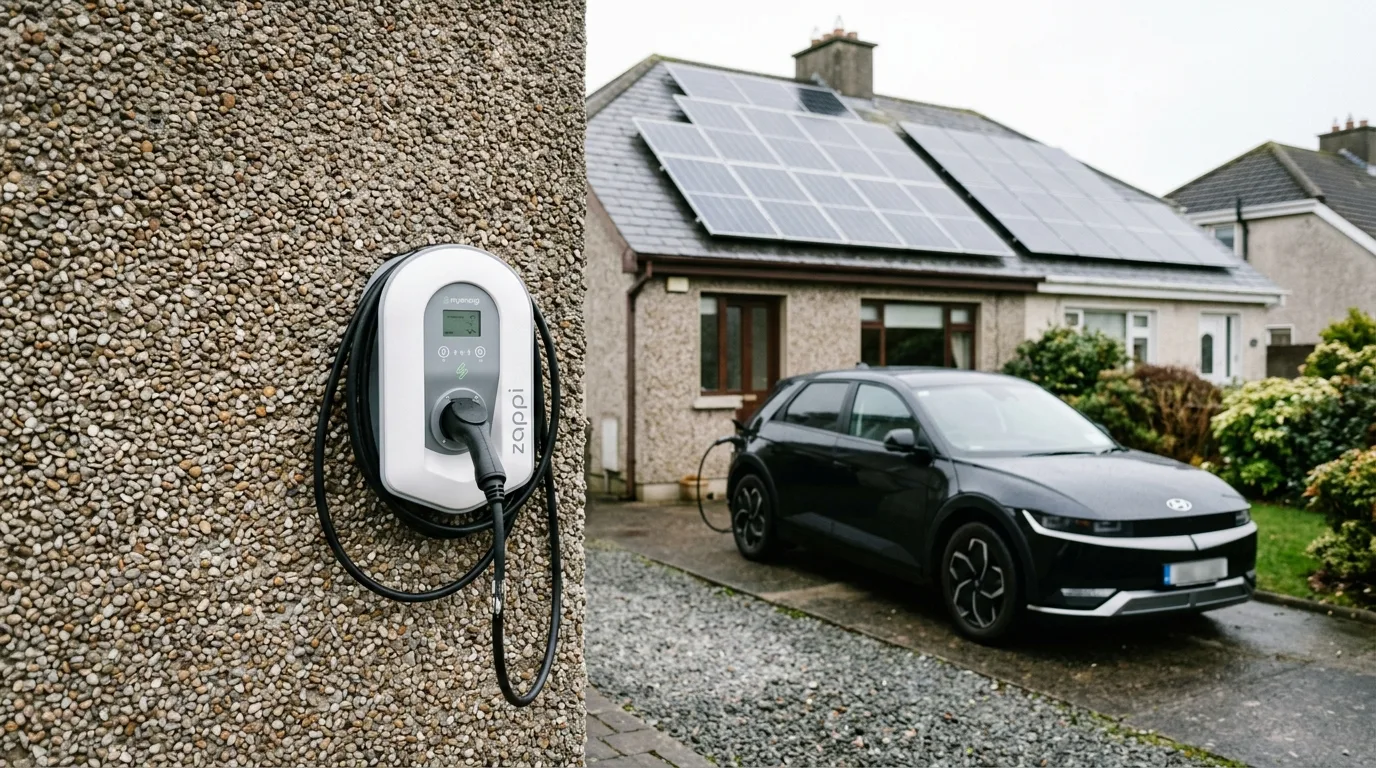
MyEnergi Zappi: Built for Solar Homes
The MyEnergi Zappi is unique among home EV chargers in being specifically designed around solar PV integration. While other chargers offer smart scheduling and OCPP compliance as their primary selling points, the Zappi's defining feature is its ability to automatically divert excess solar generation to EV charging — capturing the value of solar energy that would otherwise be exported to the grid at a low rate.
For the growing number of Irish homeowners who have both solar PV and an EV — or who plan to install both — the Zappi is the natural choice. This review examines the Zappi's capabilities in the Irish context, including its SEAI approval, pricing, and real-world solar diversion performance.
Specifications
| Specification | Detail |
|---|---|
| Max power output | 7.4 kW (32A, single-phase) |
| Three-phase option | Yes — Zappi 22 kW (3-phase) available |
| Connector | Untethered Type 2 socket or tethered cable options |
| IP rating | IP65 |
| Communication | Wi-Fi (via myenergi Hub), Bluetooth, OCPP 2.0.1 |
| Smart charging | Yes — Eco, Eco+, Fast modes; solar diversion |
| CT clamp | Included — monitors import/export at meter |
| Warranty | 3 years |
| SEAI approved | Yes |
| RCD type | Type B DC fault detection built-in |
Notable: the Zappi has one of the better IP ratings in the market at IP65 — dust-tight and protected against water jets. This is particularly reassuring for exposed coastal locations in Ireland.
The Three Charging Modes
The Zappi's central concept is its three charging modes, which determine how it balances solar diversion against grid power:
Fast Mode
The Zappi charges at full power (up to 7.4 kW) regardless of solar output. It behaves like any other smart charger, drawing from the grid as needed. This mode is appropriate when you need a quick charge and do not care about solar self-consumption.
Eco Mode
The Zappi charges at minimum grid import, automatically adjusting its charge rate to use available solar surplus. If solar is generating 4 kW and household load is 2 kW, the 2 kW surplus goes to the EV. If a cloud passes and solar drops, the Zappi reduces EV charging current in real time, never exceeding a configurable grid import limit.
Eco+ Mode
Eco+ is the most solar-optimised mode. The Zappi waits until solar surplus is enough to charge above the minimum current (6A, approximately 1.4 kW). When sufficient surplus is available, it begins charging at the maximum possible solar rate. Below the minimum threshold, the Zappi does not draw from the grid at all — the EV simply waits.
This means on a sunny Irish day where your panels generate 3 kW and your household uses 1.5 kW, the Zappi starts charging at 1.5 kW from pure solar. As the sun intensifies, it ramps up. On overcast days, it may not charge from solar at all and defers to a night schedule for grid top-up.
The CT Clamp: How Solar Diversion Is Detected
The Zappi monitors power flow using a CT (current transformer) clamp installed around the main import/export cable at your meter. This is a non-invasive clip that measures current flow without direct electrical contact — safe, reversible, and compatible with any solar inverter brand.
The CT clamp reading tells the Zappi:
- How much power is currently being imported from the grid
- How much power is being exported to the grid (surplus solar)
From this, the Zappi calculates exactly how much EV charging power is available from solar alone. The calculation updates every few seconds, making the Zappi's response to changing solar conditions fast and precise.
Installation of the CT clamp is part of the Zappi installation process and is included in the standard installer quote.
The myenergi App
The myenergi app (iOS and Android) is a functional but not the most visually polished charger app in the market. It offers:
- Mode selection (Fast/Eco/Eco+) remotely
- Charging schedules for night-rate grid top-up
- Historical energy data (kWh from solar vs grid)
- Boost timer configuration
- Integration with the myenergi hub (required for Wi-Fi connectivity — the Zappi itself connects via the Hub, which is an additional device)
The myenergi Hub: Unlike the Easee One and Wallbox Pulsar Plus, the Zappi requires a separate myenergi Hub device for Wi-Fi connectivity and app control. The Hub (approximately €80–€120) connects to your home router and all myenergi devices in the house communicate via the Hub on a proprietary frequency (433 MHz). This is a slightly more complex setup than plug-and-play Wi-Fi chargers, but the Hub enables a full myenergi ecosystem including the Eddi (solar hot water diverter) and Libbi (home battery).
Integration with myenergi Ecosystem
A significant advantage of the Zappi for Irish solar homeowners is the broader myenergi ecosystem:
- Eddi: A solar diversion device for immersion heating — diverts excess solar to heat your hot water (alternative to heating with the gas/oil boiler)
- Libbi: A home battery system that stores excess solar for later use
- Harvi: A wireless CT clamp for installations where wired CT cabling is impractical
A homeowner with solar PV, a Zappi, and an Eddi is simultaneously minimising grid electricity import for EV charging and water heating — capturing the full value of solar generation that would otherwise be exported at 18–24 c/kWh.
Pricing and SEAI Grant
Typical supply cost in Ireland 2026: €550–€680 (7.4 kW Zappi + Hub)
Typical installed cost: €1,200–€1,600
After SEAI Home Charger Grant (€600): €600–€1,000
The Zappi + Hub combination is typically the most expensive standard home EV charger installation in Ireland. The premium is justified for solar homeowners who will recoup significant value from solar diversion. For non-solar homes, the Easee One or Wallbox Pulsar Plus delivers similar smart charging at lower cost.
Should You Choose the Zappi?
Yes, if:
- You have solar PV installed or plan to install it
- You want to maximise the value of solar generation rather than export it cheaply
- You are interested in the broader myenergi ecosystem (Eddi, Libbi)
Consider alternatives if:
- You do not have and do not plan to install solar PV — the Easee One or Wallbox Pulsar Plus are cheaper and equally capable for grid-only smart charging
- You want a simpler setup without the Hub device requirement
- Budget is the primary concern and you do not need solar diversion
Verdict
The MyEnergi Zappi is the best home EV charger in Ireland for solar homeowners, without question. Its solar diversion modes are purpose-built, reliable, and genuinely effective at capturing the value of excess solar generation. The IP65 rating, SEAI approval, and OCPP compliance complete a compelling package.
The premium over non-solar-optimised chargers is real but quickly recovered through solar self-consumption savings for homes with even a modest 3–4 kW solar PV array.
Rating: 5/5 for solar homes; 3.5/5 for non-solar homes (where Easee or Wallbox offer better value)
Get 3 free EV charger quotes — free and no obligation.
Frequently asked questions
Does the Zappi work with any solar inverter brand?
Yes — the Zappi uses a CT clamp at the meter to detect power flow, making it compatible with any grid-connected solar inverter: SolarEdge, Fronius, SMA, Growatt, Solis, GoodWe, or any other brand. It does not communicate directly with the inverter.
Is the myenergi Hub required for the Zappi?
For Wi-Fi connectivity and app control, yes. Without the Hub, the Zappi still functions as a solar diversion charger and can be configured via its front-panel buttons — but you lose remote control and energy monitoring via the app. Most Irish installations include the Hub.
Is the Zappi SEAI approved for the Home Charger Grant?
Yes — multiple Zappi variants are on the SEAI approved home charger product list. The €600 grant applies to the Zappi supply and installation cost. Check the SEAI website for the specific variant codes before purchasing.
What is the minimum solar generation needed for Eco+ mode to activate?
The minimum charge current is 6A at 230V, approximately 1.4 kW. In Eco+ mode, the Zappi waits for at least this level of solar surplus before beginning to charge the EV. On overcast Irish days, this threshold may not be met, in which case the Zappi defers to a night schedule for grid charging.
Can the Zappi charge from both solar and the grid simultaneously?
Yes — in Eco mode, the Zappi uses all available solar surplus and tops up from the grid as needed to maintain a minimum charge current. This ensures the EV is always charging (avoiding very slow sessions) while still prioritising solar use.
Sources & further reading
- SEAI Home Charger Grant Approved Products — seai.ie
- SEAI Microgeneration Support Scheme — seai.ie
- SEAI Solar PV Grant — seai.ie