EV Charging Cost Per Kilometre in Ireland 2026: Home vs Public vs Petrol
The per-kilometre cost of EV driving in Ireland depends heavily on where and when you charge. Home night-rate charging costs around 2.5–3 c/km — diesel at current prices runs 10–12 c/km. Here is the full breakdown.
By Smart Solar Editorial · Updated 15 May 2026 · 7 min read
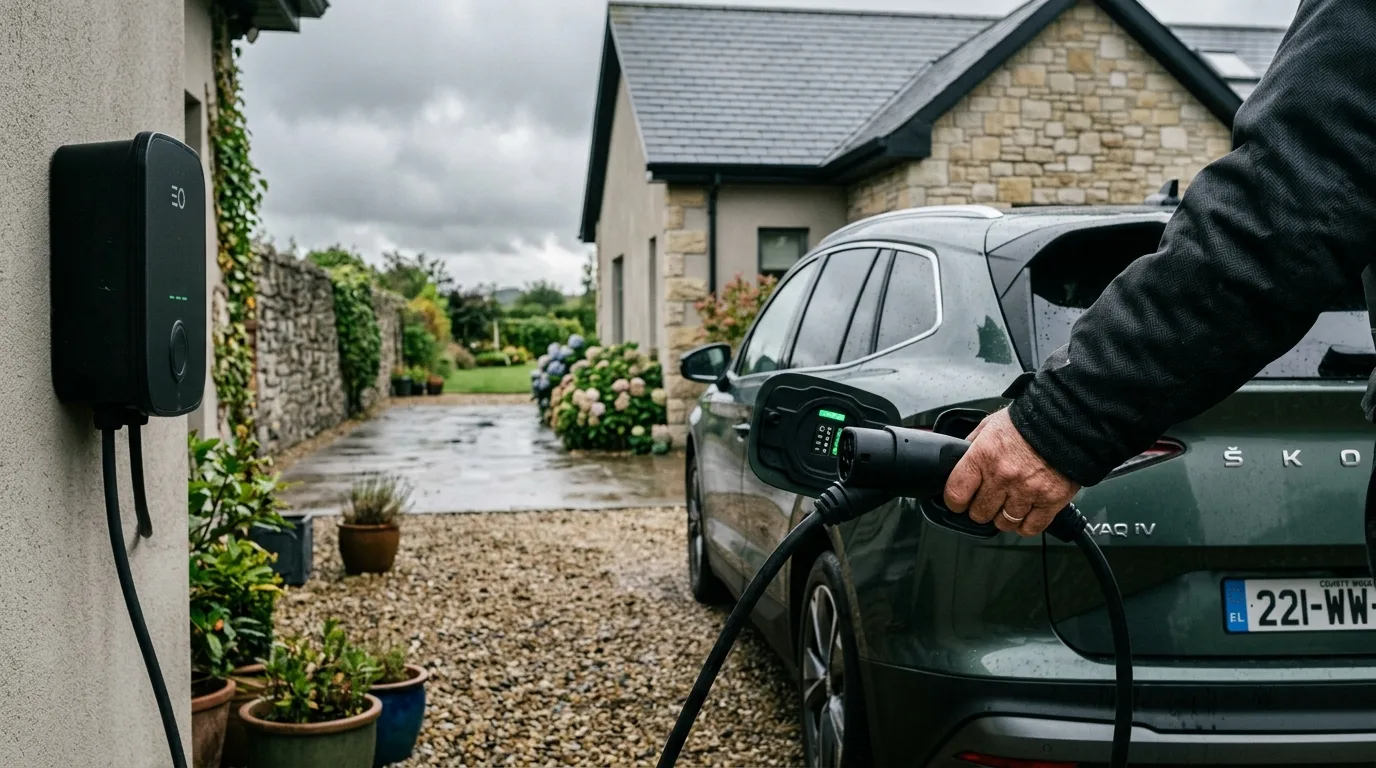
The Most Important EV Question: What Does It Cost Per Kilometre?
Fuel cost is one of the clearest financial differences between an EV and a conventional petrol or diesel car. But EV owners in Ireland quickly discover that the cost per km varies dramatically depending on where and when they charge. Home overnight charging at 13 c/kWh and public rapid charging at 40 c/kWh represent more than a 3× difference in energy cost — a difference that compounds significantly over a vehicle's lifetime.
This guide works through the cost per km for every charging scenario an Irish driver is likely to encounter, and compares the totals to petrol and diesel equivalents.
The Baseline: EV Energy Consumption
To calculate cost per km, you need to know how much electricity your EV uses per 100 km. This varies by vehicle and driving conditions:
| Vehicle Type | Typical Consumption (kWh/100 km) |
|---|---|
| Small EV (Fiat 500e, Renault Zoe) | 14–17 kWh |
| Medium EV (VW ID.3, Hyundai Ioniq 6) | 16–20 kWh |
| Large/SUV EV (VW ID.4, Kia EV6) | 18–22 kWh |
| Performance EV (Model 3 Long Range) | 17–21 kWh |
| Large SUV EV (BMW iX, Mercedes EQS) | 22–28 kWh |
For this guide, we use 20 kWh/100 km as a representative average for the most popular EVs in Ireland (medium-to-large crossovers), which covers most actual Irish driving conditions including motorway speeds and winter range loss.
At 20 kWh/100 km, every 1 km costs you 0.2 kWh of electricity.
Scenario 1: Home Night-Rate Charging
Cost per kWh: 12–15 c (Electric Ireland Night Boost, Bord Gáis EV Tariff, Energia Smart Drive — all approximately 12–15 c/kWh in 2026)
Using 13 c/kWh as the midpoint:
- Cost per kWh: €0.13
- Energy per km: 0.2 kWh
- Cost per km: €0.026 (2.6 c/km)
For 15,000 km/year: €390/year in fuel costs.
This is the scenario every Irish EV owner should optimise for. A home wallbox on a smart night tariff is the foundation of cost-effective EV ownership.
Scenario 2: Home Day-Rate Charging
If you charge at home during the day (not on a night tariff, or using a standard domestic rate), you pay approximately 30–35 c/kWh:
- Using 32 c/kWh: 6.4 c/km
For 15,000 km/year: €960/year. Significantly more expensive than night-rate charging, and not much cheaper than public AC charging at some locations.
This underlines why switching to an EV night tariff is one of the most important financial steps an Irish EV owner can take.
Scenario 3: Public AC Charging
Public AC charge points (ESB eCars standard points, destination chargers at supermarkets, hotels) typically charge 25–35 c/kWh in 2026:
- Using 30 c/kWh: 6.0 c/km
Some public AC chargers are still free (IKEA, some local authority car parks), which brings this to zero — but free public charging is becoming rarer as operators monetise their infrastructure.
Scenario 4: Public DC Rapid Charging
DC rapid chargers (50 kW, 100 kW, 150 kW) at motorway services, Circle K, and ESB eCars hubs:
- ESB eCars rapid (pay-as-you-go): approximately 40–45 c/kWh
- Ionity (without membership): approximately 55–70 c/kWh
- Circle K/Applegreen: approximately 40–50 c/kWh
Using 45 c/kWh as a representative rapid charging rate:
- Cost per km: 9.0 c/km
For 15,000 km/year: €1,350/year — 3.5 times the cost of home night-rate charging.
Rapid charging as a primary strategy is expensive. As an occasional top-up on a long journey, the convenience premium is entirely justified. As a daily charging habit (because you lack home charging), the annual cost premium versus home charging runs to €900–€1,000.
Petrol and Diesel Comparison
For context, here is the fuel cost per km for conventional vehicles at 2026 Irish pump prices:
| Fuel | Efficiency | Price | Cost per km |
|---|---|---|---|
| Petrol | 7 L/100 km | €1.75/L | 12.3 c/km |
| Diesel | 6 L/100 km | €1.65/L | 9.9 c/km |
| Petrol (efficient car) | 5.5 L/100 km | €1.75/L | 9.6 c/km |
| Diesel (efficient car) | 4.5 L/100 km | €1.65/L | 7.4 c/km |
Home night-rate EV (2.6 c/km) is 4–5 times cheaper than petrol per km and roughly 3–4 times cheaper than diesel. Over 15,000 km/year, home-charged EV driving saves €1,400–€1,700/year compared to a typical petrol car.
Even on public rapid charging (9.0 c/km), an EV is comparable to diesel on a per-km basis — still saving roughly €130/year versus a 6 L/100 km diesel.
Annual Fuel Cost Summary for 15,000 km/year
| Scenario | Cost per km | Annual cost |
|---|---|---|
| Home night-rate EV | 2.6 c | €390 |
| Home day-rate EV | 6.4 c | €960 |
| Public AC EV | 6.0 c | €900 |
| Public DC rapid EV | 9.0 c | €1,350 |
| Petrol car | 12.3 c | €1,845 |
| Diesel car | 9.9 c | €1,485 |
Factoring in Charger and Car Purchase Cost
For a complete financial picture, the upfront costs must be amortised:
Home charger: €1,100–€1,500 total, less €600 SEAI grant = €500–€900. Over 10 years: €50–€90/year
EV purchase premium: New EVs in Ireland typically cost €3,000–€10,000 more than equivalent petrol models (after SEAI/VRT relief). Over 10 years: €300–€1,000/year
Even adding these costs, home-charged EV total ownership (fuel + amortised vehicle premium + charger) typically comes out cheaper than petrol for Irish drivers covering 12,000+ km/year. The savings are most dramatic for high-mileage drivers.
Practical Advice: Maximising Your Cost Advantage
- Install a home charger and switch to a night-rate tariff — this is the single biggest lever for minimising EV fuel cost.
- Charge at work if your employer offers free or subsidised charging — this is effectively zero-cost fuel.
- Use rapid charging selectively — on long journeys, it is entirely appropriate. As a daily habit, it is expensive.
- Add solar PV — if you can combine a Zappi charger with a solar array, you can charge from sunlight during the day (free) and from the night rate overnight (cheap), minimising daytime grid import.
- Monitor your tariff — EV tariff rates in Ireland are updated quarterly. Review your tariff annually and compare alternatives on Switcher.ie or Bonkers.ie.
Get 3 free EV charger quotes — free and no obligation.
Frequently asked questions
Is it cheaper to drive an EV than a diesel in Ireland in 2026?
On home night-rate charging (2.6 c/km), yes — significantly cheaper than diesel (9.9 c/km typical). On public rapid charging (9.0 c/km), an EV is broadly comparable to an efficient diesel. Home charging is the key variable.
How much can I save per year switching from petrol to an EV charged at home?
At 15,000 km/year, switching from a 7 L/100 km petrol car (12.3 c/km at €1.75/L) to a home night-rate charged EV (2.6 c/km at 13 c/kWh) saves approximately €1,455/year in fuel costs alone — before factoring in lower servicing costs and VRT/SEAI EV incentives.
Does winter affect EV charging cost per km?
Yes — EV energy consumption increases in cold weather (battery performance drops, heating draws more energy). In Irish winter conditions, consumption may be 20–30% higher than in summer, increasing cost per km by a similar proportion. Budget for roughly 3–4 c/km in cold weather on home night-rate charging.
Is public charging getting cheaper in Ireland?
Public charging prices in Ireland have been broadly stable or modestly rising in 2025–2026, tracking electricity wholesale prices. There is no clear trend toward significantly cheaper public rapid charging — the infrastructure and network costs are substantial. Home charging remains by far the cheapest option.
Do I pay road tax on an EV in Ireland?
Battery EVs in Ireland qualify for the minimum Motor Tax band — €120/year as of 2026. This compares to €400–€1,000+ for typical petrol or diesel vehicles, representing an additional annual saving of €280–€880.
Sources & further reading
- SEAI Electric Vehicle Running Costs — seai.ie
- ESB eCars Charging Tariffs — esbnetworks.ie
- Gov.ie — EV Incentives and Running Costs — gov.ie