EV Charger Driveway Installation in Ireland: What to Expect
A driveway EV charger is the simplest and most common home installation in Ireland. Here is exactly what the process involves — from site survey to SEAI grant payment — and what you can expect to pay.
By Smart Solar Editorial · Updated 15 May 2026 · 7 min read
The Standard Home EV Charger Scenario
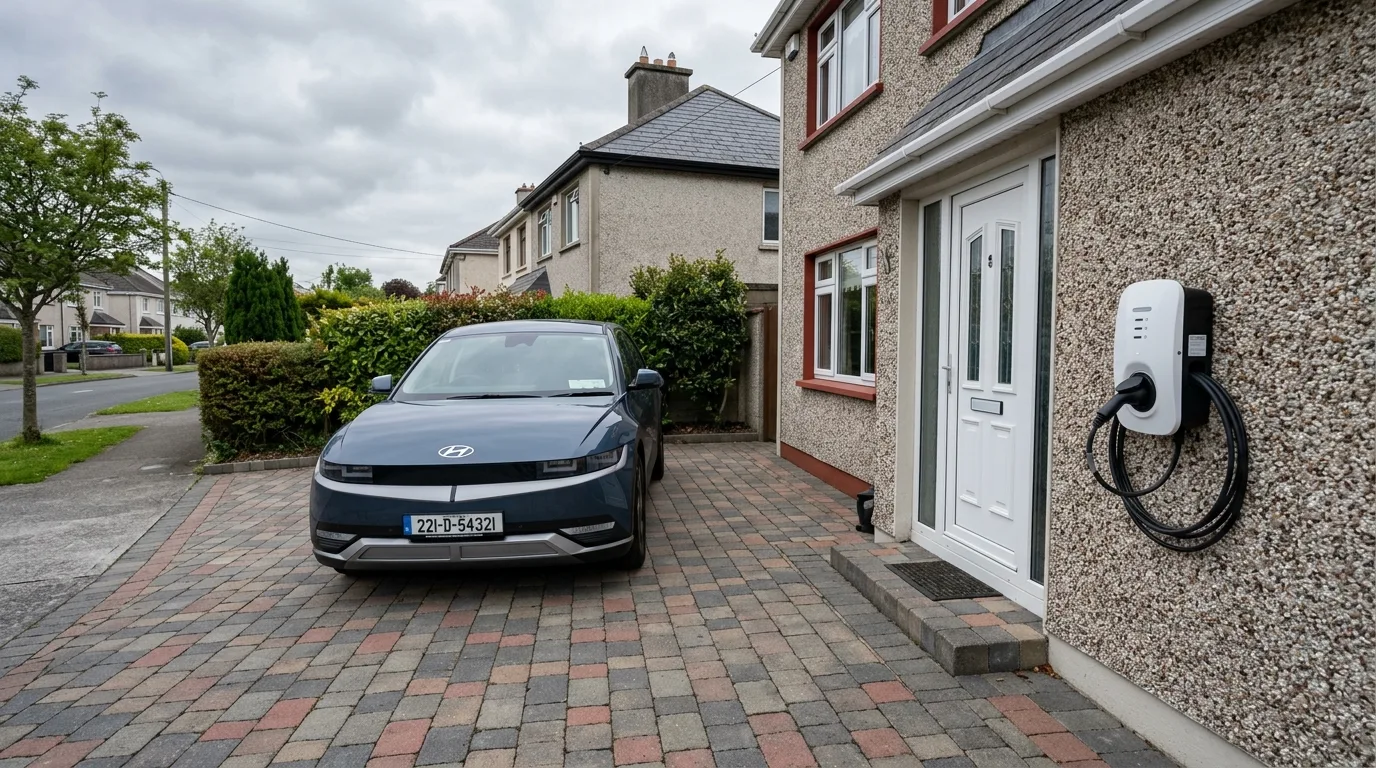
For the majority of Irish homeowners — those living in a semi-detached or detached house with an off-street driveway — installing a home EV charger is a relatively straightforward project. The typical configuration is a 7.4 kW wallbox mounted on the exterior wall of the house nearest the driveway, with a dedicated 32A circuit running back to the consumer unit (fuse board) inside.
This is the scenario the SEAI Home Charger Grant is designed for, and it is what most Irish electricians specialising in EV chargers install day in, day out.
Step 1: Site Survey
Before any work begins, a reputable installer will visit your property for a site survey. This typically takes 30–60 minutes and covers:
- Consumer unit assessment: Is there capacity for a new 32A MCB (miniature circuit breaker)? Is the consumer unit modern (RCBO or dual RCD) or does it need upgrading?
- Cable route: What is the most practical route from the consumer unit to the charger location? Through an internal wall, under a floor, through the soffit, or externally?
- Charger mounting position: Which wall, at what height, and how close to the parking position?
- Cable length: Longer cable runs add cost and may require a larger cable cross-section to avoid voltage drop.
- ESB Networks supply assessment: Is the service head and meter location compatible with the additional load? For chargers above 7 kW, ESB Networks notification is required.
A good installer will not quote without a site survey. Be cautious of any company quoting purely over the phone with no site visit.
Step 2: Choosing the Charger
For a driveway installation, the main considerations are:
Weatherproofing: The charger must be rated at least IP54 for outdoor use. In exposed coastal locations, consider IP65 or IP66. All SEAI-approved chargers meet minimum IP ratings.
Tethered or untethered: Tethered is popular for driveway installations because the cable is always to hand and tidily managed. Untethered chargers like the Easee One and Wallbox Pulsar Plus are equally suitable and have the advantage of cable security locking.
Smart features: All SEAI-approved chargers support OCPP smart scheduling. This lets you schedule charging to overnight tariff windows (Electric Ireland Night Boost, Bord Gáis EV Tariff, Energia Smart Drive — all around 12–15 c/kWh in 2026).
Brand options for driveway installations in Ireland: Easee One, Wallbox Pulsar Plus, MyEnergi Zappi, Ohme Home Pro, EO Mini Pro 3, Hypervolt Home 3, Project EV PRO-E.
Step 3: The Electrical Work
A typical driveway installation involves:
-
Opening the consumer unit and installing a new 32A Type B RCBO (or MCB where the panel already has RCD protection). Using a Type B RCBO rather than Type A is important because EV chargers can produce DC residual fault currents.
-
Running the cable — typically 6mm² two-core armoured cable (SWA) for outdoor runs, or 6mm² twin-and-earth in conduit for internal routes. The cable must be protected from mechanical damage for its entire route.
-
Mounting the charger on the wall. Fixings must be appropriate for the wall material — pebbledash render requires rawl bolts into the blockwork behind.
-
Connecting and testing — the electrician tests insulation resistance, earth continuity, and polarity before energising.
-
Issuing the Safe Electric completion certificate — this is mandatory and is required for your SEAI grant application.
The electrical work typically takes 4–6 hours for a straightforward driveway installation and can usually be done in a single day visit.
Step 4: ESB Networks Notification (If Required)
If your charger is 7 kW or below (the standard 7.4 kW is technically 32A × 230V = 7.36 kW), no ESB Networks notification is required in most cases. However, if you are installing an 11 kW or 22 kW three-phase charger, you must notify ESB Networks using your MPRN before installation. Your installer should handle this as part of the process, but confirm it is included in the quote.
ESB Networks may need to assess whether the local low-voltage network can accommodate the additional load. In most urban and suburban areas this is straightforward, but in rural areas with older network infrastructure it can occasionally require network reinforcement work — which ESB Networks funds, not the homeowner.
Step 5: SEAI Grant Application
The €600 SEAI Home Charger Grant is applied for online at seai.ie. The process:
- Pre-application: Register on the SEAI portal, enter your MPRN and vehicle registration.
- Installation: Have the work carried out by a SEAI-registered installer.
- Completion: Upload the Safe Electric certificate and installer invoice.
- Payment: SEAI typically processes payment within 4–8 weeks.
The grant is paid directly to you, not to the installer — so you pay the full installation cost upfront and are reimbursed. Make sure your installer is registered with SEAI before proceeding.
Typical Costs for a Driveway Installation in Ireland (2026)
| Item | Typical Cost |
|---|---|
| 7.4 kW smart wallbox (supply) | €400–€700 |
| Installation (labour, circuit, MCB) | €500–€800 |
| Total before grant | €900–€1,500 |
| SEAI Home Charger Grant | −€600 |
| Typical net cost | €300–€900 |
The wide range reflects differences in:
- Distance of cable run from consumer unit to charger
- Whether the consumer unit needs upgrading (adds €200–€500)
- Charger brand and specification
- Labour rates by region (Dublin typically higher)
Cable Route Options for Driveway Installations
Internal route (preferred): The cable runs inside the house from the consumer unit to an external wall, exiting through a waterproof gland into an outdoor conduit or directly to the charger. This keeps most of the cable protected from weather and mechanical damage.
External route: Where internal routing is difficult (solid masonry walls, no cavity), SWA (steel wire armoured) cable can run along the exterior of the building in trunking or buried in the ground. SWA is rated for direct burial and is appropriate for underground routes across the driveway.
Underground route: If the charger needs to be mounted on a standalone post (e.g., where no suitable wall exists near the parking position), the cable is buried at least 500mm deep in a suitable duct. A post-mounted charger typically adds €100–€200 to installation cost.
Planning Permission for Driveway Chargers
In almost all cases, no planning permission is required for a home EV charger in Ireland. Under Schedule 2 of the Planning and Development Regulations, EV chargers installed on residential properties are exempted development, subject to the charger not projecting more than 200mm from the wall and complying with other conditions.
See our dedicated guide EV Charger Planning Permission Ireland for full details and the exceptions that apply in protected structures and certain conservation areas.
Get 3 free EV charger quotes — free and no obligation.
Frequently asked questions
How long does a typical driveway EV charger installation take?
Most straightforward driveway installations are completed in 4–6 hours by a single electrician. If the consumer unit needs upgrading or the cable run is complex, allow a full day. The electrician will confirm the expected duration after the site survey.
Does my driveway need any preparation before the charger is installed?
Usually not. If the cable route involves burying underground across the driveway, some excavation is needed — your installer will manage this. For wall-mounted installations with an internal cable route, no driveway work is required.
Can I install a charger if my consumer unit is old?
Yes, but your electrician will assess whether an upgrade is needed. Consumer units that are more than 15–20 years old may need to be replaced with a modern dual-RCD or RCBO board to safely accommodate the new 32A circuit. Budget an additional €200–€500 for this if required.
Can the charger be installed inside a garage instead of on the driveway wall?
Yes — garage installations are very common in Ireland. The charger is mounted on the interior garage wall and the cable route is shorter. All the same SEAI grant rules apply. A garage install is often slightly cheaper because less outdoor cabling is required.
What happens if I sell my house — can I take the charger?
Technically yes, but in practice most homeowners leave the charger as it adds value to the property. Removing it leaves bare conduit and a hole in the wall that would need to be made good. EV chargers are increasingly expected by buyers and can be a positive selling point.
Sources & further reading
- SEAI Home Charger Grant — seai.ie
- ESB Networks EV Charger Notification — esbnetworks.ie
- Planning and Development Regulations — Exempted Development — gov.ie
- Safe Electric — Find a Registered Electrician — safeelectric.ie