Home Battery and EV Charging: The Perfect Irish Energy Partnership
An EV, a home battery, and solar panels form the most powerful energy cost-reduction system available to Irish homeowners in 2026. Here's how to make all three work together.
By Smart Solar Editorial · Updated 15 May 2026 · 8 min read
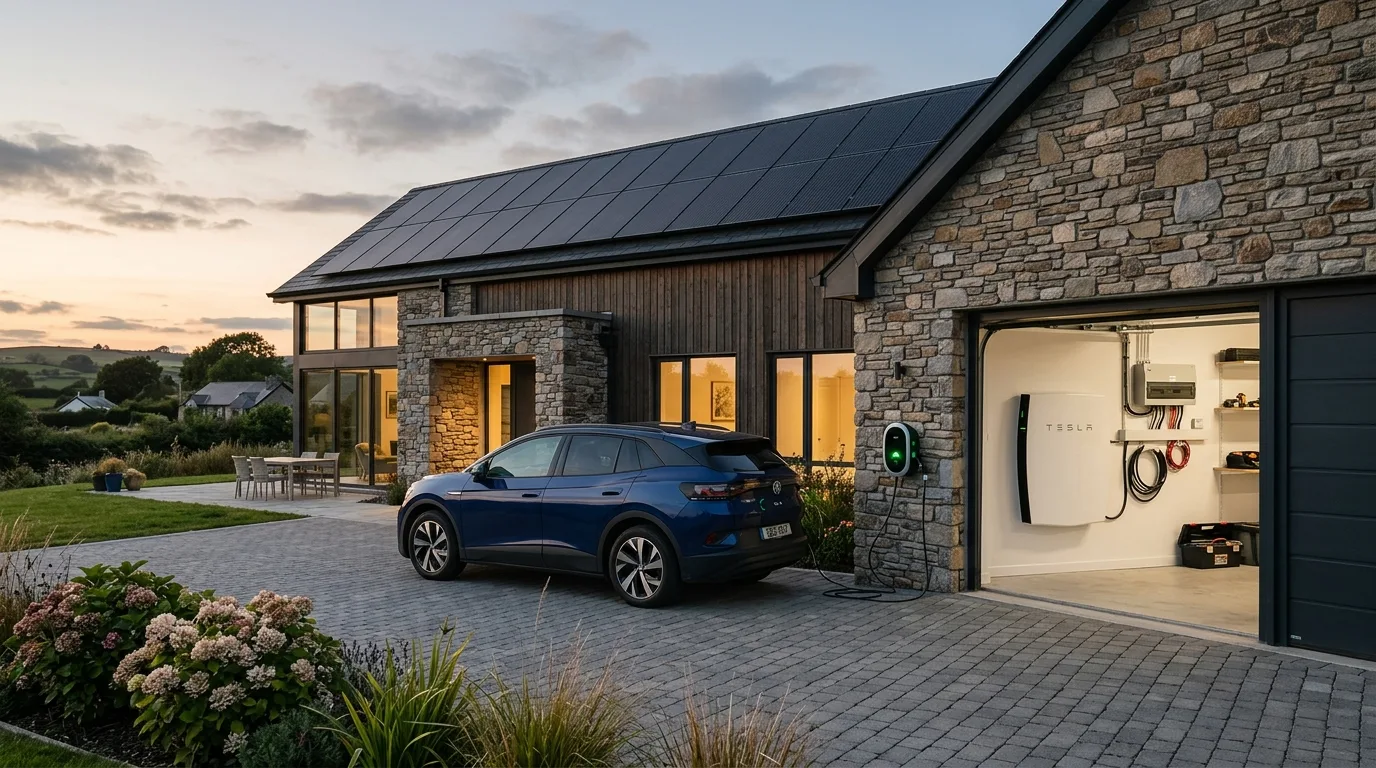
Why EV Owners Are Ireland's Biggest Home Battery Beneficiaries
Electric vehicle owners in Ireland are the natural sweet spot for home battery storage. The reason is simple: EVs dramatically increase household electricity demand — most Irish EV owners add 2,000–5,000 kWh per year to their annual electricity consumption, equivalent to 30–50% more energy than before they switched. That additional demand creates a much larger opportunity for bill optimisation through a battery.
When you combine solar PV, a home battery, and an EV, you create a closed-loop energy system: the sun charges the battery, the battery charges the car (and powers the house), and the grid only supplies what solar and battery cannot cover. In an Irish context, this combination can reduce your total energy costs — home electricity plus transport fuel — by €1,800–€3,000 per year compared to a home without these technologies.
The Energy Flow in a Solar-Battery-EV System
Understanding how energy flows through the system helps you configure it optimally.
Priority order in a well-configured system:
- Solar panels power current household loads (lights, appliances) directly.
- Surplus solar charges the home battery.
- When battery is full, surplus solar charges the EV (if plugged in and EV charger supports solar-priority mode).
- Remaining surplus exports to grid under MSS (18–21 c/kWh).
- If battery is low in the evening, discharge to power household.
- At 02:00–04:00, charge battery from grid at 6.5 c/kWh night rate.
- At 02:00–07:00, charge EV from grid at 6.5 c/kWh night rate (via EV smart charging schedule).
This priority stack maximises use of free solar energy and cheap night-rate electricity, minimising expensive peak-rate grid imports.
Solar Charging Your EV: The Practical Reality in Ireland
Solar EV charging sounds ideal but has practical limitations in an Irish climate.
A 4 kWp solar system generates roughly 3,400–3,800 kWh per year in Ireland. The average EV (e.g., Volkswagen ID.3 with 58 kWh battery) travels approximately 15,000 km per year, consuming roughly 3,000 kWh of electricity for charging.
In theory, your 4 kWp solar system could almost fully power your EV. In practice:
- Solar output varies massively with the season — high in summer, very low in winter
- On a good summer's day, 4 kWp generates 15–20 kWh; the EV needs only 5–10 kWh for typical daily use
- The battery absorbs solar surplus and can feed it to the EV in the evening or morning
- In winter, solar contributes little; most EV charging comes from the grid
Realistic annual split (4 kWp solar + 10 kWh battery + EV):
- ~40–50% of EV energy from solar (directly or via battery)
- ~50–60% from grid night rate
- Combined average cost: ~6–12 c/kWh (versus 40 c/kWh peak or 140–180 c/litre petrol equivalent)
Choosing the Right EV Charger for Battery Integration
Not all home EV chargers integrate with home batteries and solar. The key feature to look for is solar-priority or surplus charging mode — the charger throttles back or pauses to match available solar power, avoiding grid import.
Compatible Systems in Ireland (2026)
ZAPPI by myenergi: The most popular solar-compatible EV charger in Ireland. ZAPPI has three modes:
- Fast mode: Charges at full rated rate (7 kW) from any available source
- Eco mode: Charges using surplus solar only, throttling between 1.4 kW and 7 kW
- Eco+ mode: Waits until there is sufficient surplus to start, then charges using surplus only
ZAPPI pairs with myenergi's EDDI diverter and LIBBI home battery for a full myenergi ecosystem. However, it also works with third-party batteries via CT clamp monitoring.
GivEnergy EV Charger: Integrates natively with GivEnergy batteries and the MyGivEnergy app for coordinated solar-battery-EV scheduling.
Tesla Wall Connector + Powerwall: Tesla's ecosystem allows coordinated charging — the Powerwall app manages when grid charging happens and can prioritise solar for the vehicle.
Ohme ePod / Ohme Home Pro: Cloud-based smart charger that integrates with Octopus Energy (and other smart tariffs) for automatic schedule optimisation. Less solar-native than ZAPPI but excellent for tariff-based scheduling.
The EV as a Grid Buffer: V2H and V2G
Vehicle-to-Home (V2H) and Vehicle-to-Grid (V2G) technologies allow the EV battery itself to power the home or export to the grid, eliminating the need for a separate home battery entirely.
As of 2026 in Ireland, V2H and V2G are emerging:
- Nissan Leaf (CHAdeMO) and some Chinese EVs support V2H with compatible chargers.
- Ford F-150 Lightning supports V2H natively.
- Hyundai Ioniq 5/6 and Kia EV6 support V2X (V2H/V2G) with compatible bidirectional chargers.
However, mainstream V2G services are not yet widely available in Ireland. The CRU is conducting trials, and ESB Networks has announced a V2G pilot programme. Full commercial V2G is expected to be available to Irish consumers from 2027–2028.
For now, a dedicated home battery remains the practical solution for energy storage — the EV is treated as a load to be powered by the battery, not a source.
Sizing Your Battery for EV Ownership
The addition of an EV increases the argument for a larger battery:
- Without EV, typical Irish home: 10 kWh battery covers most daily demand
- With EV, daily driving 30 km: EV needs ~6 kWh per day of charging. Combined daily demand: 11–15 kWh household + 6 kWh EV = 17–21 kWh
- Recommended battery with EV: 15–20 kWh, or a stackable system (e.g., two GivEnergy 9.5 kWh units) to cover both home and top-up EV charging from storage
However, if your EV charges primarily at night from the grid (scheduled cheap-rate charging), and the home battery handles only household demand, a 10 kWh battery remains appropriate. The key question is: do you want the battery to charge the EV, or do you simply schedule the EV to charge directly from the grid at night?
Most Irish EV owners find the hybrid approach optimal: solar and battery cover household demand and daytime top-ups; the EV schedules its main charge at 02:00–06:00 from the grid at night rate.
Financial Case: Combined Solar-Battery-EV System
Let's model a household that replaces a petrol car with an EV and simultaneously installs solar + battery.
Previous annual costs:
- Petrol car: 15,000 km × €0.15/km (at 7 L/100km × €1.60/L) = €2,250/yr in fuel
- Home electricity (before solar/battery): €2,200/yr
- Total: €4,450/yr
New annual costs (solar 4 kWp + 10 kWh battery + EV on smart tariff):
- EV charging cost: ~3,000 kWh × average 10 c/kWh (mix of solar, battery, night rate) = €300/yr
- Home electricity net (with solar, battery, MSS earnings): approximately €800/yr
- Total: €1,100/yr
Annual saving: ~€3,350/yr
The combined system (solar + battery + EV charger) costs roughly €15,000–€20,000 all-in. At €3,350/yr in combined savings, payback is approximately 5–6 years — one of the best financial arguments for any home energy upgrade in Ireland.
Getting the Wiring Right
A solar-battery-EV system requires coordination between your solar installer, electrician, and EV charger installer. Key considerations:
- The main distribution board must have capacity for a 7 kW EV charger circuit (32 A dedicated circuit).
- The battery inverter and EV charger need to be on the same phase (or three-phase if applicable).
- A dedicated sub-meter for the EV charger may be required for SEAI OHME grant compliance.
- ESB Networks may need to assess your connection for total export capacity if all systems export simultaneously.
Use a single installer or a project-managed team experienced in all three technologies — it avoids compatibility issues and wiring conflicts.
Get 3 free battery storage quotes — free and no obligation.
Frequently asked questions
Should I get a battery before or after buying an EV in Ireland?
Either order works, but installing both at the same time is cheaper (one electrician visit, shared wiring work). If you already have solar PV, adding a battery before an EV ensures you're maximising self-consumption from day one. If you're buying an EV first, at minimum install a smart EV charger (like ZAPPI) that's battery-compatible for future integration.
Can I charge my EV entirely from solar in Ireland?
In summer, a 4 kWp system can generate enough to cover a typical EV's daily driving needs (5–10 kWh/day). In winter, solar contribution is minimal and grid night-rate charging takes over. Annual solar coverage of EV charging: typically 40–50% with a 4 kWp system.
What is ZAPPI and why is it popular in Ireland?
ZAPPI (by myenergi) is an EV charger that can detect solar surplus and automatically throttle charging to use it, rather than importing from the grid. It's the most popular solar-compatible EV charger in Ireland because it works with any inverter brand via CT clamp monitoring.
Is V2H or V2G available in Ireland in 2026?
V2H is technically possible with some EVs (Nissan Leaf, certain Hyundai/Kia models) and compatible bidirectional chargers, but commercial V2G services in Ireland are still in trial phase. Full commercial V2G is expected from approximately 2027–2028.
How much bigger should my battery be if I have an EV?
If the EV charges directly from the grid at night (most common setup), a 10 kWh battery remains appropriate for household storage. If you want the battery to also charge the EV from solar storage, upsize to 15–20 kWh. Discuss your specific EV charging needs with your installer.